tespy.components module
tespy.components.component module
Module class component.
All tespy components inherit from this class.
This file is part of project TESPy (github.com/oemof/tespy). It’s copyrighted by the contributors recorded in the version control history of the file, available from its original location tespy/components/components.py
SPDX-License-Identifier: MIT
- class tespy.components.component.Component(label, **kwargs)[source]
Bases:
objectClass Component is the base class of all TESPy components.
- Parameters:
label (str) – The label of the component.
design (list) – List containing design parameters (stated as String).
offdesign (list) – List containing offdesign parameters (stated as String).
design_path (str) – Path to the components design case.
local_offdesign (boolean) – Treat this component in offdesign mode in a design calculation.
local_design (boolean) – Treat this component in design mode in an offdesign calculation.
char_warnings (boolean) – Ignore warnings on default characteristics usage for this component.
printout (boolean) – Include this component in the network’s results printout.
**kwargs – See the class documentation of desired component for available keywords.
Note
The initialisation method (__init__), setter method (set_attr) and getter method (get_attr) are used for instances of class component and its children.
Allowed keywords in kwargs are ‘design_path’, ‘design’ and ‘offdesign’. Additional keywords depend on the type of component you want to create.
Example
Basic example for a setting up a
tespy.components.component.Componentobject. This example does not run a tespy calculation.>>> from tespy.components.component import Component >>> comp = Component('myComponent') >>> type(comp) <class 'tespy.components.component.Component'>
- bus_func(bus)[source]
Base method for calculation of the value of the bus function.
- Parameters:
bus (tespy.connections.bus.Bus) – TESPy bus object.
- Returns:
residual (float) – Residual value of bus equation.
- calc_bus_efficiency(bus)[source]
Return the busses’ efficiency.
- Parameters:
bus (tespy.connections.bus.Bus) – Bus to calculate the efficiency value on.
- Returns:
efficiency (float) – Efficiency value of the bus.
\[\begin{split}\eta_\mathrm{bus} = \begin{cases} \eta\left( \frac{\dot{E}_\mathrm{bus}}{\dot{E}_\mathrm{bus,ref}}\right) & \text{bus base = 'bus'}\\ \eta\left( \frac{\dot{E}_\mathrm{component}} {\dot{E}_\mathrm{component,ref}}\right) & \text{bus base = 'component'} \end{cases}\end{split}\]
Note
If the base value of the bus is the bus value itself, a newton iteration is used to find the bus value satisfying the corresponding equation (case 1).
- calc_bus_expr(bus)[source]
Return the busses’ characteristic line input expression.
- Parameters:
bus (tespy.connections.bus.Bus) – Bus to calculate the characteristic function expression for.
- Returns:
expr (float) – Ratio of power to power design depending on the bus base specification.
- calc_bus_value(bus)[source]
Return the busses’ value of the component’s energy transfer.
- Parameters:
bus (tespy.connections.bus.Bus) – Bus to calculate energy transfer on.
- Returns:
bus_value (float) – Value of the energy transfer on the specified bus.
\[\begin{split}\dot{E}_\mathrm{bus} = \begin{cases} \frac{\dot{E}_\mathrm{component}}{f\left( \frac{\dot{E}_\mathrm{bus}}{\dot{E}_\mathrm{bus,ref}}\right)} & \text{bus base = 'bus'}\\ \dot{E}_\mathrm{component} \cdot f\left( \frac{\dot{E}_\mathrm{component}} {\dot{E}_\mathrm{component,ref}}\right) & \text{bus base = 'component'} \end{cases}\end{split}\]
Note
If the base value of the bus is the bus value itself, a newton iteration is used to find the bus value satisfying the corresponding equation (case 1).
- dp_func(dp=None, inconn=None, outconn=None)[source]
Calculate residual value of pressure difference function.
- Parameters:
dp (str) – Component parameter to evaluate the dp_func on, e.g.
dp1.inconn (int) – Connection index of inlet.
outconn (int) – Connection index of outlet.
- Returns:
residual (float) – Residual value of function.
\[0 = p_{in} - p_{out} - dp\]
- exergy_balance(T0)[source]
Exergy balance calculation method.
- Parameters:
T0 (float) – Ambient temperature T0 / K.
- get_attr(key)[source]
Get the value of a component’s attribute.
- Parameters:
key (str) – The attribute you want to retrieve.
- Returns:
out – Value of specified attribute.
- get_char_expr(param, type='rel', inconn=0, outconn=0)[source]
Generic method to access characteristic function parameters.
- Parameters:
param (str) – Parameter for characteristic function evaluation.
type (str) – Type of expression:
rel: relative to design valueabs: absolute value
inconn (int) – Index of inlet connection.
outconn (int) – Index of outlet connection.
- Returns:
expr (float) – Value of expression
- initialise_source(c, key)[source]
Return a starting value for pressure and enthalpy at outlet.
- Parameters:
c (tespy.connections.connection.Connection) – Connection to perform initialisation on.
key (str) – Fluid property to retrieve.
- Returns:
val (float) – Starting value for pressure/enthalpy in SI units.
\[\begin{split}val = \begin{cases} 0 & \text{key = 'p'}\\ 0 & \text{key = 'h'} \end{cases}\end{split}\]
- initialise_target(c, key)[source]
Return a starting value for pressure and enthalpy at inlet.
- Parameters:
c (tespy.connections.connection.Connection) – Connection to perform initialisation on.
key (str) – Fluid property to retrieve.
- Returns:
val (float) – Starting value for pressure/enthalpy in SI units.
\[\begin{split}val = \begin{cases} 0 & \text{key = 'p'}\\ 0 & \text{key = 'h'} \end{cases}\end{split}\]
- pr_deriv(increment_filter, k, pr=None, inconn=0, outconn=0)[source]
Calculate residual value of pressure ratio function.
- Parameters:
increment_filter (ndarray) – Matrix for filtering non-changing variables.
k (int) – Position of equation in Jacobian matrix.
pr (str) – Component parameter to evaluate the pr_func on, e.g.
pr1.inconn (int) – Connection index of inlet.
outconn (int) – Connection index of outlet.
- pr_func(pr=None, inconn=0, outconn=0)[source]
Calculate residual value of pressure ratio function.
- Parameters:
pr (str) – Component parameter to evaluate the pr_func on, e.g.
pr1.inconn (int) – Connection index of inlet.
outconn (int) – Connection index of outlet.
- Returns:
residual (float) – Residual value of function.
\[0 = p_{in} \cdot pr - p_{out}\]
- set_attr(**kwargs)[source]
Set, reset or unset attributes of a component for provided arguments.
- Parameters:
design (list) – List containing design parameters (stated as String).
offdesign (list) – List containing offdesign parameters (stated as String).
design_path (str) – Path to the components design case.
**kwargs – See the class documentation of desired component for available keywords.
Note
Allowed keywords in kwargs are obtained from class documentation as all components share the
tespy.components.component.Component.set_attr()method.
- zeta_func(zeta=None, inconn=0, outconn=0)[source]
Calculate residual value of \(\zeta\)-function.
- Parameters:
zeta (str) – Component parameter to evaluate the zeta_func on, e.g.
zeta1.inconn (int) – Connection index of inlet.
outconn (int) – Connection index of outlet.
- Returns:
residual (float) – Residual value of function.
\[\begin{split}0 = \begin{cases} p_{in} - p_{out} & |\dot{m}| < \epsilon \\ \frac{\zeta}{D^4} - \frac{(p_{in} - p_{out}) \cdot \pi^2} {8 \cdot \dot{m}_{in} \cdot |\dot{m}_{in}| \cdot \frac{v_{in} + v_{out}}{2}} & |\dot{m}| > \epsilon \end{cases}\end{split}\]
Note
The zeta value is caluclated on the basis of a given pressure loss at a given flow rate in the design case. As the cross sectional area A will not change, it is possible to handle the equation in this way:
\[\frac{\zeta}{D^4} = \frac{\Delta p \cdot \pi^2} {8 \cdot \dot{m}^2 \cdot v}\]
tespy.components.subsystem module
Module for custom component groups.
It is possible to create subsystems of component groups in tespy. The subsystem class is the base class for custom subsystems.
This file is part of project TESPy (github.com/oemof/tespy). It’s copyrighted by the contributors recorded in the version control history of the file, available from its original location tespy/components/subsystems.py
SPDX-License-Identifier: MIT
- class tespy.components.subsystem.Subsystem(label)[source]
Bases:
objectClass Subsystem is the base class of all TESPy subsystems.
- Parameters:
label (str) – The label of the subsystem.
Example
Basic example for a setting up a Subsystem object. This example does not run a TESPy calculation!
>>> from tespy.components import Subsystem
>>> class MySubsystem(Subsystem):
...     def create_network(self):
...         pass
>>> mysub = MySubsystem('mySubsystem')
>>> type(mysub)
<class 'tespy.components.subsystem.MySubsystem'>
>>> mysub.label
'mySubsystem'
>>> type(mysub.inlet)
<class 'tespy.components.basics.subsystem_interface.SubsystemInterface'>
>>> type(mysub.outlet)
<class 'tespy.components.basics.subsystem_interface.SubsystemInterface'>
If you want to connect to the subsystem from outside of it in a Network, then you have to pass the respective number of inlet and outlet connections. The number is to your choice, but for the Subsystem to be functional, all of the available interfaces must be wired properly internally in the
create_networkmethod. For example, consider a subsystem which is just passing its inlet to the outlet:>>> from tespy.components import Source, Sink >>> from tespy.connections import Connection >>> from tespy.networks import Network >>> class MySubsystem(Subsystem): ... def __init__(self, label): ... self.num_in = 1 ... self.num_out = 1 ... super().__init__(label) ... ... def create_network(self): ... c1 = Connection(self.inlet, "out1", self.outlet, "in1", label="1") ... self.add_conns(c1) >>> mysub = MySubsystem('mySubsystem') >>> nw = Network() >>> so = Source("source") >>> si = Sink("sink") >>> c1 = Connection(so, "out1", mysub, "in1", label="1") >>> c2 = Connection(mysub, "out1", si, "in1", label="2") >>> nw.add_conns(c1, c2) >>> nw.add_subsystems(mysub)
We can run the
check_topologymethod to check if everything is properly connected and a valid topology was created, without needing to parametrize the system (for the sake of simplicity in this example).>>> nw.check_topology()
You can retrieve components and connections from inside the subsystem with their label, which is used inside the
create_networkmethod of the subsystem.>>> type(mysub.get_conn("1")) <class 'tespy.connections.connection.Connection'> >>> type(mysub.get_comp("inlet")) <class 'tespy.components.basics.subsystem_interface.SubsystemInterface'>
Their actual label is prefixed with the subsystem’s label, and therefore to get it from the network level, you must use that label:
>>> mysub.get_conn("1").label
'mySubsystem_1'
>>> type(nw.get_conn('mySubsystem_1'))
<class 'tespy.connections.connection.Connection'>
The same is true for components:
>>> mysub.get_comp("inlet").label
'mySubsystem_inlet'
>>> type(nw.get_comp("mySubsystem_inlet"))
<class 'tespy.components.basics.subsystem_interface.SubsystemInterface'>
tespy.components.basics.cycle_closer module
Module for class CycleCloser
This file is part of project TESPy (github.com/oemof/tespy). It’s copyrighted by the contributors recorded in the version control history of the file, available from its original location tespy/components/basics/cycle_closer.py
SPDX-License-Identifier: MIT
- class tespy.components.basics.cycle_closer.CycleCloser(label, **kwargs)[source]
Bases:
ComponentComponent for closing cycles.
Mandatory Equations
tespy.components.basics.cycle_closer.CycleCloser.pressure_equality_func()tespy.components.basics.cycle_closer.CycleCloser.enthalpy_equality_func()
Image not available
- Parameters:
label (str) – The label of the component.
design (list) – List containing design parameters (stated as String).
offdesign (list) – List containing offdesign parameters (stated as String).
design_path (str) – Path to the components design case.
local_offdesign (boolean) – Treat this component in offdesign mode in a design calculation.
local_design (boolean) – Treat this component in design mode in an offdesign calculation.
char_warnings (boolean) – Ignore warnings on default characteristics usage for this component.
printout (boolean) – Include this component in the network’s results printout.
Note
This component can be used to close a cycle process. The system of equations describing your plant will overdetermined, if you close a cycle without this component or a cut the cycle with a sink and a source at some point of the cycle. This component can be used instead of cutting the cycle.
Example
Create a cycle containing a pump and a pipe. The pump increases pressure the pipe cools the liquid and destroys the pressure rise. The heat extracted at the pipe must be the same value of the power input at the pump (but negative), as there is no other in- or outputs of energy in the system.
>>> from tespy.components import CycleCloser, Pipe, Pump
>>> from tespy.connections import Connection
>>> from tespy.networks import Network
>>> nw = Network(p_unit='bar', T_unit='C', iterinfo=False)
>>> pi = Pipe('pipe')
>>> pu = Pump('pump')
>>> cc = CycleCloser('cycle closing component')
>>> pu_pi = Connection(pu, 'out1', pi, 'in1')
>>> pi_cc = Connection(pi, 'out1', cc, 'in1')
>>> cc_pu = Connection(cc, 'out1', pu, 'in1')
>>> nw.add_conns(pu_pi, pi_cc, cc_pu)
>>> pi_cc.set_attr(p=1, T=20, fluid={'water': 1})
>>> pu_pi.set_attr(p=10)
>>> pu.set_attr(eta_s=0.8, P=1000)
>>> nw.solve('design')
>>> round(pi.Q.val, 1) == -round(pu.P.val, 1)
True
tespy.components.basics.sink module
Module for class Sink.
This file is part of project TESPy (github.com/oemof/tespy). It’s copyrighted by the contributors recorded in the version control history of the file, available from its original location tespy/components/basics/sink.py
SPDX-License-Identifier: MIT
- class tespy.components.basics.sink.Sink(label, **kwargs)[source]
Bases:
ComponentA flow drains in a Sink.
- Parameters:
label (str) – The label of the component.
design (list) – List containing design parameters (stated as String).
offdesign (list) – List containing offdesign parameters (stated as String).
design_path (str) – Path to the components design case.
local_offdesign (boolean) – Treat this component in offdesign mode in a design calculation.
local_design (boolean) – Treat this component in design mode in an offdesign calculation.
char_warnings (boolean) – Ignore warnings on default characteristics usage for this component.
printout (boolean) – Include this component in the network’s results printout.
Example
Create a sink and specify a label.
>>> from tespy.components import Sink
>>> si = Sink('a labeled sink')
>>> si.label
'a labeled sink'
- exergy_balance(T0)[source]
Exergy balance calculation method of a sink.
A sink does not destroy or produce exergy. The value of \(\dot{E}_\mathrm{bus}\) is set to the exergy of the mass flow to make exergy balancing methods more simple as in general a mass flow can be fuel, product or loss.
- Parameters:
T0 (float) – Ambient temperature T0 / K.
Note
\[\dot{E}_\mathrm{bus} = \dot{E}_\mathrm{in}^\mathrm{PH}\]
tespy.components.basics.source module
Module for class Source.
This file is part of project TESPy (github.com/oemof/tespy). It’s copyrighted by the contributors recorded in the version control history of the file, available from its original location tespy/components/basics/source.py
SPDX-License-Identifier: MIT
- class tespy.components.basics.source.Source(label, **kwargs)[source]
Bases:
ComponentA flow originates from a Source.
- Parameters:
label (str) – The label of the component.
design (list) – List containing design parameters (stated as String).
offdesign (list) – List containing offdesign parameters (stated as String).
design_path (str) – Path to the components design case.
local_offdesign (boolean) – Treat this component in offdesign mode in a design calculation.
local_design (boolean) – Treat this component in design mode in an offdesign calculation.
char_warnings (boolean) – Ignore warnings on default characteristics usage for this component.
printout (boolean) – Include this component in the network’s results printout.
Example
Create a source and specify a label.
>>> from tespy.components import Source
>>> so = Source('a labeled source')
>>> so.label
'a labeled source'
- exergy_balance(T0)[source]
Exergy balance calculation method of a source.
A source does not destroy or produce exergy. The value of \(\dot{E}_\mathrm{bus}\) is set to the exergy of the mass flow to make exergy balancing methods more simple as in general a mass flow can be fuel, product or loss.
- Parameters:
T0 (float) – Ambient temperature T0 / K.
Note
\[\dot{E}_\mathrm{bus} = \dot{E}_\mathrm{out}^\mathrm{PH}\]
tespy.components.basics.subsystem_interface module
Module for class SubsystemInterface.
This file is part of project TESPy (github.com/oemof/tespy). It’s copyrighted by the contributors recorded in the version control history of the file, available from its original location tespy/components/basics/subsystem_interface.py
SPDX-License-Identifier: MIT
- class tespy.components.basics.subsystem_interface.SubsystemInterface(label, **kwargs)[source]
Bases:
ComponentThe subsystem interface does not change fluid properties.
Mandatory Equations
tespy.components.component.Component.fluid_func()tespy.components.component.Component.mass_flow_func()tespy.components.component.Component.pressure_equality_func()tespy.components.component.Component.enthalpy_equality_func()
Inlets/Outlets
Specify number of inlets and outlets with
num_inter, predefined value: 1.
Image
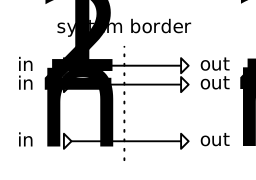

- Parameters:
label (str) – The label of the component.
design (list) – List containing design parameters (stated as String).
offdesign (list) – List containing offdesign parameters (stated as String).
design_path (str) – Path to the components design case.
local_offdesign (boolean) – Treat this component in offdesign mode in a design calculation.
local_design (boolean) – Treat this component in design mode in an offdesign calculation.
char_warnings (boolean) – Ignore warnings on default characteristics usage for this component.
printout (boolean) – Include this component in the network’s results printout.
num_inter (float, dict) – Number of interfaces for subsystem.
Note
This component passes all fluid properties and mass flow from its inlet to the outlet.
Example
As connections can only connect a component with a different component, the subsystem interface is used to connect subsystems with the rest of your network. It is necessary to specify the number of interfaces of the subsystem interface, if you want any number other than 1. We will not go in depth of subsystem usage in this example. Please refer to this section for more information on building your own subsystems.
>>> from tespy.components import Sink, Source, SubsystemInterface
>>> from tespy.connections import Connection
>>> from tespy.networks import Network
>>> nw = Network()
>>> nw.set_attr(p_unit='bar', T_unit='C', h_unit='kJ / kg', iterinfo=False)
>>> so1 = Source('source 1')
>>> si1 = Sink('sink 1')
>>> so2 = Source('source 2')
>>> si2 = Sink('sink 2')
>>> IF = SubsystemInterface('subsystem interface', num_inter=2)
>>> len(IF.inlets())
2
The interface does not change the fluid properties in any way.
>>> inc1 = Connection(so1, 'out1', IF, 'in1')
>>> outg1 = Connection(IF, 'out1', si1, 'in1')
>>> inc2 = Connection(so2, 'out1', IF, 'in2')
>>> outg2 = Connection(IF, 'out2', si2, 'in1')
>>> nw.add_conns(inc1, outg1, inc2, outg2)
>>> inc1.set_attr(fluid={'H2O': 1}, T=40, p=3, m=100)
>>> inc2.set_attr(fluid={'N2': 1}, T=60, p=1)
>>> outg2.set_attr(v=10)
>>> nw.solve('design')
>>> inc1.m.val_SI == outg1.m.val_SI
True
>>> inc2.m.val_SI == outg2.m.val_SI
True
>>> inc1.h.val_SI == outg1.h.val_SI
True
>>> inc2.h.val_SI == outg2.h.val_SI
True
tespy.components.combustion.base module
Module of class CombustionChamber.
This file is part of project TESPy (github.com/oemof/tespy). It’s copyrighted by the contributors recorded in the version control history of the file, available from its original location tespy/components/combustion/base.py
SPDX-License-Identifier: MIT
- class tespy.components.combustion.base.CombustionChamber(label, **kwargs)[source]
Bases:
ComponentThe class CombustionChamber is parent class of all combustion components.
Mandatory Equations
tespy.components.combustion.base.CombustionChamber.mass_flow_func()tespy.components.combustion.base.CombustionChamber.combustion_pressure_func()tespy.components.combustion.base.CombustionChamber.stoichiometry()tespy.components.combustion.base.CombustionChamber.energy_balance_func()
Optional Equations
tespy.components.combustion.base.CombustionChamber.lambda_func()tespy.components.combustion.base.CombustionChamber.ti_func()
Available fuels
methane, ethane, propane, butane, hydrogen, carbon monoxide, nDodecane
Inlets/Outlets
in1, in2
out1
Image
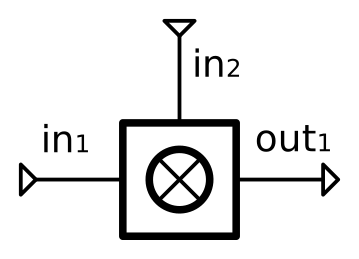

Note
The fuel and the air components can be connected to either of the inlets.
- Parameters:
label (str) – The label of the component.
design (list) – List containing design parameters (stated as String).
offdesign (list) – List containing offdesign parameters (stated as String).
design_path (str) – Path to the components design case.
local_offdesign (boolean) – Treat this component in offdesign mode in a design calculation.
local_design (boolean) – Treat this component in design mode in an offdesign calculation.
char_warnings (boolean) – Ignore warnings on default characteristics usage for this component.
printout (boolean) – Include this component in the network’s results printout.
lamb (float, dict) – Actual oxygen to stoichiometric oxygen ratio, \(\lambda/1\).
ti (float, dict) – Thermal input, (\({LHV \cdot \dot{m}_f}\)), \(ti/\text{W}\).
Note
For more information on the usage of the combustion chamber see the examples section on github or look for the combustion chamber tutorials at tespy.readthedocs.io.
Example
The combustion chamber calculates energy input due to combustion as well as the flue gas composition based on the type of fuel and the amount of oxygen supplied. In this example a mixture of methane, hydrogen and carbondioxide is used as fuel.
>>> from tespy.components import Sink, Source, CombustionChamber
>>> from tespy.connections import Connection
>>> from tespy.networks import Network
>>> from tespy.tools.fluid_properties import T_sat_p
>>> nw = Network(p_unit='bar', T_unit='C', iterinfo=False)
>>> amb = Source('ambient air')
>>> sf = Source('fuel')
>>> fg = Sink('flue gas outlet')
>>> comb = CombustionChamber('combustion chamber')
>>> amb_comb = Connection(amb, 'out1', comb, 'in1')
>>> sf_comb = Connection(sf, 'out1', comb, 'in2')
>>> comb_fg = Connection(comb, 'out1', fg, 'in1')
>>> nw.add_conns(sf_comb, amb_comb, comb_fg)
Specify the thermal input of the combustion chamber. At the given fluid compositions this determines the mass flow of the fuel. The outlet temperature of the flue gas determines the ratio of oxygen to fuel mass flow.
>>> comb.set_attr(ti=500000)
>>> amb_comb.set_attr(p=1, T=20, fluid={'Ar': 0.0129, 'N2': 0.7553,
... 'CO2': 0.0004, 'O2': 0.2314})
>>> sf_comb.set_attr(T=25, fluid={'CO2': 0.03, 'H2': 0.01, 'CH4': 0.96})
>>> comb_fg.set_attr(T=1200)
>>> nw.solve('design')
>>> round(comb.lamb.val, 3)
2.014
>>> comb.set_attr(lamb=2)
>>> comb_fg.set_attr(T=None)
>>> nw.solve('design')
>>> round(comb_fg.T.val, 1)
1206.6
- bus_deriv(bus)[source]
Calculate the matrix of partial derivatives of the bus function.
- Parameters:
bus (tespy.connections.bus.Bus) – TESPy bus object.
- Returns:
deriv (ndarray) – Matrix of partial derivatives.
- bus_func(bus)[source]
Calculate the value of the bus function.
- Parameters:
bus (tespy.connections.bus.Bus) – TESPy bus object.
- Returns:
val (float) – Value of energy transfer \(\dot{E}\). This value is passed to
tespy.components.component.Component.calc_bus_value()for value manipulation according to the specified characteristic line of the bus.\[\dot{E} = LHV \cdot \dot{m}_{f}\]
- calc_lambda()[source]
Calculate oxygen to stoichimetric oxygen ration
- Returns:
lambda (float) – Oxygent to stoichiometric oxygen ratio.
\[ \begin{align}\begin{aligned}\lambda = \frac{\dot{m}_{f,m}}{\dot{m}_{O_2,m} \cdot \left(n_{C,fuel} + 0.25 \cdot n_{H,fuel}\right)}\\\begin{split}\dot{m}_{fluid,m} = \sum_i \frac{x_{fluid,i} \cdot \dot{m}_{i}} {M_{fluid}}\\ \forall i \in inlets\end{split}\end{aligned}\end{align} \]
- calc_lhv(f)[source]
Calculate the lower heating value of the combustion chamber’s fuel.
- Parameters:
f (str) – Alias of the fuel.
- Returns:
val (float) – Lower heating value of the combustion chambers fuel.
\[\begin{split}LHV = -\frac{\sum_i {\Delta H_f^0}_i - \sum_j {\Delta H_f^0}_j } {M_{fuel}}\\ \forall i \in \text{reation products},\\ \forall j \in \text{reation educts},\\ \Delta H_f^0: \text{molar formation enthalpy}\end{split}\]
- calc_ti()[source]
Calculate the thermal input of the combustion chamber.
- Returns:
ti (float) – Thermal input.
\[ti = LHV \cdot \left[\sum_i \left(\dot{m}_{in,i} \cdot x_{fuel,in,i} \right) - \dot{m}_{out,1} \cdot x_{fuel,out,1} \right] \; \forall i \in [1,2]\]
- combustion_pressure_structure_matrix(k)[source]
Equations for reactor pressure balance.
- Returns:
residual (list) – Residual values of equations.
\[\begin{split}0 = p_\mathrm{in,1} - p_\mathrm{out,1}\\ 0 = p_\mathrm{in,2} - p_\mathrm{out,1}\end{split}\]
- convergence_check()[source]
Perform a convergence check.
Note
Manipulate enthalpies/pressure at inlet and outlet if not specified by user to match physically feasible constraints, keep fluid composition within feasible range and then propagates it towards the outlet.
- energy_balance_func()[source]
Calculate the energy balance of the adiabatic combustion chamber.
- Returns:
residual (float) – Residual value of equation.
\[ \begin{align}\begin{aligned}\begin{split}\begin{split} 0 = & \sum_i \dot{m}_{in,i} \cdot \left( h_{in,i} - h_{in,i,ref} \right)\\ & -\dot{m}_{out,2}\cdot\left( h_{out,1}-h_{out,1,ref} \right)\\ & + LHV_{fuel} \cdot\left(\sum_i\dot{m}_{in,i}\cdot x_{fuel,in,i}- \dot{m}_{out,1} \cdot x_{fuel} \right) \end{split}\\\end{split}\\\forall i \in \text{inlets}\end{aligned}\end{align} \]
Note
The temperature for the reference state is set to 25 °C, thus the water may be liquid. In order to make sure, the state is referring to the lower heating value, the state of the water in the flue gas is fored to gaseous.
Reference temperature: 298.15 K.
Reference pressure: 1 bar.
- entropy_balance()[source]
Calculate entropy balance of combustion chamber.
Note
The entropy balance makes the following parameter available:
T_mcomb: Thermodynamic temperature of heat of combustionS_comb: Entropy production due to combustionS_irr: Entropy production due to irreversibilty
The methodology for entropy analysis of combustion processes is derived from [20]. Similar to the energy balance of a combustion reaction, we need to define the same reference state for the entropy balance of the combustion. The temperature for the reference state is set to 25 °C and reference pressure is 1 bar. As the water in the flue gas may be liquid but the thermodynmic temperature of heat of combustion refers to the lower heating value, the water is forced to gas at the reference point by considering evaporation.
Reference temperature: 298.15 K.
Reference pressure: 1 bar.
\[\begin{split}T_\mathrm{m,comb}= \frac{\dot{m}_\mathrm{fuel} \cdot LHV} {\dot{S}_\mathrm{comb}}\\ \dot{S}_\mathrm{comb}= \dot{m}_\mathrm{fluegas} \cdot \left(s_\mathrm{fluegas}-s_\mathrm{fluegas,ref}\right) - \sum_{i=1}^2 \dot{m}_{\mathrm{in,}i} \cdot \left( s_{\mathrm{in,}i} - s_{\mathrm{in,ref,}i} \right)\\ \dot{S}_\mathrm{irr}= 0\\\end{split}\]
- exergy_balance(T0)[source]
Exergy balance calculation method.
- Parameters:
T0 (float) – Ambient temperature T0 / K.
- static initialise_source(c, key)[source]
Return a starting value for pressure and enthalpy at outlet.
- Parameters:
c (tespy.connections.connection.Connection) – Connection to perform initialisation on.
key (str) – Fluid property to retrieve.
- Returns:
val (float) – Starting value for pressure/enthalpy in SI units.
\[\begin{split}val = \begin{cases} 5 \cdot 10^5 & \text{key = 'p'}\\ 10^6 & \text{key = 'h'} \end{cases}\end{split}\]
- static initialise_target(c, key)[source]
Return a starting value for pressure and enthalpy at inlet.
- Parameters:
c (tespy.connections.connection.Connection) – Connection to perform initialisation on.
key (str) – Fluid property to retrieve.
- Returns:
val (float) – Starting value for pressure/enthalpy in SI units.
\[\begin{split}val = \begin{cases} 5 \cdot 10^5 & \text{key = 'p'}\\ 5 \cdot 10^5 & \text{key = 'h'} \end{cases}\end{split}\]
- lambda_func()[source]
Calculate the residual for specified lambda.
- Returns:
residual (float) – Residual value of equation.
\[ \begin{align}\begin{aligned}0 = \frac{\dot{m}_{f,m}}{\dot{m}_{O_2,m} \cdot \left(n_{C,fuel} + 0.25 \cdot n_{H,fuel}\right)} - \lambda\\\begin{split}\dot{m}_{fluid,m} = \sum_i \frac{x_{fluid,i} \cdot \dot{m}_{i}} {M_{fluid}}\\ \forall i \in inlets\end{split}\end{aligned}\end{align} \]
- mass_flow_deriv(increment_filter, k, dependents=None)[source]
Calculate the partial derivatives for all mass flow balance equations.
- Returns:
deriv (ndarray) – Matrix with partial derivatives for the fluid equations.
- mass_flow_func()[source]
Calculate the residual value for component’s mass flow balance.
- Returns:
residual (list) – Vector with residual value for component’s mass flow balance.
\[0 = \dot{m}_{in,1} + \dot{m}_{in,2} - \dot{m}_{out,1}\]
- stoichiometry(fluid)[source]
Calculate the reaction balance for one fluid.
determine molar mass flows of fuel and oxygen
calculate mole number of carbon and hydrogen atoms in fuel
calculate molar oxygen flow for stoichiometric combustion
calculate residual value for the corresponding fluid
for excess fuel
calculate excess carbon and hydrogen in fuels
calculate excess fuel shares
General equations
\[ \begin{align}\begin{aligned}\begin{split}res = \sum_i \left(x_{fluid,i} \cdot \dot{m}_{i}\right) - \sum_j \left(x_{fluid,j} \cdot \dot{m}_{j}\right)\\ \forall i \in \text{combustion inlets}\\ \forall j \in text{flue gas outlet}\end{split}\\\begin{split}\dot{m}_{fluid,m} = \sum_i \frac{x_{fluid,i} \cdot \dot{m}_{i}} {M_{fluid}}\\ \forall i \in \text{combustion inlets}\end{split}\\\dot{m}_{O_2,m,stoich}=\frac{\dot{m}_{H_m}}{4} + \dot{m}_{C_m}\\\lambda = \frac{\dot{m}_{O_2,m}}{\dot{m}_{O_2,m,stoich}}\end{aligned}\end{align} \]Excess carbon and hydrogen
\[ \begin{align}\begin{aligned}\begin{split}\dot{m}_{H_{exc,m}} = \begin{cases} 0 & \lambda \geq 1\\ 4 \cdot \left( \dot{m}_{O_2,m,stoich} - \dot{m}_{O_2,m}\right) & \lambda < 1 \end{cases}\end{split}\\\begin{split}\dot{m}_{C_{exc,m}} = \begin{cases} 0 & \lambda \geq 1\\ \dot{m}_{O_2,m,stoich} - \dot{m}_{O_2,m} & \lambda < 1 \end{cases}\end{split}\end{aligned}\end{align} \]Equation for fuels
\[ \begin{align}\begin{aligned}\begin{split}0 = res - \left(\dot{m}_{f,m} - \dot{m}_{f,exc,m}\right) \cdot M_{fuel}\\\end{split}\\\begin{split}\dot{m}_{f,exc,m} = \begin{cases} 0 & \lambda \geq 1\\ \dot{m}_{f,m} - \frac{\dot{m}_{O_2,m}} {n_{C,fuel} + 0.25 \cdot n_{H,fuel}} \end{cases}\end{split}\end{aligned}\end{align} \]Equation for oxygen
\[\begin{split}0 = res - \begin{cases} -\frac{\dot{m}_{O_2,m} \cdot M_{O_2}}{\lambda} & \lambda \geq 1\\ - \dot{m}_{O_2,m} \cdot M_{O_2} & \lambda < 1 \end{cases}\end{split}\]Equation for water
\[0 = res + \left( \dot{m}_{H_m} - \dot{m}_{H_{exc,m}} \right) \cdot 0.5 \cdot M_{H_2O}\]Equation for carbondioxide
\[0 = res + \left( \dot{m}_{C_m} - \dot{m}_{C_{exc,m}} \right) \cdot M_{CO_2}\]Equation for all other fluids
\[0 = res\]- Parameters:
fluid (str) – Fluid to calculate residual value for.
- Returns:
residual (float) – Residual value for corresponding fluid.
- stoichiometry_deriv(increment_filter, k, dependents=None)[source]
Calculate partial derivatives of the reaction balance.
- Parameters:
increment_filter (ndarray) – Matrix for filtering non-changing variables.
k (int) – Position of equation in Jacobian matrix.
- stoichiometry_func()[source]
Collect residual values for all fluids in stoichiometry.
- Returns:
residual (list) – Vector with residual values of equations.
tespy.components.combustion.diabatic module
Module of class CombustionChamber.
This file is part of project TESPy (github.com/oemof/tespy). It’s copyrighted by the contributors recorded in the version control history of the file, available from its original location tespy/components/combustion/diabatic.py
SPDX-License-Identifier: MIT
- class tespy.components.combustion.diabatic.DiabaticCombustionChamber(label, **kwargs)[source]
Bases:
CombustionChamberThe class CombustionChamber is parent class of all combustion components.
Mandatory Equations
tespy.components.combustion.base.CombustionChamber.mass_flow_func()tespy.components.combustion.base.CombustionChamber.combustion_pressure_func()tespy.components.combustion.base.CombustionChamber.stoichiometry()
Optional Equations
tespy.components.combustion.base.CombustionChamber.lambda_func()tespy.components.combustion.base.CombustionChamber.ti_func()tespy.components.combustion.diabatic.DiabaticCombustionChamber.energy_balance_func()tespy.components.combustion.diabatic.DiabaticCombustionChamber.pr_func()
Available fuels
methane, ethane, propane, butane, hydrogen, carbon monoxide, nDodecane
Inlets/Outlets
in1, in2
out1
Image
Note
The fuel and the air components can be connected to either of the inlets. The pressure of inlet 2 is disconnected from the pressure of inlet 1. A warning is prompted, if the pressure at inlet 2 is lower than the pressure at inlet 1.
- Parameters:
label (str) – The label of the component.
design (list) – List containing design parameters (stated as String).
offdesign (list) – List containing offdesign parameters (stated as String).
design_path (str) – Path to the components design case.
local_offdesign (boolean) – Treat this component in offdesign mode in a design calculation.
local_design (boolean) – Treat this component in design mode in an offdesign calculation.
char_warnings (boolean) – Ignore warnings on default characteristics usage for this component.
printout (boolean) – Include this component in the network’s results printout.
lamb (float, dict) – Actual oxygen to stoichiometric oxygen ratio, \(\lambda/1\).
ti (float, dict) – Thermal input, (\({LHV \cdot \dot{m}_f}\)), \(ti/\text{W}\).
eta (float, dict) – Combustion thermal efficiency, \(\eta\). Heat loss calculation based on share of thermal input.
pr (float, dict) – Pressure ratio of outlet 1 to inlet 1, \(pr\).
Note
For more information on the usage of the combustion chamber see the examples section on github or look for the combustion chamber tutorials at tespy.readthedocs.io.
Example
The combustion chamber calculates energy input due to combustion as well as the flue gas composition based on the type of fuel and the amount of oxygen supplied. In this example a mixture of methane, hydrogen and carbondioxide is used as fuel.
>>> from tespy.components import Sink, Source, DiabaticCombustionChamber
>>> from tespy.connections import Connection
>>> from tespy.networks import Network
>>> from tespy.tools.fluid_properties import T_sat_p
>>> nw = Network(p_unit='bar', T_unit='C', iterinfo=False)
>>> amb = Source('ambient air')
>>> sf = Source('fuel')
>>> fg = Sink('flue gas outlet')
>>> comb = DiabaticCombustionChamber('combustion chamber')
>>> amb_comb = Connection(amb, 'out1', comb, 'in1')
>>> sf_comb = Connection(sf, 'out1', comb, 'in2')
>>> comb_fg = Connection(comb, 'out1', fg, 'in1')
>>> nw.add_conns(sf_comb, amb_comb, comb_fg)
Specify the thermal input of the combustion chamber. At the given fluid compositions this determines the mass flow of the fuel. The outlet temperature of the flue gas determines the ratio of oxygen to fuel mass flow. In contrast to the simple combustion chamber, this component does allow for a pressure drop. Therefore the outlet pressure or the pressure ratio of the combustion chamber must be specified. Since the component is not adiabatic, an efficiency value
etacan be supplied to account for heat loss to the ambient. First, we specifyeta=1and expect identical lambda or outlet temperature as in an adiabatic combustion chamber.>>> comb.set_attr(ti=500000, pr=0.95, eta=1) >>> amb_comb.set_attr( ... p=1.2, T=20, ... fluid={'Ar': 0.0129, 'N2': 0.7553, 'CO2': 0.0004, 'O2': 0.2314} ... ) >>> sf_comb.set_attr( ... p=1.3, T=25, fluid={'CO2': 0.03, 'H2': 0.01, 'CH4': 0.96} ... ) >>> comb_fg.set_attr(T=1200) >>> nw.solve('design') >>> round(comb.lamb.val, 3) 2.014 >>> round(comb_fg.p.val, 2) 1.14
Instead of the pressure ration, we can also specify the outlet pressure. The pressure ratio is the ratio or pressure at the outlet to the pressure at the inlet 1 (ambient air inlet in this example).
>>> comb.set_attr(pr=None)
>>> comb_fg.set_attr(p=1)
>>> nw.solve('design')
>>> round(comb.pr.val, 3)
0.833
We can change lambda to a specific value and unset the flue gas temperature:
>>> comb.set_attr(lamb=2)
>>> comb_fg.set_attr(T=None)
>>> nw.solve('design')
>>> round(comb_fg.T.val, 1)
1206.5
Now, if we change the efficiency value, e.g. to 0.9, a total of 10 % of heat respective to the thermal input will be transferred to the ambient. Note, that the heat loss
Qlosshas a negative value as it is extracted from the system.>>> eta = 0.9 >>> comb.set_attr(eta=eta) >>> nw.solve('design') >>> round(comb.Qloss.val, 0) -50000.0 >>> round(comb.ti.val * comb.eta.val, 0) 450000.0
- energy_balance_func()[source]
Calculate the energy balance of the diabatic combustion chamber.
- Returns:
residual (float) – Residual value of equation.
\[ \begin{align}\begin{aligned}\begin{split}\begin{split} 0 = & \sum_i \dot{m}_{in,i} \cdot \left( h_{in,i} - h_{in,i,ref} \right)\\ & -\dot{m}_{out,2}\cdot\left( h_{out,1}-h_{out,1,ref} \right)\\ & + LHV_{fuel} \cdot\left(\sum_i\dot{m}_{in,i}\cdot x_{fuel,in,i}- \dot{m}_{out,1} \cdot x_{fuel} \right) \cdot \eta \end{split}\\\end{split}\\\forall i \in \text{inlets}\end{aligned}\end{align} \]
Note
The temperature for the reference state is set to 25 °C, thus the water may be liquid. In order to make sure, the state is referring to the lower heating value, the state of the water in the flue gas is fored to gaseous.
Reference temperature: 298.15 K.
Reference pressure: 1 bar.
tespy.components.combustion.engine module
Module of class CombustionEngine.
This file is part of project TESPy (github.com/oemof/tespy). It’s copyrighted by the contributors recorded in the version control history of the file, available from its original location tespy/components/combustion/engine.py
SPDX-License-Identifier: MIT
- class tespy.components.combustion.engine.CombustionEngine(label, **kwargs)[source]
Bases:
CombustionChamberAn internal combustion engine supplies power and heat cogeneration.
The combustion engine produces power and heat in cogeneration from fuel combustion. The combustion properties are identical to the combustion chamber. Thermal input and power output, heat output and heat losses are linked with an individual characteristic line for each property.
Mandatory Equations
tespy.components.combustion.engine.CombustionEngine.fluid_func()(for cooling water)tespy.components.combustion.engine.CombustionEngine.mass_flow_func()tespy.components.combustion.base.CombustionChamber.combustion_pressure_func()tespy.components.combustion.base.CombustionChamber.stoichiometry()tespy.components.combustion.engine.CombustionEngine.energy_balance_func()tespy.components.combustion.engine.CombustionEngine.tiP_char_func()tespy.components.combustion.engine.CombustionEngine.Q1_char_func()tespy.components.combustion.engine.CombustionEngine.Q2_char_func()tespy.components.combustion.engine.CombustionEngine.Qloss_char_func()
Optional Equations
tespy.components.combustion.base.CombustionChamber.lambda_func()tespy.components.combustion.base.CombustionChamber.ti_func()tespy.components.combustion.engine.CombustionEngine.Q1_func()tespy.components.combustion.engine.CombustionEngine.Q2_func()cooling loops:
Available fuels
methane, ethane, propane, butane, hydrogen, carbon monoxide, nDodecane
Inlets/Outlets
in1, in2 (cooling water), in3, in4 (air and fuel)
out1, out2 (cooling water), out3 (flue gas)
Power outlets
power
Image
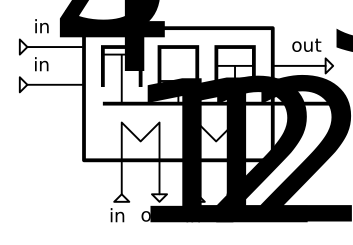

Note
The fuel and the air components can be connected to either of the inlets.
- Parameters:
label (str) – The label of the component.
design (list) – List containing design parameters (stated as String).
offdesign (list) – List containing offdesign parameters (stated as String).
design_path (str) – Path to the components design case.
local_offdesign (boolean) – Treat this component in offdesign mode in a design calculation.
local_design (boolean) – Treat this component in design mode in an offdesign calculation.
char_warnings (boolean) – Ignore warnings on default characteristics usage for this component.
printout (boolean) – Include this component in the network’s results printout.
lamb (float, dict) – Air to stoichiometric air ratio, \(\lambda/1\).
ti (float, dict) – Thermal input, (\({LHV \cdot \dot{m}_f}\)), \(ti/\text{W}\).
P (float, dict,
"var") – Power output, \(P/\text{W}\).Q1 (float, dict) – Heat output 1, \(\dot Q/\text{W}\).
Q2 (float, dict) – Heat output 2, \(\dot Q/\text{W}\).
Qloss (float, dict,
"var") – Heat loss, \(\dot Q_{loss}/\text{W}\).pr1 (float, dict,
"var") – Pressure ratio heat outlet 1, \(pr/1\).pr2 (float, dict,
"var") – Pressure ratio heat outlet 2, \(pr/1\).zeta1 (float, dict,
"var") – Geometry independent friction coefficient heating loop 1, \(\zeta_1/\frac{1}{\text{m}^4}\).zeta2 (float, dict,
"var") – Geometry independent friction coefficient heating loop 2, \(\zeta_2/\frac{1}{\text{m}^4}\).tiP_char (tespy.tools.characteristics.CharLine, dict) – Characteristic line linking fuel input to power output.
Q1_char (tespy.tools.characteristics.CharLine, dict) – Characteristic line linking heat output 1 to power output.
Q2_char (tespy.tools.characteristics.CharLine, dict) – Characteristic line linking heat output 2 to power output.
Qloss_char (tespy.tools.characteristics.CharLine, dict) – Characteristic line linking heat loss to power output.
eta_mech (float) – Value of internal efficiency of the combustion engine. This value is required to determine the (virtual) thermodynamic temperature of heat inside the combustion engine for the entropy balance calculation. Default value is 0.85.
Note
Parameters available through entropy balance are listed in the respective method:
Example
The combustion chamber calculates energy input due to combustion as well as the flue gas composition based on the type of fuel and the amount of oxygen supplied. In this example a mixture of methane, hydrogen and carbondioxide is used as fuel. There are two cooling ports, the cooling water will flow through them in parallel.
>>> from tespy.components import (Sink, Source, CombustionEngine, Merge,
... Splitter)
>>> from tespy.connections import Connection, Ref
>>> from tespy.networks import Network
>>> import os
>>> nw = Network(p_unit='bar', T_unit='C', iterinfo=False)
>>> amb = Source('ambient')
>>> sf = Source('fuel')
>>> fg = Sink('flue gas outlet')
>>> cw_in = Source('cooling water inlet')
>>> sp = Splitter('cooling water splitter', num_out=2)
>>> me = Merge('cooling water merge', num_in=2)
>>> cw_out = Sink('cooling water outlet')
>>> chp = CombustionEngine(label='internal combustion engine')
>>> amb_comb = Connection(amb, 'out1', chp, 'in3')
>>> sf_comb = Connection(sf, 'out1', chp, 'in4')
>>> comb_fg = Connection(chp, 'out3', fg, 'in1')
>>> nw.add_conns(sf_comb, amb_comb, comb_fg)
>>> cw_sp = Connection(cw_in, 'out1', sp, 'in1')
>>> sp_chp1 = Connection(sp, 'out1', chp, 'in1')
>>> sp_chp2 = Connection(sp, 'out2', chp, 'in2')
>>> chp1_me = Connection(chp, 'out1', me, 'in1')
>>> chp2_me = Connection(chp, 'out2', me, 'in2')
>>> me_cw = Connection(me, 'out1', cw_out, 'in1')
>>> nw.add_conns(cw_sp, sp_chp1, sp_chp2, chp1_me, chp2_me, me_cw)
The combustion engine produces a power output of 10 MW the oxygen to stoichiometric oxygen ratio is set to 1. Only pressure ratio 1 is set as we reconnect both cooling water streams. At the merge all pressure values will be identical automatically. Reference the mass flow at the splitter to be split in half.
>>> chp.set_attr(pr1=0.99, P=-10e6, lamb=1.0,
... design=['pr1'], offdesign=['zeta1'])
>>> amb_comb.set_attr(p=5, T=30, fluid={'Ar': 0.0129, 'N2': 0.7553,
... 'CO2': 0.0004, 'O2': 0.2314})
>>> sf_comb.set_attr(T=30, fluid={'CH4': 1})
>>> cw_sp.set_attr(p=3, T=60, m=50, fluid={'H2O': 1})
>>> sp_chp2.set_attr(m=Ref(sp_chp1, 1, 0))
>>> mode = 'design'
>>> nw.solve(mode=mode)
>>> nw.save('tmp.json')
>>> round(chp.ti.val, 0)
25300000.0
>>> round(chp.Q1.val, 0)
-4980000.0
>>> chp.set_attr(Q1=-4e6, P=None)
>>> mode = 'offdesign'
>>> nw.solve(mode=mode, init_path='tmp.json', design_path='tmp.json')
>>> round(chp.ti.val, 0)
17794554.0
>>> round(chp.P.val / chp.P.design, 3)
0.617
>>> chp.set_attr(P=chp.P.design * 0.75, Q1=None)
>>> mode = 'offdesign'
>>> nw.solve(mode=mode, init_path='tmp.json', design_path='tmp.json')
>>> round(chp.ti.val, 0)
20550000.0
>>> round(chp.P.val / chp.P.design, 3)
0.75
>>> os.remove('tmp.json')
- Q1_char_func()[source]
Calculate the relation of heat output 1 and thermal input.
- Returns:
residual (float) – Residual value of equation.
\[\begin{split}\begin{split} 0 = & \dot{m}_1 \cdot \left(h_{out,1} - h_{in,1} \right) \cdot f_{TI}\left(\frac{P}{P_{design}}\right) \\ & - LHV \cdot \left[\sum_i \left(\dot{m}_{in,i} \cdot x_{f,i}\right) - \dot{m}_{out,3} \cdot x_{f,3} \right] \cdot f_{Q1}\left(\frac{P}{P_{ref}}\right)\\ \end{split}\\ \forall i \in [3,4]\end{split}\]
- Q1_func()[source]
Calculate residual value of primary heat loop function.
- Returns:
residual (float) – Residual value of equation.
\[0 = \dot{m}_1 \cdot \left(h_{out,1} + h_{in,1} \right) + \dot{Q}_1\]
- Q2_char_func()[source]
Calculate the relation of heat output 2 and thermal input.
- Returns:
residual (float) – Residual value of equation.
\[\begin{split}\begin{split} 0 = & \dot{m}_2 \cdot \left(h_{out,2} - h_{in,2} \right) \cdot f_{TI}\left(\frac{P}{P_{design}}\right) \\ & - LHV \cdot \left[\sum_i \left(\dot{m}_{in,i} \cdot x_{f,i}\right) - \dot{m}_{out,3} \cdot x_{f,3} \right] \cdot f_{Q2}\left(\frac{P}{P_{ref}}\right)\\ \end{split}\\ \forall i \in [3,4]\end{split}\]
- Q2_func()[source]
Calculate residual value of secondary heat loop function.
- Returns:
residual (float) – Residual value of equation.
\[0 = \dot{m}_2 \cdot \left(h_{out,2} - h_{in,2} \right) + \dot{Q}_2\]
- Qloss_char_func()[source]
Calculate the relation of heat loss and thermal input.
- Returns:
residual (float) – Residual value of equation.
\[\begin{split}\begin{split} 0 = & \dot{Q}_{loss} \cdot f_{TI}\left(\frac{P}{P_{design}}\right) \\ & + LHV \cdot \left[\sum_i \left(\dot{m}_{in,i} \cdot x_{f,i}\right) - \dot{m}_{out,3} \cdot x_{f,3} \right] \cdot f_{QLOSS}\left(\frac{P}{P_{ref}}\right)\\ \end{split}\\ \forall i \in [3,4]\end{split}\]
- bus_deriv(bus)[source]
Calculate the matrix of partial derivatives of the bus function.
- Parameters:
bus (tespy.connections.bus.Bus) – TESPy bus object.
- Returns:
deriv (ndarray) – Matrix of partial derivatives.
- bus_func(bus)[source]
Calculate the value of the bus function.
- Parameters:
bus (tespy.connections.bus.Bus) – TESPy bus object.
- Returns:
residual (float) – Value of energy transfer \(\dot{E}\). This value is passed to
tespy.components.component.Component.calc_bus_value()for value manipulation according to the specified characteristic line of the bus.\[\begin{split}\dot{E} = \begin{cases} LHV \cdot \dot{m}_{f} & \text{key = 'TI'}\\ P & \text{key = 'P'}\\ -\dot{m}_1 \cdot \left( h_{1,out} - h_{1,in} \right) -\dot{m}_2 \cdot \left( h_{2,out} - h_{2,in} \right) & \text{key = 'Q'}\\ -\dot{m}_1 \cdot \left( h_{1,out} - h_{1,in} \right) & \text{key = 'Q1'}\\ -\dot{m}_2 \cdot \left( h_{2,out} - h_{2,in} \right) & \text{key = 'Q2'}\\ \dot{Q}_{loss} & \text{key = 'Qloss'} \end{cases}\end{split}\]
- calc_P()[source]
Calculate the power output of the combustion engine.
- Returns:
P (float) – Power output.
\[P = -\frac{LHV \cdot \dot{m}_{f}} {f_{TI}\left(\frac{P}{P_{ref}}\right)}\]
- calc_Qloss()[source]
Calculate the heat loss of the combustion engine.
- Returns:
Qloss (float) – Heat loss.
\[\dot{Q}_{loss} = -\frac{LHV \cdot \dot{m}_{f} \cdot f_{QLOSS}\left(\frac{P}{P_{ref}}\right)} {f_{TI}\left(\frac{P}{P_{ref}}\right)}\]
- energy_balance_deriv(increment_filter, k, dependents=None)[source]
Calculate partial derivatives of energy balance function.
- Parameters:
increment_filter (ndarray) – Matrix for filtering non-changing variables.
k (int) – Position of equation in Jacobian matrix.
- energy_balance_func()[source]
Calculate the energy balance of the combustion engine.
- Returns:
residual (float) – Residual value of equation.
\[\begin{split}\begin{split} 0 = & \sum_i \dot{m}_{in,i} \cdot \left( h_{in,i} - h_{in,i,ref} \right)\\ & - \sum_j \dot{m}_{out,3} \cdot \left( h_{out,3} - h_{out,3,ref} \right)\\ & + LHV_{fuel} \cdot \left(\sum_i \left(\dot{m}_{in,i} \cdot x_{fuel,i} \right)- \dot{m}_{out,3} \cdot x_{fuel,3} \right)\\ & - \dot{Q}_1 - \dot{Q}_2 - P - \dot{Q}_{loss}\\ \end{split}\\ \forall i \in [3,4]\end{split}\]
Note
The temperature for the reference state is set to 25 °C, thus the water may be liquid. In order to make sure, the state is referring to the lower heating value, the necessary enthalpy difference for evaporation is added.
Reference temperature: 298.15 K.
Reference pressure: 1 bar.
- entropy_balance()[source]
Calculate entropy balance of combustion engine.
For the entropy balance of a combustion engine two additional parameters need to be specified:
virtual inner temperature
T_v_innerthat is used to determine the entropy of heat transferred from the hot side.mechanical efficiency
eta_mechdescribing the ratio of power outputPto reversible power of the motor [21]. It is used to determine the irreversibilty inside the motor.\[P_\mathrm{irr,inner}=\left(1 - \frac{1}{\eta_\mathrm{mech}} \right) \cdot P\]
The default values are:
T_v_inner: flue gas temperature (result of calculation)eta_mech: 0.85
Note
The entropy balance makes the following parameter available:
T_mcomb: Thermodynamic temperature of heat of combustionS_comb: Entropy production due to combustionT_mQ1: Thermodynamic temperature of heat at cold side of heater 1S_Q11: Entropy transport at hot side of heater 1S_Q12: Entropy transport at cold side of heater 1S_Q1irr: Entropy production due to heat transfer at heater 1S_irr1: Entropy production due to pressure losses at heater 1T_mQ2: Thermodynamic temperature of heat at cold side of heater 2S_Q21: Entropy transport at hot side of heater 2S_Q22: Entropy transport at cold side of heater 2S_Q2irr: Entropy production due to heat transfer at heater 2S_irr2: Entropy production due to pressure losses at heater 2S_irr_i: Entropy production due to internal irreversibiltyS_Qloss: Entropy transport with heat loss to ambientS_Qcomb: Virtual entropy transport of heat to revert combustion gases to reference stateS_irr: Total entropy production due to irreversibilty
The methodology for entropy analysis of combustion processes is derived from [20]. Similar to the energy balance of a combustion reaction, we need to define the same reference state for the entropy balance of the combustion. The temperature for the reference state is set to 25 °C and reference pressure is 1 bar. As the water in the flue gas may be liquid but the thermodynmic temperature of heat of combustion refers to the lower heating value, the water is forced to gas at the reference point by considering evaporation.
Reference temperature: 298.15 K.
Reference pressure: 1 bar.
\[\begin{split}\begin{split} T_\mathrm{m,comb}= & \frac{\dot{m}_\mathrm{fuel} \cdot LHV} {\dot{S}_\mathrm{comb}}\\ \dot{S}_\mathrm{comb} =&\dot{S}_\mathrm{Q,comb}-\left( \dot{S}_\mathrm{Q,11} + \dot{S}_\mathrm{Q,21} + \dot{S}_\mathrm{Q,loss} +\dot{S}_\mathrm{irr,i}\right)\\ \dot{S}_\mathrm{Q,comb}= & \dot{m}_\mathrm{fluegas} \cdot \left(s_\mathrm{fluegas}-s_\mathrm{fluegas,ref}\right)\\ & - \sum_{i=3}^4 \dot{m}_{\mathrm{in,}i} \cdot \left( s_{\mathrm{in,}i} - s_{\mathrm{in,ref,}i} \right)\\ \dot{S}_\mathrm{Q,11}= & \frac{\dot{Q}_1}{T_\mathrm{v,inner}}\\ \dot{S}_\mathrm{Q,21}= & \frac{\dot{Q}_2}{T_\mathrm{v,inner}}\\ \dot{S}_\mathrm{Q,loss}= & \frac{\dot{Q}_\mathrm{loss}} {T_\mathrm{v,inner}}\\ \dot{S}_\mathrm{irr,i}= & \frac{\left(1 - \frac{1}{\eta_\mathrm{mech}}\right) \cdot P}{T_\mathrm{v,inner}}\\ T_\mathrm{Q,12} = &\frac{-\dot{Q}_1}{\dot{m}_1 \cdot \left( s_\mathrm{out,1} - s_\mathrm{in,1}\right)}\\ T_\mathrm{Q,22} = &\frac{-\dot{Q}_2}{\dot{m}_2 \cdot \left( s_\mathrm{out,2} - s_\mathrm{in,2}\right)}\\ \dot{S}_\mathrm{irr} = &\sum \dot{S}_\mathrm{irr}\\ \end{split}\\\end{split}\]
- exergy_balance(T0)[source]
Exergy balance calculation method.
- Parameters:
T0 (float) – Ambient temperature T0 / K.
- static initialise_source(c, key)[source]
Return a starting value for pressure and enthalpy at outlet.
- Parameters:
c (tespy.connections.connection.Connection) – Connection to perform initialisation on.
key (str) – Fluid property to retrieve.
- Returns:
val (float) – Starting value for pressure/enthalpy in SI units.
\[\begin{split}val = \begin{cases} 5 \cdot 10^5 & \text{key = 'p'}\\ 10^6 & \text{key = 'h'} \end{cases}\end{split}\]
- static initialise_target(c, key)[source]
Return a starting value for pressure and enthalpy at inlet.
- Parameters:
c (tespy.connections.connection.Connection) – Connection to perform initialisation on.
key (str) – Fluid property to retrieve.
- Returns:
val (float) – Starting value for pressure/enthalpy in SI units.
\[\begin{split}val = \begin{cases} 5 \cdot 10^5 & \text{key = 'p'}\\ 5 \cdot 10^5 & \text{key = 'h'} \end{cases}\end{split}\]
- tiP_char_func()[source]
Calculate the relation of output power and thermal input.
- Returns:
residual (float) – Residual value of equation.
\[0 = P \cdot f_{TI}\left(\frac{P}{P_{design}}\right)+ LHV \cdot \left[\sum_i \left(\dot{m}_{in,i} \cdot x_{f,i}\right) - \dot{m}_{out,3} \cdot x_{f,3} \right] \; \forall i \in [3,4]\]
tespy.components.heat_exchangers.base module
Module of class HeatExchanger.
This file is part of project TESPy (github.com/oemof/tespy). It’s copyrighted by the contributors recorded in the version control history of the file, available from its original location tespy/components/heat_exchangers/base.py
SPDX-License-Identifier: MIT
- class tespy.components.heat_exchangers.base.HeatExchanger(label, **kwargs)[source]
Bases:
ComponentClass for counter current heat exchanger.
The component HeatExchanger is the parent class for the components:
Mandatory Equations
Optional Equations
tespy.components.heat_exchangers.base.HeatExchanger.energy_balance_hot_func()tespy.components.heat_exchangers.base.HeatExchanger.kA_func()tespy.components.heat_exchangers.base.HeatExchanger.kA_char_func()tespy.components.heat_exchangers.base.HeatExchanger.ttd_u_func()tespy.components.heat_exchangers.base.HeatExchanger.ttd_l_func()tespy.components.heat_exchangers.base.HeatExchanger.ttd_min_func()tespy.components.heat_exchangers.base.HeatExchanger.eff_cold_func()tespy.components.heat_exchangers.base.HeatExchanger.eff_hot_func()tespy.components.heat_exchangers.base.HeatExchanger.eff_max_func()
Inlets/Outlets
in1, in2 (index 1: hot side, index 2: cold side)
out1, out2 (index 1: hot side, index 2: cold side)
Image
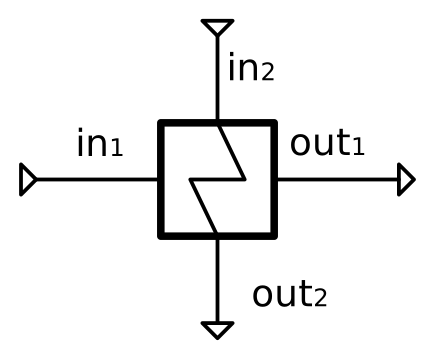

- Parameters:
label (str) – The label of the component.
design (list) – List containing design parameters (stated as String).
offdesign (list) – List containing offdesign parameters (stated as String).
design_path (str) – Path to the components design case.
local_offdesign (boolean) – Treat this component in offdesign mode in a design calculation.
local_design (boolean) – Treat this component in design mode in an offdesign calculation.
char_warnings (boolean) – Ignore warnings on default characteristics usage for this component.
printout (boolean) – Include this component in the network’s results printout.
Q (float, dict) – Heat transfer, \(Q/\text{W}\).
pr1 (float, dict,
"var") – Outlet to inlet pressure ratio at hot side, \(pr/1\).pr2 (float, dict,
"var") – Outlet to inlet pressure ratio at cold side, \(pr/1\).dp1 (float, dict,
"var") – Inlet to outlet pressure delta at hot side, unit is the network’s pressure unit!.dp2 (float, dict,
"var") – Inlet to outlet pressure delta at cold side, unit is the network’s pressure unit!.zeta1 (float, dict,
"var") – Geometry independent friction coefficient at hot side, \(\frac{\zeta}{D^4}/\frac{1}{\text{m}^4}\).zeta2 (float, dict,
"var") – Geometry independent friction coefficient at cold side, \(\frac{\zeta}{D^4}/\frac{1}{\text{m}^4}\).ttd_l (float, dict) – Lower terminal temperature difference \(ttd_\mathrm{l}/\text{K}\).
ttd_u (float, dict) – Upper terminal temperature difference \(ttd_\mathrm{u}/\text{K}\).
ttd_min (float, dict) – Minumum terminal temperature difference \(ttd_\mathrm{min}/\text{K}\).
eff_cold (float, dict) – Cold side heat exchanger effectiveness \(eff_\text{cold}/\text{1}\).
eff_hot (float, dict) – Hot side heat exchanger effectiveness \(eff_\text{hot}/\text{1}\).
eff_max (float, dict) – Max value of hot and cold side heat exchanger effectiveness values \(eff_\text{max}/\text{1}\).
kA (float, dict) – Area independent heat transfer coefficient, \(kA/\frac{\text{W}}{\text{K}}\).
kA_char (dict) – Area independent heat transfer coefficient characteristic.
kA_char1 (tespy.tools.characteristics.CharLine, dict) – Characteristic line for hot side heat transfer coefficient.
kA_char2 (tespy.tools.characteristics.CharLine, dict) – Characteristic line for cold side heat transfer coefficient.
Note
The HeatExchanger and subclasses (
tespy.components.heat_exchangers.condenser.Condenser,tespy.components.heat_exchangers.desuperheater.Desuperheater) are countercurrent heat exchangers. Equations (kA,ttd_u,ttd_l) do not work for directcurrent and crosscurrent or combinations of different types.Example
A water cooling is installed to transfer heat from hot exhaust air. The heat exchanger is designed for a terminal temperature difference of 5 K. From this, it is possible to calculate the heat transfer coefficient and predict water and air outlet temperature in offdesign operation.
>>> from tespy.components import Sink, Source, HeatExchanger
>>> from tespy.connections import Connection
>>> from tespy.networks import Network
>>> import os
>>> nw = Network(T_unit='C', p_unit='bar', h_unit='kJ / kg', iterinfo=False)
>>> exhaust_hot = Source('Exhaust air outlet')
>>> exhaust_cold = Sink('Exhaust air inlet')
>>> cw_cold = Source('cooling water inlet')
>>> cw_hot = Sink('cooling water outlet')
>>> he = HeatExchanger('waste heat exchanger')
>>> ex_he = Connection(exhaust_hot, 'out1', he, 'in1')
>>> he_ex = Connection(he, 'out1', exhaust_cold, 'in1')
>>> cw_he = Connection(cw_cold, 'out1', he, 'in2')
>>> he_cw = Connection(he, 'out2', cw_hot, 'in1')
>>> nw.add_conns(ex_he, he_ex, cw_he, he_cw)
The volumetric flow of the air is at 100 l/s. After designing the component it is possible to predict the temperature at different flow rates or different inlet temperatures of the exhaust air.
>>> he.set_attr(pr1=0.98, pr2=0.98, ttd_u=5,
... design=['pr1', 'pr2', 'ttd_u'], offdesign=['zeta1', 'zeta2', 'kA_char'])
>>> cw_he.set_attr(fluid={'water': 1}, T=10, p=3,
... offdesign=['m'])
>>> he_cw.set_attr(h0=1e2)
>>> ex_he.set_attr(fluid={'air': 1}, v=0.1, T=35)
>>> he_ex.set_attr(T=17.5, p=1, design=['T'])
>>> nw.solve('design')
>>> nw.save('tmp.json')
>>> round(ex_he.T.val - he_cw.T.val, 0)
5.0
>>> ex_he.set_attr(v=0.075)
>>> nw.solve('offdesign', design_path='tmp.json')
>>> round(he_cw.T.val, 1)
27.5
>>> round(he_ex.T.val, 1)
14.4
>>> ex_he.set_attr(v=0.1, T=40)
>>> nw.solve('offdesign', design_path='tmp.json')
>>> round(he_cw.T.val, 1)
33.9
>>> round(he_ex.T.val, 1)
18.8
>>> os.remove("tmp.json")
- bus_deriv(bus)[source]
Calculate partial derivatives of the bus function.
- Parameters:
bus (tespy.connections.bus.Bus) – TESPy bus object.
- Returns:
deriv (ndarray) – Matrix of partial derivatives.
- bus_func(bus)[source]
Calculate the value of the bus function.
- Parameters:
bus (tespy.connections.bus.Bus) – TESPy bus object.
- Returns:
val (float) – Value of energy transfer \(\dot{E}\). This value is passed to
tespy.components.component.Component.calc_bus_value()for value manipulation according to the specified characteristic line of the bus.\[\dot{E} = \dot{m}_{in,1} \cdot \left( h_{out,1} - h_{in,1} \right)\]
- calc_dh_max_cold()[source]
Calculate the theoretical maximum enthalpy increase on the cold side
- Returns:
float – Maxmium cold side enthalpy increase.
\[h\left(p_{out,2}, T_{in,1}\right) - h_{in,2}\]
- calc_dh_max_hot()[source]
Calculate the theoretical maximum enthalpy decrease on the hot side
- Returns:
float – Maxmium hot side enthalpy decrease.
\[h\left(p_{out,1}, T_{in,2}\right) - h_{in,1}\]
- eff_cold_func()[source]
Equation for cold side heat exchanger effectiveness.
- Returns:
residual (float) – Residual value of equation.
\[0 = \text{eff}_\text{cold} \cdot \left(h\left(p_{out,2}, T_{in,1} \right) - h_{in,2}\right) - \left( h_{out,2} - h_{in,2} \right)\]
- eff_hot_func()[source]
Equation for hot side heat exchanger effectiveness.
- Returns:
residual (float) – Residual value of equation.
\[0 = \text{eff}_\text{hot} \cdot \left(h\left(p_{out,1}, T_{in,2}\right) - h_{in,1}\right) - \left( h_{out,1} - h_{in,1}\right)\]
- eff_max_func()[source]
Equation for maximum heat exchanger effectiveness.
Note
This functions works on what is larger: hot side or cold side effectiveness. It may cause numerical issues, if applied, when one of both sides’ effectiveness is already predetermined, e.g. by temperature specifications.
- Returns:
residual (float) – Residual value of equation.
\[0 = \text{eff}_\text{max} - \text{max} \left(\text{eff}_\text{hot},\text{eff}_\text{cold}\right)\]
- energy_balance_func()[source]
Equation for heat exchanger energy balance.
- Returns:
residual (float) – Residual value of equation.
\[0 = \dot{m}_{in,1} \cdot \left(h_{out,1} - h_{in,1} \right) + \dot{m}_{in,2} \cdot \left(h_{out,2} - h_{in,2} \right)\]
- energy_balance_hot_func()[source]
Equation for hot side heat exchanger energy balance.
- Returns:
residual (float) – Residual value of equation.
\[0 =\dot{m}_{in,1} \cdot \left(h_{out,1}-h_{in,1}\right)-\dot{Q}\]
- entropy_balance()[source]
Calculate entropy balance of a heat exchanger.
The allocation of the entropy streams due to heat exchanged and due to irreversibility is performed by solving for T on both sides of the heat exchanger:
\[h_\mathrm{out} - h_\mathrm{in} = \int_\mathrm{in}^\mathrm{out} v \cdot dp - \int_\mathrm{in}^\mathrm{out} T \cdot ds\]As solving \(\int_\mathrm{in}^\mathrm{out} v \cdot dp\) for non isobaric processes would require perfect process knowledge (the path) on how specific volume and pressure change throught the component, the heat transfer is splitted into three separate virtual processes for both sides:
in->in*: decrease pressure to \(p_\mathrm{in*}=p_\mathrm{in}\cdot\sqrt{\frac{p_\mathrm{out}}{p_\mathrm{in}}}\) without changing enthalpy.
in*->out* transfer heat without changing pressure. \(h_\mathrm{out*}-h_\mathrm{in*}=h_\mathrm{out}-h_\mathrm{in}\)
out*->out decrease pressure to outlet pressure \(p_\mathrm{out}\) without changing enthalpy.
Note
The entropy balance makes the follwing parameter available:
\[\begin{split}\text{S\_Q1}=\dot{m} \cdot \left(s_\mathrm{out*,1}-s_\mathrm{in*,1} \right)\\ \text{S\_Q2}=\dot{m} \cdot \left(s_\mathrm{out*,2}-s_\mathrm{in*,2} \right)\\ \text{S\_Qirr}=\text{S\_Q2} - \text{S\_Q1}\\ \text{S\_irr1}=\dot{m} \cdot \left(s_\mathrm{out,1}-s_\mathrm{in,1} \right) - \text{S\_Q1}\\ \text{S\_irr2}=\dot{m} \cdot \left(s_\mathrm{out,2}-s_\mathrm{in,2} \right) - \text{S\_Q2}\\ \text{S\_irr}=\sum \dot{S}_\mathrm{irr}\\ \text{T\_mQ1}=\frac{\dot{Q}}{\text{S\_Q1}}\\ \text{T\_mQ2}=\frac{\dot{Q}}{\text{S\_Q2}}\end{split}\]
- exergy_balance(T0)[source]
Calculate exergy balance of a heat exchanger.
- Parameters:
T0 (float) – Ambient temperature T0 / K.
Note
\[ \begin{align}\begin{aligned}\begin{split}\dot{E}_\mathrm{P} = \begin{cases} \dot{E}_\mathrm{out,2}^\mathrm{T} - \dot{E}_\mathrm{in,2}^\mathrm{T} & T_\mathrm{in,1}, T_\mathrm{in,2}, T_\mathrm{out,1}, T_\mathrm{out,2} > T_0\\ \dot{E}_\mathrm{out,1}^\mathrm{T} - \dot{E}_\mathrm{in,1}^\mathrm{T} & T_0 \geq T_\mathrm{in,1}, T_\mathrm{in,2}, T_\mathrm{out,1}, T_\mathrm{out,2}\\ \dot{E}_\mathrm{out,1}^\mathrm{T} + \dot{E}_\mathrm{out,2}^\mathrm{T} & T_\mathrm{in,1}, T_\mathrm{out,2} > T_0 \geq T_\mathrm{in,2}, T_\mathrm{out,1}\\ \dot{E}_\mathrm{out,1}^\mathrm{T} & T_\mathrm{in,1} > T_0 \geq T_\mathrm{in,2}, T_\mathrm{out,1}, T_\mathrm{out,2}\\ \text{not defined (nan)} & T_\mathrm{in,1}, T_\mathrm{out,1} > T_0 \geq T_\mathrm{in,2}, T_\mathrm{out,2}\\ \dot{E}_\mathrm{out,2}^\mathrm{T} & T_\mathrm{in,1}, T_\mathrm{out,1}, T_\mathrm{out,2} \geq T_0 > T_\mathrm{in,2}\\ \end{cases}\end{split}\\\begin{split}\dot{E}_\mathrm{F} = \begin{cases} \dot{E}_\mathrm{in,1}^\mathrm{PH} - \dot{E}_\mathrm{out,1}^\mathrm{PH} + \dot{E}_\mathrm{in,2}^\mathrm{M} - \dot{E}_\mathrm{out,2}^\mathrm{M} & T_\mathrm{in,1}, T_\mathrm{in,2}, T_\mathrm{out,1}, T_\mathrm{out,2} > T_0\\ \dot{E}_\mathrm{in,2}^\mathrm{PH} - \dot{E}_\mathrm{out,2}^\mathrm{PH} + \dot{E}_\mathrm{in,1}^\mathrm{M} - \dot{E}_\mathrm{out,1}^\mathrm{M} & T_0 \geq T_\mathrm{in,1}, T_\mathrm{in,2}, T_\mathrm{out,1}, T_\mathrm{out,2}\\ \dot{E}_\mathrm{in,1}^\mathrm{PH} + \dot{E}_\mathrm{in,2}^\mathrm{PH} - \dot{E}_\mathrm{out,1}^\mathrm{M} - \dot{E}_\mathrm{out,2}^\mathrm{M} & T_\mathrm{in,1}, T_\mathrm{out,2} > T_0 \geq T_\mathrm{in,2}, T_\mathrm{out,1}\\ \dot{E}_\mathrm{in,1}^\mathrm{PH} + \dot{E}_\mathrm{in,2}^\mathrm{PH} - \dot{E}_\mathrm{out,2}^\mathrm{PH} - \dot{E}_\mathrm{out,1}^\mathrm{M} & T_\mathrm{in,1} > T_0 \geq T_\mathrm{in,2}, T_\mathrm{out,1}, T_\mathrm{out,2}\\ \dot{E}_\mathrm{in,1}^\mathrm{PH} - \dot{E}_\mathrm{out,1}^\mathrm{PH} + \dot{E}_\mathrm{in,2}^\mathrm{PH} - \dot{E}_\mathrm{out,2}^\mathrm{PH} & T_\mathrm{in,1}, T_\mathrm{out,1} > T_0 \geq T_\mathrm{in,2}, T_\mathrm{out,2}\\ \dot{E}_\mathrm{in,1}^\mathrm{PH} - \dot{E}_\mathrm{out,1}^\mathrm{PH} + \dot{E}_\mathrm{in,2}^\mathrm{PH} - \dot{E}_\mathrm{out,2}^\mathrm{M} & T_\mathrm{in,1}, T_\mathrm{out,1}, T_\mathrm{out,2} \geq T_0 > T_\mathrm{in,2}\\ \end{cases}\end{split}\end{aligned}\end{align} \]
- get_plotting_data()[source]
Generate a dictionary containing FluProDia plotting information.
- Returns:
data (dict) – A nested dictionary containing the keywords required by the
calc_individual_isolinemethod of theFluidPropertyDiagramclass. First level keys are the connection index (‘in1’ -> ‘out1’, therefore1etc.).
- initialise_source(c, key)[source]
Return a starting value for pressure and enthalpy at outlet.
- Parameters:
c (tespy.connections.connection.Connection) – Connection to perform initialisation on.
key (str) – Fluid property to retrieve.
- Returns:
val (float) – Starting value for pressure/enthalpy in SI units.
\[\begin{split}val = \begin{cases} 4 \cdot 10^5 & \text{key = 'p'}\\ h\left(p, 200 \text{K} \right) & \text{key = 'h' at outlet 1}\\ h\left(p, 250 \text{K} \right) & \text{key = 'h' at outlet 2} \end{cases}\end{split}\]
- initialise_target(c, key)[source]
Return a starting value for pressure and enthalpy at inlet.
- Parameters:
c (tespy.connections.connection.Connection) – Connection to perform initialisation on.
key (str) – Fluid property to retrieve.
- Returns:
val (float) – Starting value for pressure/enthalpy in SI units.
\[\begin{split}val = \begin{cases} 4 \cdot 10^5 & \text{key = 'p'}\\ h\left(p, 300 \text{K} \right) & \text{key = 'h' at inlet 1}\\ h\left(p, 220 \text{K} \right) & \text{key = 'h' at outlet 2} \end{cases}\end{split}\]
- kA_char_func()[source]
Calculate heat transfer from heat transfer coefficient characteristic.
- Returns:
residual (float) – Residual value of equation.
\[ \begin{align}\begin{aligned}0 = \dot{m}_{in,1} \cdot \left( h_{out,1} - h_{in,1}\right) + kA_{design} \cdot f_{kA} \cdot \frac{T_{out,1} - T_{in,2} - T_{in,1} + T_{out,2}} {\ln{\frac{T_{out,1} - T_{in,2}}{T_{in,1} - T_{out,2}}}}\\f_{kA} = \frac{2}{\frac{1}{f_1\left( expr_1\right)} + \frac{1}{f_2\left( expr_2\right)}}\end{aligned}\end{align} \]
Note
For standard functions f1 and f2 see module
tespy.data.
- kA_deriv(increment_filter, k, dependents=None)[source]
Partial derivatives of heat transfer coefficient function.
- Parameters:
increment_filter (ndarray) – Matrix for filtering non-changing variables.
k (int) – Position of derivatives in Jacobian matrix (k-th equation).
- kA_func()[source]
Calculate heat transfer from heat transfer coefficient.
- Returns:
residual (float) – Residual value of equation.
\[0 = \dot{m}_{in,1} \cdot \left( h_{out,1} - h_{in,1}\right) + kA \cdot \frac{T_{out,1} - T_{in,2} - T_{in,1} + T_{out,2}} {\ln{\frac{T_{out,1} - T_{in,2}}{T_{in,1} - T_{out,2}}}}\]
- ttd_l_func()[source]
Equation for lower terminal temperature difference.
- Returns:
residual (float) – Residual value of equation.
\[0 = ttd_{l} - T_{out,1} + T_{in,2}\]
tespy.components.heat_exchangers.movingboundary module
Module of class MovingBoundaryCondenser.
This file is part of project TESPy (github.com/oemof/tespy). It’s copyrighted by the contributors recorded in the version control history of the file, available from its original location tespy/components/heat_exchangers/movingboundary.py
SPDX-License-Identifier: MIT
- class tespy.components.heat_exchangers.movingboundary.MovingBoundaryHeatExchanger(label, **kwargs)[source]
Bases:
HeatExchangerClass for counter current heat exchanger with UA sections.
The heat exchanger is internally discretized into multiple sections, which are defined by phase changes. The component assumes, that no pressure losses occur. In principle the implementations follows [22].
Mandatory Equations
Optional Equations
tespy.components.heat_exchangers.base.HeatExchanger.energy_balance_hot_func()tespy.components.heat_exchangers.base.HeatExchanger.kA_func()tespy.components.heat_exchangers.base.HeatExchanger.kA_char_func()tespy.components.heat_exchangers.base.HeatExchanger.ttd_u_func()tespy.components.heat_exchangers.base.HeatExchanger.ttd_l_func()tespy.components.heat_exchangers.base.HeatExchanger.ttd_min_func()tespy.components.heat_exchangers.base.HeatExchanger.eff_cold_func()tespy.components.heat_exchangers.base.HeatExchanger.eff_hot_func()tespy.components.heat_exchangers.base.HeatExchanger.eff_max_func()tespy.components.heat_exchangers.movingboundary.MovingBoundaryHeatExchanger.UA_func()tespy.components.heat_exchangers.movingboundary.MovingBoundaryHeatExchanger.td_pinch_func()
Inlets/Outlets
in1, in2 (index 1: hot side, index 2: cold side)
out1, out2 (index 1: hot side, index 2: cold side)
Image
- Parameters:
label (str) – The label of the component.
design (list) – List containing design parameters (stated as String).
offdesign (list) – List containing offdesign parameters (stated as String).
design_path (str) – Path to the components design case.
local_offdesign (boolean) – Treat this component in offdesign mode in a design calculation.
local_design (boolean) – Treat this component in design mode in an offdesign calculation.
char_warnings (boolean) – Ignore warnings on default characteristics usage for this component.
printout (boolean) – Include this component in the network’s results printout.
Q (float, dict) – Heat transfer, \(Q/\text{W}\).
pr1 (float, dict,
"var") – Outlet to inlet pressure ratio at hot side, \(pr/1\).pr2 (float, dict,
"var") – Outlet to inlet pressure ratio at cold side, \(pr/1\).dp1 (float, dict,
"var") – Inlet to outlet pressure delta at hot side, unit is the network’s pressure unit!.dp2 (float, dict,
"var") – Inlet to outlet pressure delta at cold side, unit is the network’s pressure unit!.zeta1 (float, dict,
"var") – Geometry independent friction coefficient at hot side, \(\frac{\zeta}{D^4}/\frac{1}{\text{m}^4}\).zeta2 (float, dict,
"var") – Geometry independent friction coefficient at cold side, \(\frac{\zeta}{D^4}/\frac{1}{\text{m}^4}\).ttd_l (float, dict) – Lower terminal temperature difference \(ttd_\mathrm{l}/\text{K}\).
ttd_u (float, dict) – Upper terminal temperature difference \(ttd_\mathrm{u}/\text{K}\).
ttd_min (float, dict) – Minumum terminal temperature difference \(ttd_\mathrm{min}/\text{K}\).
eff_cold (float, dict) – Cold side heat exchanger effectiveness \(eff_\text{cold}/\text{1}\).
eff_hot (float, dict) – Hot side heat exchanger effectiveness \(eff_\text{hot}/\text{1}\).
eff_max (float, dict) – Max value of hot and cold side heat exchanger effectiveness values \(eff_\text{max}/\text{1}\).
kA (float, dict) – Area independent heat transfer coefficient, \(kA/\frac{\text{W}}{\text{K}}\).
kA_char (dict) – Area independent heat transfer coefficient characteristic.
kA_char1 (tespy.tools.characteristics.CharLine, dict) – Characteristic line for hot side heat transfer coefficient.
kA_char2 (tespy.tools.characteristics.CharLine, dict) – Characteristic line for cold side heat transfer coefficient.
UA (float, dict) – Sum of UA in all sections of the heat exchanger.
td_pinch (float, dict) – Value of the lowest delta T between hot side and cold side at the different sections.
Note
The equations only apply to counter-current heat exchangers.
Example
Water vapor should be cooled down, condensed and then further subcooled. For this air is heated up from 15 °C to 25 °C.
>>> from tespy.components import Source, Sink, MovingBoundaryHeatExchanger
>>> from tespy.connections import Connection
>>> from tespy.networks import Network
>>> import numpy as np
>>> nw = Network(T_unit="C", p_unit="bar")
>>> nw.set_attr(iterinfo=False)
>>> so1 = Source("vapor source")
>>> so2 = Source("air source")
>>> cd = MovingBoundaryHeatExchanger("condenser")
>>> si1 = Sink("water sink")
>>> si2 = Sink("air sink")
>>> c1 = Connection(so1, "out1", cd, "in1", label="1")
>>> c2 = Connection(cd, "out1", si1, "in1", label="2")
>>> c11 = Connection(so2, "out1", cd, "in2", label="11")
>>> c12 = Connection(cd, "out2", si2, "in1", label="12")
>>> nw.add_conns(c1, c2, c11, c12)
To generate good guess values, first we run the simulation with fixed pressure on the water side. The water enters at superheated vapor state with 15 °C superheating and leaves it with 10 °C subcooling.
>>> c1.set_attr(fluid={"Water": 1}, p=1, Td_bp=15, m=1)
>>> c2.set_attr(Td_bp=-15)
>>> c11.set_attr(fluid={"Air": 1}, p=1, T=15)
>>> c12.set_attr(T=25)
>>> cd.set_attr(pr1=1, pr2=1)
>>> nw.solve("design")
Now we can remove the pressure specifications on the air side and impose the minimum pinch instead, which will determine the actual water condensation pressure.
>>> c1.set_attr(p=None)
>>> cd.set_attr(td_pinch=5)
>>> nw.solve("design")
>>> round(c1.p.val, 3)
0.056
We can also see the temperature differences in all sections of the heat exchanger. Since the water vapor is cooled, condensed and then subcooled, while the air does not change phase, three sections will form:
>>> Q_sections, T_steps_hot, T_steps_cold, Q_per_section, td_log_per_section = cd.calc_sections()
>>> T_steps_hot, T_steps_cold = cd._get_T_at_steps(Q_sections)
>>> delta_T_between_sections = T_steps_hot - T_steps_cold
>>> [round(float(dT), 2) for dT in delta_T_between_sections]
[5.0, 19.75, 10.11, 25.0]
We can see that the lowest delta T is the first one. This is the delta T between the hot side outlet and the cold side inlet, which can also be seen if we have a look at the network’s results.
>>> ();nw.print_results();()
(...)
If we change the subcooling degree at the water outlet, the condensation pressure and pinch will move.
>>> c2.set_attr(Td_bp=-5)
>>> nw.solve("design")
>>> round(c1.p.val, 3)
0.042
>>> Q_sections, T_steps_hot, T_steps_cold, Q_per_section, td_log_per_section = cd.calc_sections()
>>> T_steps_hot, T_steps_cold = cd._get_T_at_steps(Q_sections)
>>> delta_T_between_sections = T_steps_hot - T_steps_cold
>>> [round(float(dT), 2) for dT in delta_T_between_sections]
[9.88, 14.8, 5.0, 19.88]
Finally, in contrast to the baseclass
HeatExchangerkA value, the UA value takes into account the heat transfer per section and calculates the heat transfer coefficient as the sum of all sections, while the kA value only takes into account the inlet and outlet temperatures and the total heat transfer.>>> round(cd.kA.val) 173307 >>> round(cd.UA.val) 273449
- UA_func(**kwargs)[source]
Calculate heat transfer from heat transfer coefficients for desuperheating and condensation as well as total heat exchange area.
- Returns:
residual (float) – Residual value of equation.
\[0 = UA - \sum UA_\text{i}\]
- calc_UA(sections)[source]
Calculate the sum of UA for all sections in the heat exchanger
- Returns:
float – Sum of UA values of all heat exchanger sections.
- calc_sections()[source]
Calculate the sections of the heat exchanger.
- Returns:
tuple – Cumulated heat transfer over sections, temperature at steps hot side, temperature at steps cold side, heat transfer per section
tespy.components.heat_exchangers.condenser module
Module of class Condenser.
This file is part of project TESPy (github.com/oemof/tespy). It’s copyrighted by the contributors recorded in the version control history of the file, available from its original location tespy/components/heat_exchangers/condenser.py
SPDX-License-Identifier: MIT
- class tespy.components.heat_exchangers.condenser.Condenser(label, **kwargs)[source]
Bases:
HeatExchangerA Condenser cools a fluid until it is in liquid state.
The condensing fluid is cooled by the cold side fluid. The fluid on the hot side of the condenser must be pure. Subcooling is available.
Mandatory Equations
tespy.components.component.Component.fluid_func()tespy.components.component.Component.mass_flow_func()tespy.components.heat_exchangers.base.HeatExchanger.energy_balance_func()condensate outlet state, function can be disabled by specifying
set_attr(subcooling=True)tespy.components.heat_exchangers.condenser.Condenser.subcooling_func()
Optional Equations
tespy.components.heat_exchangers.base.HeatExchanger.energy_balance_hot_func()tespy.components.heat_exchangers.condenser.Condenser.kA_func()tespy.components.heat_exchangers.condenser.Condenser.kA_char_func()tespy.components.heat_exchangers.condenser.Condenser.ttd_u_func()tespy.components.heat_exchangers.base.HeatExchanger.ttd_l_func()tespy.components.heat_exchangers.base.HeatExchanger.ttd_min_func()tespy.components.heat_exchangers.base.HeatExchanger.eff_cold_func()tespy.components.heat_exchangers.base.HeatExchanger.eff_hot_func()tespy.components.heat_exchangers.base.HeatExchanger.eff_max_func()
Inlets/Outlets
in1, in2 (index 1: hot side, index 2: cold side)
out1, out2 (index 1: hot side, index 2: cold side)
Image
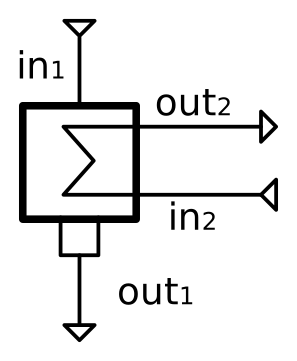

- Parameters:
label (str) – The label of the component.
design (list) – List containing design parameters (stated as String).
offdesign (list) – List containing offdesign parameters (stated as String).
design_path (str) – Path to the components design case.
local_offdesign (boolean) – Treat this component in offdesign mode in a design calculation.
local_design (boolean) – Treat this component in design mode in an offdesign calculation.
char_warnings (boolean) – Ignore warnings on default characteristics usage for this component.
printout (boolean) – Include this component in the network’s results printout.
Q (float, dict) – Heat transfer, \(Q/\text{W}\).
pr1 (float, dict,
"var") – Outlet to inlet pressure ratio at hot side, \(pr/1\).pr2 (float, dict,
"var") – Outlet to inlet pressure ratio at cold side, \(pr/1\).dp1 (float, dict,
"var") – Inlet to outlet pressure delta at hot side, unit is the network’s pressure unit!.dp2 (float, dict,
"var") – Inlet to outlet pressure delta at cold side, unit is the network’s pressure unit!.zeta1 (float, dict,
"var") – Geometry independent friction coefficient at hot side, \(\frac{\zeta}{D^4}/\frac{1}{\text{m}^4}\).zeta2 (float, dict,
"var") – Geometry independent friction coefficient at cold side, \(\frac{\zeta}{D^4}/\frac{1}{\text{m}^4}\).ttd_l (float, dict) – Lower terminal temperature difference \(ttd_\mathrm{l}/\text{K}\).
ttd_u (float, dict) – Upper terminal temperature difference (referring to saturation temprature of condensing fluid) \(ttd_\mathrm{u}/\text{K}\).
ttd_min (float, dict) – Minumum terminal temperature difference \(ttd_\mathrm{min}/\text{K}\).
eff_cold (float, dict) – Cold side heat exchanger effectiveness \(eff_\text{cold}/\text{1}\).
eff_hot (float, dict) – Hot side heat exchanger effectiveness \(eff_\text{hot}/\text{1}\).
eff_max (float, dict) – Max value of hot and cold side heat exchanger effectiveness values \(eff_\text{max}/\text{1}\).
kA (float, dict) – Area independent heat transfer coefficient, \(kA/\frac{\text{W}}{\text{K}}\).
kA_char (tespy.tools.data_containers.SimpleDataContainer) – Area independent heat transfer coefficient characteristic.
kA_char1 (tespy.tools.characteristics.CharLine, dict) – Characteristic line for hot side heat transfer coefficient.
kA_char2 (tespy.tools.characteristics.CharLine, dict) – Characteristic line for cold side heat transfer coefficient.
subcooling (boolean) – Enable/disable subcooling, default value: disabled.
Note
The condenser has an additional equation for enthalpy at hot side outlet: The fluid leaves the component in saturated liquid state. If subcooling is activated, it possible to specify the enthalpy at the outgoing connection manually.
It has different calculation method for given heat transfer coefficient and upper terminal temperature dierence: These parameters refer to the condensing temperature, even if the fluid on the hot side enters the component in superheated state.
Example
Air is used to condensate water in a condenser. 1 kg/s waste steam is chilled with a terminal temperature difference of 15 K.
>>> from tespy.components import Sink, Source, Condenser
>>> from tespy.connections import Connection
>>> from tespy.networks import Network
>>> from tespy.tools.fluid_properties import T_sat_p
>>> import os
>>> nw = Network(T_unit='C', p_unit='bar', h_unit='kJ / kg',
... m_range=[0.01, 1000], iterinfo=False)
>>> amb_in = Source('ambient air inlet')
>>> amb_out = Sink('air outlet')
>>> waste_steam = Source('waste steam')
>>> c = Sink('condensate sink')
>>> cond = Condenser('condenser')
>>> amb_he = Connection(amb_in, 'out1', cond, 'in2')
>>> he_amb = Connection(cond, 'out2', amb_out, 'in1')
>>> ws_he = Connection(waste_steam, 'out1', cond, 'in1')
>>> he_c = Connection(cond, 'out1', c, 'in1')
>>> nw.add_conns(amb_he, he_amb, ws_he, he_c)
The air flow can not be controlled, thus is constant in offdesign operation. If the waste steam mass flow or the ambient air temperature change, the outlet temperature of the air will change, too.
>>> cond.set_attr(pr1=0.98, pr2=0.999, ttd_u=15, design=['pr2', 'ttd_u'],
... offdesign=['zeta2', 'kA_char'])
>>> ws_he.set_attr(fluid={'water': 1}, h=2700, m=1)
>>> amb_he.set_attr(fluid={'air': 1}, T=20, offdesign=['v'])
>>> he_amb.set_attr(p=1, T=40, design=['T'])
>>> nw.solve('design')
>>> nw.save('tmp.json')
>>> round(amb_he.v.val, 2)
103.17
>>> round(ws_he.T.val - he_amb.T.val, 1)
66.9
>>> round(ws_he.calc_T_sat() - 273.15 - he_amb.T.val, 1)
15.0
>>> ws_he.set_attr(m=0.7)
>>> amb_he.set_attr(T=30)
>>> nw.solve('offdesign', design_path='tmp.json')
>>> round(ws_he.T.val - he_amb.T.val, 1)
62.5
>>> round(ws_he.calc_T_sat() - 273.15 - he_amb.T.val, 1)
11.3
It is possible to activate subcooling. The difference to boiling point temperature is specified to 5 K.
>>> cond.set_attr(subcooling=True)
>>> he_c.set_attr(Td_bp=-5)
>>> nw.solve('offdesign', design_path='tmp.json')
>>> round(ws_he.T.val - he_amb.T.val, 1)
62.5
>>> round(ws_he.calc_T_sat() - 273.15 - he_amb.T.val, 1)
13.4
>>> os.remove('tmp.json')
- kA_char_func()[source]
Calculate heat transfer from heat transfer coefficient characteristic.
- Returns:
residual (float) – Residual value of equation.
\[ \begin{align}\begin{aligned}0 = \dot{m}_{in,1} \cdot \left( h_{out,1} - h_{in,1}\right) + kA_{design} \cdot f_{kA} \cdot \frac{T_{out,1} - T_{in,2} - T_{sat} \left(p_{in,1}\right) + T_{out,2}} {\ln{\frac{T_{out,1} - T_{in,2}} {T_{sat} \left(p_{in,1}\right) - T_{out,2}}}}\\f_{kA} = \frac{2}{\frac{1}{f_1 \left( expr_1\right)} + \frac{1}{f_2 \left( expr_2\right)}}\end{aligned}\end{align} \]
Note
For standard functions f1 and f2 see module
tespy.data.
tespy.components.heat_exchangers.desuperheater module
Module of class Desuperheater.
This file is part of project TESPy (github.com/oemof/tespy). It’s copyrighted by the contributors recorded in the version control history of the file, available from its original location tespy/components/heat_exchangers/desuperheater.py
SPDX-License-Identifier: MIT
- class tespy.components.heat_exchangers.desuperheater.Desuperheater(label, **kwargs)[source]
Bases:
HeatExchangerThe Desuperheater cools a fluid to the saturated gas state.
Mandatory Equations
tespy.components.heat_exchangers.base.HeatExchanger.energy_balance_func()tespy.components.heat_exchangers.desuperheater.Desuperheater.saturated_gas_func()
Optional Equations
tespy.components.heat_exchangers.base.HeatExchanger.energy_balance_hot_func()tespy.components.heat_exchangers.base.HeatExchanger.kA_func()tespy.components.heat_exchangers.base.HeatExchanger.kA_char_func()tespy.components.heat_exchangers.base.HeatExchanger.ttd_u_func()tespy.components.heat_exchangers.base.HeatExchanger.ttd_l_func()
Inlets/Outlets
in1, in2 (index 1: hot side, index 2: cold side)
out1, out2 (index 1: hot side, index 2: cold side)
Image
- Parameters:
label (str) – The label of the component.
design (list) – List containing design parameters (stated as String).
offdesign (list) – List containing offdesign parameters (stated as String).
design_path (str) – Path to the components design case.
local_offdesign (boolean) – Treat this component in offdesign mode in a design calculation.
local_design (boolean) – Treat this component in design mode in an offdesign calculation.
char_warnings (boolean) – Ignore warnings on default characteristics usage for this component.
printout (boolean) – Include this component in the network’s results printout.
Q (float, dict) – Heat transfer, \(Q/\text{W}\).
pr1 (float, dict,
"var") – Outlet to inlet pressure ratio at hot side, \(pr/1\).pr2 (float, dict,
"var") – Outlet to inlet pressure ratio at cold side, \(pr/1\).zeta1 (float, dict,
"var") – Geometry independent friction coefficient at hot side, \(\frac{\zeta}{D^4}/\frac{1}{\text{m}^4}\).zeta2 (float, dict,
"var") – Geometry independent friction coefficient at cold side, \(\frac{\zeta}{D^4}/\frac{1}{\text{m}^4}\).ttd_l (float, dict) – Lower terminal temperature difference \(ttd_\mathrm{l}/\text{K}\).
ttd_u (float, dict) – Upper terminal temperature difference \(ttd_\mathrm{u}/\text{K}\).
kA (float, dict) – Area independent heat transfer coefficient, \(kA/\frac{\text{W}}{\text{K}}\).
kA_char1 (tespy.tools.characteristics.CharLine, dict) – Characteristic line for hot side heat transfer coefficient.
kA_char2 (tespy.tools.characteristics.CharLine, dict) – Characteristic line for cold side heat transfer coefficient.
Note
The desuperheater has an additional equation for enthalpy at hot side outlet: The fluid leaves the component in saturated gas state.
Example
Overheated enthanol is cooled with water in a heat exchanger until it reaches the state of saturated gas.
>>> from tespy.components import Sink, Source, Desuperheater
>>> from tespy.connections import Connection
>>> from tespy.networks import Network
>>> import os
>>> nw = Network(
...     T_unit='C', p_unit='bar', h_unit='kJ / kg', v_unit='l / s',
...     iterinfo=False
... )
>>> et_in = Source('ethanol inlet')
>>> et_out = Sink('ethanol outlet')
>>> cw_in = Source('cooling water inlet')
>>> cw_out = Sink('cooling water outlet')
>>> desu = Desuperheater('desuperheater')
>>> et_de = Connection(et_in, 'out1', desu, 'in1')
>>> de_et = Connection(desu, 'out1', et_out, 'in1')
>>> cw_de = Connection(cw_in, 'out1', desu, 'in2')
>>> de_cw = Connection(desu, 'out2', cw_out, 'in1')
>>> nw.add_conns(et_de, de_et, cw_de, de_cw)
The cooling water enters the component at 15 °C. 10 l/s of ethanol is cooled from 100 K above boiling point. The water flow rate is at 1 l/s. Knowing the component’s design parameters it is possible to predict behavior at different inlet temperatures or different volumetric flow of ethanol. Controlling the ethanol’s state at the outlet is only possible, if the cooling water flow rate is adjusted accordingly.
>>> desu.set_attr(
...     pr1=0.99, pr2=0.98, design=['pr1', 'pr2'],
...     offdesign=['zeta1', 'zeta2', 'kA_char']
... )
>>> cw_de.set_attr(fluid={'water': 1}, T=15, v=1, design=['v'])
>>> de_cw.set_attr(p=1)
>>> et_de.set_attr(fluid={'ethanol': 1}, Td_bp=100, v=10)
>>> de_et.set_attr(p=1)
>>> nw.solve('design')
>>> nw.save('tmp.json')
>>> round(de_cw.T.val, 1)
15.5
>>> round(de_et.x.val, 1)
1.0
>>> et_de.set_attr(v=12)
>>> nw.solve('offdesign', design_path='tmp.json')
>>> round(cw_de.v.val, 2)
1.94
>>> et_de.set_attr(v=7)
>>> nw.solve('offdesign', init_path='tmp.json', design_path='tmp.json')
>>> round(cw_de.v.val, 2)
0.41
>>> os.remove('tmp.json')
tespy.components.heat_exchangers.simple module
Module of class SimpleHeatExchanger.
This file is part of project TESPy (github.com/oemof/tespy). It’s copyrighted by the contributors recorded in the version control history of the file, available from its original location tespy/components/heat_exchangers/simple.py
SPDX-License-Identifier: MIT
- class tespy.components.heat_exchangers.simple.SimpleHeatExchanger(label, **kwargs)[source]
Bases:
ComponentA basic heat exchanger representing a heat source or heat sink.
The component SimpleHeatExchanger is the parent class for the components:
tespy.components.heat_exchangers.solar_collector.SolarCollectortespy.components.heat_exchangers.parabolic_trough.ParabolicTrough
Mandatory Equations
tespy.components.component.Component.fluid_func()tespy.components.component.Component.mass_flow_func()
Optional Equations
tespy.components.heat_exchangers.simple.SimpleHeatExchanger.energy_balance_func()tespy.components.heat_exchangers.simple.SimpleHeatExchanger.darcy_func()tespy.components.heat_exchangers.simple.SimpleHeatExchanger.hazen_williams_func()tespy.components.heat_exchangers.simple.SimpleHeatExchanger.kA_group_func()tespy.components.heat_exchangers.simple.SimpleHeatExchanger.kA_char_group_func()
Inlets/Outlets
in1
out1
Image
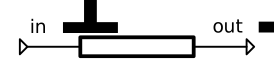

- Parameters:
label (str) – The label of the component.
design (list) – List containing design parameters (stated as String).
offdesign (list) – List containing offdesign parameters (stated as String).
design_path (str) – Path to the components design case.
local_offdesign (boolean) – Treat this component in offdesign mode in a design calculation.
local_design (boolean) – Treat this component in design mode in an offdesign calculation.
char_warnings (boolean) – Ignore warnings on default characteristics usage for this component.
printout (boolean) – Include this component in the network’s results printout.
Q (float, dict,
"var") – Heat transfer, \(Q/\text{W}\).pr (float, dict,
"var") – Outlet to inlet pressure ratio, \(pr/1\).zeta (float, dict,
"var") – Geometry independent friction coefficient, \(\frac{\zeta}{D^4}/\frac{1}{\text{m}^4}\).D (float, dict,
"var") – Diameter of the pipes, \(D/\text{m}\).L (float, dict,
"var") – Length of the pipes, \(L/\text{m}\).ks (float, dict,
"var") – Pipe’s roughness, \(ks/\text{m}\).darcy_group (str, dict) – Parametergroup for pressure drop calculation based on pipes dimensions using darcy weissbach equation.
ks_HW (float, dict,
"var") – Pipe’s roughness, \(ks/\text{1}\).hw_group (str, dict) – Parametergroup for pressure drop calculation based on pipes dimensions using hazen williams equation.
kA (float, dict,
"var") – Area independent heat transfer coefficient, \(kA/\frac{\text{W}}{\text{K}}\).kA_char (tespy.tools.characteristics.CharLine, dict) – Characteristic line for heat transfer coefficient.
Tamb (float, dict) – Ambient temperature, provide parameter in network’s temperature unit.
kA_group (str, dict) – Parametergroup for heat transfer calculation from ambient temperature and area independent heat transfer coefficient kA.
Example
The SimpleHeatExchanger can be used as a sink or source of heat. This component does not simulate the secondary side of the heat exchanger. It is possible to calculate the pressure ratio with the Darcy-Weisbach equation or in case of liquid water use the Hazen-Williams equation. Also, given ambient temperature and the heat transfer coeffiecient, it is possible to predict heat transfer.
>>> from tespy.components import Sink, Source, SimpleHeatExchanger
>>> from tespy.connections import Connection
>>> from tespy.networks import Network
>>> import os
>>> nw = Network()
>>> nw.set_attr(p_unit='bar', T_unit='C', h_unit='kJ / kg', iterinfo=False)
>>> so1 = Source('source 1')
>>> si1 = Sink('sink 1')
>>> heat_sink = SimpleHeatExchanger('heat sink')
>>> heat_sink.set_attr(Tamb=10, pr=0.95, design=['pr'],
... offdesign=['zeta', 'kA_char'])
>>> inc = Connection(so1, 'out1', heat_sink, 'in1')
>>> outg = Connection(heat_sink, 'out1', si1, 'in1')
>>> nw.add_conns(inc, outg)
It is possible to determine the amount of heat transferred when the fluid enters the heat sink at a temperature of 200 °C and is cooled down to 150 °C. Given an ambient temperature of 10 °C this also determines the heat transfer coefficient to the ambient. Assuming a characteristic function for the heat transfer coefficient we can predict the heat transferred at variable flow rates.
>>> inc.set_attr(fluid={'N2': 1}, m=1, T=200, p=5)
>>> outg.set_attr(T=150, design=['T'])
>>> nw.solve('design')
>>> nw.save('tmp.json')
>>> round(heat_sink.Q.val, 0)
-52581.0
>>> round(heat_sink.kA.val, 0)
321.0
>>> inc.set_attr(m=1.25)
>>> nw.solve('offdesign', design_path='tmp.json')
>>> round(heat_sink.Q.val, 0)
-56599.0
>>> round(outg.T.val, 1)
156.9
>>> inc.set_attr(m=0.75)
>>> nw.solve('offdesign', design_path='tmp.json')
>>> round(heat_sink.Q.val, 1)
-47275.8
>>> round(outg.T.val, 1)
140.0
>>> os.remove('tmp.json')
- bus_deriv(bus)[source]
Calculate partial derivatives of the bus function.
- Parameters:
bus (tespy.connections.bus.Bus) – TESPy bus object.
- Returns:
deriv (ndarray) – Matrix of partial derivatives.
- bus_func(bus)[source]
Calculate the value of the bus function.
- Parameters:
bus (tespy.connections.bus.Bus) – TESPy bus object.
- Returns:
val (float) – Value of energy transfer \(\dot{E}\). This value is passed to
tespy.components.component.Component.calc_bus_value()for value manipulation according to the specified characteristic line of the bus.\[\dot{E} = \dot{m}_{in} \cdot \left( h_{out} - h_{in} \right)\]
- darcy_func()[source]
Equation for pressure drop calculation from darcy friction factor.
- Returns:
residual (float) – Residual value of equation.
\[ \begin{align}\begin{aligned}\begin{split}0 = p_{in} - p_{out} - \frac{8 \cdot |\dot{m}_{in}| \cdot \dot{m}_{in} \cdot \frac{v_{in}+v_{out}}{2} \cdot L \cdot \lambda\left(Re, ks, D\right)}{\pi^2 \cdot D^5}\\\end{split}\\\begin{split}Re = \frac{4 \cdot |\dot{m}_{in}|}{\pi \cdot D \cdot \frac{\eta_{in}+\eta_{out}}{2}}\\ \eta: \text{dynamic viscosity}\\ v: \text{specific volume}\\ \lambda: \text{darcy friction factor}\end{split}\end{aligned}\end{align} \]
- energy_balance_func()[source]
Equation for pressure drop calculation.
- Returns:
residual (float) – Residual value of equation:
\[0 =\dot{m}_{in}\cdot\left( h_{out}-h_{in}\right) -\dot{Q}\]
- entropy_balance()[source]
Calculate entropy balance of a simple heat exchanger.
The allocation of the entropy streams due to heat exchanged and due to irreversibility is performed by solving for T:
\[h_\mathrm{out} - h_\mathrm{in} = \int_\mathrm{out}^\mathrm{in} v \cdot dp - \int_\mathrm{out}^\mathrm{in} T \cdot ds\]As solving \(\int_\mathrm{out}^\mathrm{in} v \cdot dp\) for non isobaric processes would require perfect process knowledge (the path) on how specific volume and pressure change throught the component, the heat transfer is splitted into three separate virtual processes:
in->in*: decrease pressure to \(p_\mathrm{in*}=p_\mathrm{in}\cdot\sqrt{\frac{p_\mathrm{out}}{p_\mathrm{in}}}\) without changing enthalpy.
in*->out* transfer heat without changing pressure. \(h_\mathrm{out*}-h_\mathrm{in*}=h_\mathrm{out}-h_\mathrm{in}\)
out*->out decrease pressure to outlet pressure \(p_\mathrm{out}\) without changing enthalpy.
Note
The entropy balance makes the follwing parameter available:
\[\begin{split}\text{S\_Q}=\dot{m} \cdot \left(s_\mathrm{out*}-s_\mathrm{in*} \right)\\ \text{S\_irr}=\dot{m} \cdot \left(s_\mathrm{out}-s_\mathrm{in} \right) - \text{S\_Q}\\ \text{T\_mQ}=\frac{\dot{Q}}{\text{S\_Q}}\end{split}\]
- exergy_balance(T0)[source]
Calculate exergy balance of a simple heat exchanger.
The exergy of heat is calculated by allocation of thermal and mechanical share of exergy in the physical exergy. Depending on the temperature levels at the inlet and outlet of the heat exchanger as well as the direction of heat transfer (input or output) fuel and product exergy are calculated as follows.
- Parameters:
T0 (float) – Ambient temperature T0 / K.
Note
If the fluid transfers heat to the ambient, you can specify
mysimpleheatexchanger.set_attr(dissipative=False)if you do NOT want the exergy production nan (only applicable in case \(\dot{Q}<0\)).\[ \begin{align}\begin{aligned}\begin{split}\dot{E}_\mathrm{P} = \begin{cases} \begin{cases} \begin{cases} \text{not defined (nan)} & \text{if dissipative}\\ \dot{E}_\mathrm{in}^\mathrm{T} - \dot{E}_\mathrm{out}^\mathrm{T} & \text{else}\\ \end{cases} & T_\mathrm{in}, T_\mathrm{out} \geq T_0\\ \dot{E}_\mathrm{out}^\mathrm{T} & T_\mathrm{in} \geq T_0 > T_\mathrm{out}\\ \dot{E}_\mathrm{out}^\mathrm{T} - \dot{E}_\mathrm{in}^\mathrm{T} & T_0 \geq T_\mathrm{in}, T_\mathrm{out}\\ \end{cases} & \dot{Q} < 0\\\end{split}\\\begin{split}\begin{cases} \dot{E}_\mathrm{out}^\mathrm{PH} - \dot{E}_\mathrm{in}^\mathrm{PH} & T_\mathrm{in}, T_\mathrm{out} \geq T_0\\ \dot{E}_\mathrm{in}^\mathrm{T} + \dot{E}_\mathrm{out}^\mathrm{T} & T_\mathrm{out} > T_0 \geq T_\mathrm{in}\\ \dot{E}_\mathrm{in}^\mathrm{T} - \dot{E}_\mathrm{out}^\mathrm{T} + \dot{E}_\mathrm{out}^\mathrm{M} - \dot{E}_\mathrm{in}^\mathrm{M} + & T_0 \geq T_\mathrm{in}, T_\mathrm{out}\\ \end{cases} & \dot{Q} > 0\\ \end{cases}\end{split}\\\begin{split}\dot{E}_\mathrm{F} = \begin{cases} \begin{cases} \dot{E}_\mathrm{in}^\mathrm{PH} - \dot{E}_\mathrm{out}^\mathrm{PH} & T_\mathrm{in}, T_\mathrm{out} \geq T_0\\ \dot{E}_\mathrm{in}^\mathrm{T} + \dot{E}_\mathrm{in}^\mathrm{M} + \dot{E}_\mathrm{out}^\mathrm{T} - \dot{E}_\mathrm{out}^\mathrm{M} & T_\mathrm{in} \geq T_0 > T_\mathrm{out}\\ \dot{E}_\mathrm{out}^\mathrm{T} - \dot{E}_\mathrm{in}^\mathrm{T} + \dot{E}_\mathrm{in}^\mathrm{M} - \dot{E}_\mathrm{out}^\mathrm{M} + & T_0 \geq T_\mathrm{in}, T_\mathrm{out}\\ \end{cases} & \dot{Q} < 0\\\end{split}\\\begin{split}\begin{cases} \dot{E}_\mathrm{out}^\mathrm{T} - \dot{E}_\mathrm{in}^\mathrm{T} & T_\mathrm{in}, T_\mathrm{out} \geq T_0\\ \dot{E}_\mathrm{in}^\mathrm{T} + \dot{E}_\mathrm{in}^\mathrm{M} - \dot{E}_\mathrm{out}^\mathrm{M} & T_\mathrm{out} > T_0 \geq T_\mathrm{in}\\ \dot{E}_\mathrm{in}^\mathrm{T}-\dot{E}_\mathrm{out}^\mathrm{T} & T_0 \geq T_\mathrm{in}, T_\mathrm{out}\\ \end{cases} & \dot{Q} > 0\\ \end{cases}\end{split}\\\begin{split}\dot{E}_\mathrm{bus} = \begin{cases} \begin{cases} \dot{E}_\mathrm{P} & \text{other cases}\\ \dot{E}_\mathrm{in}^\mathrm{T} & T_\mathrm{in} \geq T_0 > T_\mathrm{out}\\ \end{cases} & \dot{Q} < 0\\ \dot{E}_\mathrm{F} & \dot{Q} > 0\\ \end{cases}\end{split}\end{aligned}\end{align} \]
- get_plotting_data()[source]
Generate a dictionary containing FluProDia plotting information.
- Returns:
data (dict) – A nested dictionary containing the keywords required by the
calc_individual_isolinemethod of theFluidPropertyDiagramclass. First level keys are the connection index (‘in1’ -> ‘out1’, therefore1etc.).
- hazen_williams_func()[source]
Equation for pressure drop calculation from Hazen-Williams equation.
- Returns:
residual (float) – Residual value of equation.
\[ \begin{align}\begin{aligned}0 = \left(p_{in} - p_{out} \right) \cdot \left(-1\right)^i - \frac{10.67 \cdot |\dot{m}_{in}| ^ {1.852} \cdot L}{ks^{1.852} \cdot D^{4.871}} \cdot g \cdot \left(\frac{v_{in} + v_{out}}{2}\right)^{0.852}\\\begin{split}i = \begin{cases} 0 & \dot{m}_{in} \geq 0\\ 1 & \dot{m}_{in} < 0 \end{cases}\end{split}\end{aligned}\end{align} \]
Note
Gravity \(g\) is set to \(9.81 \frac{m}{s^2}\)
- initialise_source(c, key)[source]
Return a starting value for pressure and enthalpy the outlets.
- Parameters:
c (tespy.connections.connection.Connection) – Connection to perform initialisation on.
key (str) – Fluid property to retrieve.
- Returns:
val (float) – Starting value for pressure/enthalpy in SI units.
\[\begin{split}val = \begin{cases} \begin{cases} 1 \cdot 10^5 \; \frac{\text{J}}{\text{kg}} & \dot{Q} < 0\\ 3 \cdot 10^5 \; \frac{\text{J}}{\text{kg}} & \dot{Q} = 0\\ 5 \cdot 10^5 \; \frac{\text{J}}{\text{kg}} & \dot{Q} > 0 \end{cases} & \text{key = 'h'}\\ \; \; \; \; 10^5 \text{Pa} & \text{key = 'p'} \end{cases}\end{split}\]
- initialise_target(c, key)[source]
Return a starting value for pressure and enthalpy the inlets.
- Parameters:
c (tespy.connections.connection.Connection) – Connection to perform initialisation on.
key (str) – Fluid property to retrieve.
- Returns:
val (float) – Starting value for pressure/enthalpy in SI units.
\[\begin{split}val = \begin{cases} 1 \cdot 10^5 & \text{key = 'p'}\\ \begin{cases} 5 \cdot 10^5 & \dot{Q} < 0\\ 3 \cdot 10^5 & \dot{Q} = 0\\ 1 \cdot 10^5 & \dot{Q} > 0 \end{cases} & \text{key = 'h'}\\ \end{cases}\end{split}\]
- kA_char_group_func()[source]
Calculate heat transfer from heat transfer coefficient characteristic.
- Returns:
residual (float) – Residual value of equation.
\[ \begin{align}\begin{aligned}0 = \dot{m}_{in} \cdot \left( h_{out} - h_{in}\right) + kA_{design} \cdot f_{kA} \cdot \Delta T_{log}\\\begin{split}\Delta T_{log} = \begin{cases} \frac{T_{in}-T_{out}}{\ln{\frac{T_{in}-T_{amb}} {T_{out}-T_{amb}}}} & T_{in} > T_{out} \\ \frac{T_{out}-T_{in}}{\ln{\frac{T_{out}-T_{amb}} {T_{in}-T_{amb}}}} & T_{in} < T_{out}\\ 0 & T_{in} = T_{out} \end{cases}\end{split}\\f_{kA} = \frac{2}{1 + \frac{1}{f\left( expr\right)}}\\T_{amb}: \text{ambient temperature}\end{aligned}\end{align} \]
Note
For standard function of fkA see module
tespy.data.
- kA_group_func()[source]
Calculate heat transfer from heat transfer coefficient.
- Returns:
residual (float) – Residual value of equation.
\[ \begin{align}\begin{aligned}0 = \dot{m}_{in} \cdot \left( h_{out} - h_{in}\right) + kA \cdot \Delta T_{log}\\\begin{split}\Delta T_{log} = \begin{cases} \frac{T_{in}-T_{out}}{\ln{\frac{T_{in}-T_{amb}} {T_{out}-T_{amb}}}} & T_{in} > T_{out} \\ \frac{T_{out}-T_{in}}{\ln{\frac{T_{out}-T_{amb}} {T_{in}-T_{amb}}}} & T_{in} < T_{out}\\ 0 & T_{in} = T_{out} \end{cases}\end{split}\\T_{amb}: \text{ambient temperature}\end{aligned}\end{align} \]
tespy.components.heat_exchangers.parabolic_trough module
Module of class ParabolicTrough.
This file is part of project TESPy (github.com/oemof/tespy). It’s copyrighted by the contributors recorded in the version control history of the file, available from its original location tespy/components/heat_exchangers/parabolic_trough.py
SPDX-License-Identifier: MIT
- class tespy.components.heat_exchangers.parabolic_trough.ParabolicTrough(label, **kwargs)[source]
Bases:
SimpleHeatExchangerThe ParabolicTrough calculates heat output from irradiance.
Mandatory Equations
tespy.components.component.Component.fluid_func()tespy.components.component.Component.mass_flow_func()
Optional Equations
tespy.components.heat_exchangers.simple.SimpleHeatExchanger.energy_balance_func()tespy.components.heat_exchangers.simple.SimpleHeatExchanger.darcy_func()tespy.components.heat_exchangers.simple.SimpleHeatExchanger.hazen_williams_func()tespy.components.heat_exchangers.parabolic_trough.ParabolicTrough.energy_group_func()
Inlets/Outlets
in1
out1
Image
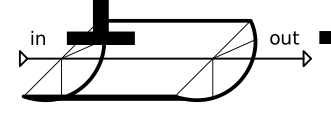

- Parameters:
label (str) – The label of the component.
design (list) – List containing design parameters (stated as String).
offdesign (list) – List containing offdesign parameters (stated as String).
design_path (str) – Path to the components design case.
local_offdesign (boolean) – Treat this component in offdesign mode in a design calculation.
local_design (boolean) – Treat this component in design mode in an offdesign calculation.
char_warnings (boolean) – Ignore warnings on default characteristics usage for this component.
printout (boolean) – Include this component in the network’s results printout.
Q (float, dict,
"var") – Heat transfer, \(Q/\text{W}\).pr (float, dict,
"var") – Outlet to inlet pressure ratio, \(pr/1\).zeta (float, dict,
"var") – Geometry independent friction coefficient, \(\frac{\zeta}{D^4}/\frac{1}{\text{m}^4}\).D (float, dict,
"var") – Diameter of the absorber tube, \(D/\text{m}\).L (float, dict,
"var") – Length of the absorber tube, \(L/\text{m}\).ks (float, dict,
"var") – Pipe’s roughness, \(ks/\text{m}\).darcy_group (str, dict) – Parametergroup for pressure drop calculation based on pipes dimensions using darcy weissbach equation.
ks_HW (float, dict,
"var") – Pipe’s roughness, \(ks/\text{1}\).hw_group (str, dict) – Parametergroup for pressure drop calculation based on pipes dimensions using hazen williams equation.
E (float, dict,
"var") – Direct irradiance to tilted collector, \(E/\frac{\text{W}}{\text{m}^2}\).aoi (float, dict,
"var") – Angle of incidience, \(aoi/^\circ\).doc (float, dict,
"var") – Degree of cleanliness (1: full absorption, 0: no absorption), \(X\).eta_opt (float, dict,
"var") – (constant) optical losses due to surface reflection, \(\eta_{opt}\).c_1 (float, dict,
"var") – Linear thermal loss key figure, \(c_1/\frac{\text{W}}{\text{K} \cdot \text{m}^2}\).c_2 (float, dict,
"var") – Quadratic thermal loss key figure, \(c_2/\frac{\text{W}}{\text{K}^2 \cdot \text{m}^2}\).iam_1 (float, dict,
"var") – Linear incidence angle modifier, \(iam_1/\frac{1}{^\circ}\).iam_2 (float, dict,
"var") – Quadratic incidence angle modifier, \(iam_2/\left(\frac{1}{^\circ}\right)^2\).A (float, dict,
"var") – Collector aperture surface area \(A/\text{m}^2\).Tamb (float, dict) – Ambient temperature, provide parameter in network’s temperature unit.
energy_group (str, dict) – Parametergroup for energy balance of solarthermal collector.
Example
A parabolic trough is installed using S800 as thermo-fluid. First, the operation conditions from [23] are reproduced. Therefore, the direct normal irradiance \(\dot{E}_\mathrm{DNI}\) is at 1000 \(\frac{\text{W}}{\text{m}^2}\) at an angle of incidence \(aoi\) at 20 °. This means, the direct irradiance to the parabolic trough \(E\) is at \(\dot{E}_{DNI} \cdot cos\left(20^\circ\right)\).
>>> from tespy.components import Sink, Source, ParabolicTrough
>>> from tespy.connections import Connection
>>> from tespy.networks import Network
>>> import math
>>> nw = Network()
>>> nw.set_attr(p_unit='bar', T_unit='C', h_unit='kJ / kg', iterinfo=False)
>>> so = Source('source')
>>> si = Sink('sink')
>>> pt = ParabolicTrough('parabolic trough collector')
>>> inc = Connection(so, 'out1', pt, 'in1')
>>> outg = Connection(pt, 'out1', si, 'in1')
>>> nw.add_conns(inc, outg)
The pressure ratio is at a constant level of 1. However, it is possible to specify the pressure losses from the absorber tube length, roughness and diameter, too. The aperture surface \(A\) is specified to 1 \(\text{m}^2\) for simplicity reasons.
>>> aoi = 20
>>> E = 1000 * math.cos(aoi / 180 * math.pi)
>>> pt.set_attr(
... pr=1, aoi=aoi, doc=1,
... Tamb=20, A=1, eta_opt=0.816, c_1=0.0622, c_2=0.00023, E=E,
... iam_1=-1.59e-3, iam_2=9.77e-5
... )
>>> inc.set_attr(fluid={'INCOMP::S800': 1}, T=220, p=10)
>>> outg.set_attr(T=260)
>>> nw.solve('design')
>>> round(pt.Q.val, 0)
736.0
For example, it is possible to calculate the aperture area of the parabolic trough given the total heat production, outflow temperature and mass flow.
>>> pt.set_attr(A='var', Q=5e6, Tamb=25)
>>> inc.set_attr(T=None)
>>> outg.set_attr(T=350, m=20)
>>> nw.solve('design')
>>> round(inc.T.val, 0)
229.0
>>> round(pt.A.val, 0)
6862.0
Given this design, it is possible to calculate the outlet temperature as well as the heat transfer at different operating points.
>>> aoi = 30
>>> E = 800 * math.cos(aoi / 180 * math.pi)
>>> pt.set_attr(A=pt.A.val, aoi=aoi, Q=None, E=E)
>>> inc.set_attr(T=150)
>>> outg.set_attr(T=None)
>>> nw.solve('design')
>>> round(outg.T.val, 0)
244.0
>>> round(pt.Q.val, 0)
3602817.0
- energy_group_func()[source]
Equation for solar collector energy balance.
- Returns:
residual (float) – Residual value of equation.
\[\begin{split}\begin{split} T_m = & \frac{T_{out} + T_{in}}{2}\\ iam = & 1 - iam_1 \cdot |aoi| - iam_2 \cdot aoi^2\\ 0 = & \dot{m} \cdot \left( h_{out} - h_{in} \right)\\ & - A \cdot \left[E \cdot \eta_{opt} \cdot doc^{1.5} \cdot iam \right. \\ & \left. - c_1 \cdot \left(T_m - T_{amb} \right) - c_2 \cdot \left(T_m - T_{amb}\right)^2 \vphantom{ \eta_{opt} \cdot doc^{1.5}} \right] \end{split}\end{split}\]Reference: [23].
tespy.components.heat_exchangers.solar_collector module
Module of class SolarCollector.
This file is part of project TESPy (github.com/oemof/tespy). It’s copyrighted by the contributors recorded in the version control history of the file, available from its original location tespy/components/heat_exchangers/solar_collector.py
SPDX-License-Identifier: MIT
- class tespy.components.heat_exchangers.solar_collector.SolarCollector(label, **kwargs)[source]
Bases:
SimpleHeatExchangerThe solar collector calculates heat output from irradiance.
Mandatory Equations
tespy.components.component.Component.fluid_func()tespy.components.component.Component.mass_flow_func()
Optional Equations
tespy.components.heat_exchangers.simple.SimpleHeatExchanger.energy_balance_func()tespy.components.heat_exchangers.simple.SimpleHeatExchanger.darcy_func()tespy.components.heat_exchangers.simple.SimpleHeatExchanger.hazen_williams_func()tespy.components.heat_exchangers.solar_collector.SolarCollector.energy_group_func()
Inlets/Outlets
in1
out1
Image
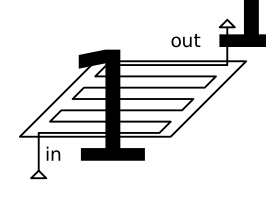

- Parameters:
label (str) – The label of the component.
design (list) – List containing design parameters (stated as String).
offdesign (list) – List containing offdesign parameters (stated as String).
design_path (str) – Path to the components design case.
local_offdesign (boolean) – Treat this component in offdesign mode in a design calculation.
local_design (boolean) – Treat this component in design mode in an offdesign calculation.
char_warnings (boolean) – Ignore warnings on default characteristics usage for this component.
printout (boolean) – Include this component in the network’s results printout.
Q (float, dict,
"var") – Heat transfer, \(Q/\text{W}\).pr (float, dict,
"var") – Outlet to inlet pressure ratio, \(pr/1\).zeta (float, dict,
"var") – Geometry independent friction coefficient, \(\frac{\zeta}{D^4}/\frac{1}{\text{m}^4}\).D (float, dict,
"var") – Diameter of the pipes, \(D/\text{m}\).L (float, dict,
"var") – Length of the pipes, \(L/\text{m}\).ks (float, dict,
"var") – Pipe’s roughness, \(ks/\text{m}\).darcy_group (str, dict) – Parametergroup for pressure drop calculation based on pipes dimensions using darcy weissbach equation.
ks_HW (float, dict,
"var") – Pipe’s roughness, \(ks/\text{1}\).hw_group (str, dict) – Parametergroup for pressure drop calculation based on pipes dimensions using hazen williams equation.
E (float, dict,
"var") – irradiance at tilted collector surface area, \(E/\frac{\text{W}}{\text{m}^2}\).eta_opt (float, dict,
"var") – optical loss at surface cover, \(\eta_{opt}\).lkf_lin (float, dict,
"var") – Linear thermal loss key figure, \(\alpha_1/\frac{\text{W}}{\text{K} \cdot \text{m}^2}\).lkf_quad (float, dict,
"var") – Quadratic thermal loss key figure, \(\alpha_2/\frac{\text{W}}{\text{K}^2 \cdot \text{m}^2}\).A (float, dict,
"var") – Collector surface area \(A/\text{m}^2\).Tamb (float, dict) – Ambient temperature, provide parameter in network’s temperature unit.
energy_group (str, dict) – Parametergroup for energy balance of solarthermal collector.
Example
The solar collector is used to calculate heat transferred to the heating system from irradiance on a tilted plane. For instance, it is possible to calculate the collector surface area required to transfer a specific amount of heat at a given irradiance. The collector parameters are the linear and the quadratic loss keyfigure as well as the optical effifiency.
>>> from tespy.components import Sink, Source, SolarCollector
>>> from tespy.connections import Connection
>>> from tespy.networks import Network
>>> import os
>>> nw = Network()
>>> nw.set_attr(p_unit='bar', T_unit='C', h_unit='kJ / kg', iterinfo=False)
>>> so = Source('source')
>>> si = Sink('sink')
>>> sc = SolarCollector('solar collector')
>>> sc.set_attr(pr=0.95, Q=1e4, design=['pr', 'Q'], offdesign=['zeta'],
...     Tamb=25, A='var', eta_opt=0.92, lkf_lin=1, lkf_quad=0.005, E=8e2)
>>> inc = Connection(so, 'out1', sc, 'in1')
>>> outg = Connection(sc, 'out1', si, 'in1')
>>> nw.add_conns(inc, outg)
The outlet temperature should be at 90 °C at a constant mass flow, which is determined in the design calculation. In offdesign operation (at a different irradiance) using the calculated surface area and mass flow, it is possible to predict the outlet temperature. It would instead be possible to calulate the change in mass flow required to hold the specified outlet temperature, too.
>>> inc.set_attr(fluid={'H2O': 1}, T=40, p=3, offdesign=['m'])
>>> outg.set_attr(T=90, design=['T'])
>>> nw.solve('design')
>>> nw.save('tmp.json')
>>> round(sc.A.val, 1)
14.5
>>> sc.set_attr(A=sc.A.val, E=5e2, Tamb=20)
>>> nw.solve('offdesign', design_path='tmp.json')
>>> round(sc.Q.val, 1)
6083.8
>>> round(outg.T.val, 1)
70.5
>>> os.remove('tmp.json')
- energy_group_func()[source]
Equation for solar collector energy balance.
- Returns:
residual (float) – Residual value of equation.
\[\begin{split}\begin{split} 0 = & \dot{m} \cdot \left( h_{out} - h_{in} \right)\\ & - A \cdot \left[E \cdot \eta_{opt} - \alpha_1 \cdot \left(T_m - T_{amb} \right) - \alpha_2 \cdot \left(T_m - T_{amb}\right)^2 \right]\\ T_m = & \frac{T_{out} + T_{in}}{2}\\ \end{split}\end{split}\]Reference: [24].
tespy.components.nodes.base module
Module of class NodeBase.
This file is part of project TESPy (github.com/oemof/tespy). It’s copyrighted by the contributors recorded in the version control history of the file, available from its original location tespy/components/nodes/base.py
SPDX-License-Identifier: MIT
- class tespy.components.nodes.base.NodeBase(label, **kwargs)[source]
Bases:
ComponentClass NodeBase is parent class for all components of submodule nodes.
- static initialise_source(c, key)[source]
Return a starting value for pressure and enthalpy at outlet.
- Parameters:
c (tespy.connections.connection.Connection) – Connection to perform initialisation on.
key (str) – Fluid property to retrieve.
- Returns:
val (float) – Starting value for pressure/enthalpy in SI units.
\[\begin{split}val = \begin{cases} 10^5 & \text{key = 'p'}\\ 5 \cdot 10^5 & \text{key = 'h'} \end{cases}\end{split}\]
- static initialise_target(c, key)[source]
Return a starting value for pressure and enthalpy at inlet.
- Parameters:
c (tespy.connections.connection.Connection) – Connection to perform initialisation on.
key (str) – Fluid property to retrieve.
- Returns:
val (float) – Starting value for pressure/enthalpy in SI units.
\[\begin{split}val = \begin{cases} 10^5 & \text{key = 'p'}\\ 5 \cdot 10^5 & \text{key = 'h'} \end{cases}\end{split}\]
- mass_flow_func()[source]
Calculate the residual value for mass flow balance equation.
- Returns:
res (float) – Residual value of equation.
\[0 = \sum \dot{m}_{in,i} - \sum \dot{m}_{out,j} \; \forall i \in inlets, \forall j \in outlets\]
- pressure_equality_func()[source]
Calculate the residual values of pressure equality equations.
- Returns:
residual (list) – Vector with residual value for pressure equality equations.
\[\begin{split}0 = p_{in,1} - p_{in,i}\forall i \in \text{inlets > 1}\\ 0 = p_{in,1} - p_{out,j}\forall j \in \text{outlets}\end{split}\]
tespy.components.nodes.droplet_separator module
Module of class DropletSeparator.
This file is part of project TESPy (github.com/oemof/tespy). It’s copyrighted by the contributors recorded in the version control history of the file, available from its original location tespy/components/nodes/droplet_separator.py
SPDX-License-Identifier: MIT
- class tespy.components.nodes.droplet_separator.DropletSeparator(label, **kwargs)[source]
Bases:
NodeBaseSeparate liquid phase from gas phase of a single fluid.
This component is the parent component of the Drum.
Mandatory Equations
tespy.components.nodes.base.NodeBase.pressure_equality_func()tespy.components.nodes.droplet_separator.DropletSeparator.fluid_func()tespy.components.nodes.droplet_separator.DropletSeparator.energy_balance_func()tespy.components.nodes.droplet_separator.DropletSeparator.outlet_states_func()
Inlets/Outlets
in1
out1, out2 (index 1: saturated liquid, index 2: saturated gas)
Image
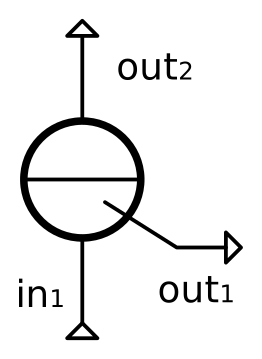

- Parameters:
label (str) – The label of the component.
design (list) – List containing design parameters (stated as String).
offdesign (list) – List containing offdesign parameters (stated as String).
design_path (str) – Path to the components design case.
local_offdesign (boolean) – Treat this component in offdesign mode in a design calculation.
local_design (boolean) – Treat this component in design mode in an offdesign calculation.
char_warnings (boolean) – Ignore warnings on default characteristics usage for this component.
printout (boolean) – Include this component in the network’s results printout.
Example
The droplet separator separates gas from liquid phase. From a stream of water the liquid phase will be separated.
>>> from tespy.components import Sink, Source, DropletSeparator
>>> from tespy.connections import Connection
>>> from tespy.networks import Network
>>> nw = Network(T_unit='C', p_unit='bar', h_unit='kJ / kg', iterinfo=False)
>>> so = Source('two phase inflow')
>>> sig = Sink('gas outflow')
>>> sil = Sink('liquid outflow')
>>> ds = DropletSeparator('droplet separator')
>>> so_ds = Connection(so, 'out1', ds, 'in1')
>>> ds_sig = Connection(ds, 'out2', sig, 'in1')
>>> ds_sil = Connection(ds, 'out1', sil, 'in1')
>>> nw.add_conns(so_ds, ds_sig, ds_sil)
We specify the fluid’s state at the inlet. At the gas outflow saturated gas enthalpy is expected, at the liquid gas outflow saturated liquid enthalpy. The mass flow at the outlets is expected to split according to the vapor mass fraction:
\[ \begin{align}\begin{aligned}\dot{m}_\mathrm{out,1} = \left(1 - \frac{h_\mathrm{in} - h'}{h'' - h'} \right) \cdot \dot{m}_\mathrm{in}\\\dot{m}_\mathrm{out,2} = \frac{h_\mathrm{in} - h'}{h'' - h'} \cdot \dot{m}_\mathrm{in}\end{aligned}\end{align} \]>>> so_ds.set_attr(fluid={'water': 1}, p=1, h=1500, m=10) >>> nw.solve('design') >>> Q_in = so_ds.calc_Q() >>> round(Q_in * so_ds.m.val_SI, 6) == round(ds_sig.m.val_SI, 6) True >>> round((1 - Q_in) * so_ds.m.val_SI, 6) == round(ds_sil.m.val_SI, 6) True >>> ds_sig.calc_Q() 1.0 >>> ds_sil.calc_Q() 0.0
In a different setup, we unset pressure and enthalpy and specify gas temperature and mass flow instead. The temperature specification must yield the corresponding boiling point pressure and the mass flow must yield the inlet enthalpy. The inlet vapor mass fraction must be equal to fraction of gas mass flow to inlet mass flow (0.95 in this example).
>>> so_ds.set_attr(fluid={'water': 1}, p=None, h=None, T=150, m=10)
>>> ds_sig.set_attr(m=9.5)
>>> nw.solve('design')
>>> round(so_ds.calc_Q(), 6)
0.95
>>> T_boil = so_ds.calc_T_sat()
>>> round(T_boil, 6) == round(so_ds.T.val_SI, 6)
True
- energy_balance_func()[source]
Calculate energy balance.
- Returns:
residual (float) – Residual value of energy balance.
\[\begin{split}0 = \sum_i \left(\dot{m}_{in,i} \cdot h_{in,i} \right) - \sum_j \left(\dot{m}_{out,j} \cdot h_{out,j} \right)\\ \forall i \in \text{inlets} \; \forall j \in \text{outlets}\end{split}\]
- fluid_structure_matrix(k)[source]
Calculate partial derivatives for all pressure equations.
- Returns:
deriv (ndarray) – Matrix with partial derivatives for the fluid equations.
- get_plotting_data()[source]
Generate a dictionary containing FluProDia plotting information.
- Returns:
data (dict) – A nested dictionary containing the keywords required by the
calc_individual_isolinemethod of theFluidPropertyDiagramclass. First level keys are the connection index (‘in1’ -> ‘out1’, therefore1etc.).
- static initialise_source(c, key)[source]
Return a starting value for pressure and enthalpy at outlet.
- Parameters:
c (tespy.connections.connection.Connection) – Connection to perform initialisation on.
key (str) – Fluid property to retrieve.
- Returns:
val (float) – Starting value for pressure/enthalpy in SI units.
\[\begin{split}val = \begin{cases} 10^6 & \text{key = 'p'}\\ h\left(p, x=1 \right) & \text{key = 'h' at outlet 1}\\ h\left(p, x=0 \right) & \text{key = 'h' at outlet 2} \end{cases}\end{split}\]
- static initialise_target(c, key)[source]
Return a starting value for pressure and enthalpy at inlet.
- Parameters:
c (tespy.connections.connection.Connection) – Connection to perform initialisation on.
key (str) – Fluid property to retrieve.
- Returns:
val (float) – Starting value for pressure/enthalpy in SI units.
\[\begin{split}val = \begin{cases} 10^6 & \text{key = 'p'}\\ h\left(p, x=0.5 \right) & \text{key = 'h' at inlet 1} \end{cases}\end{split}\]
tespy.components.nodes.drum module
Module of class Drum.
This file is part of project TESPy (github.com/oemof/tespy). It’s copyrighted by the contributors recorded in the version control history of the file, available from its original location tespy/components/nodes/drum.py
SPDX-License-Identifier: MIT
- class tespy.components.nodes.drum.Drum(label, **kwargs)[source]
Bases:
DropletSeparatorA drum separates saturated gas from saturated liquid.
Mandatory Equations
tespy.components.nodes.base.NodeBase.pressure_equality_func()tespy.components.nodes.droplet_separator.DropletSeparator.fluid_func()tespy.components.nodes.droplet_separator.DropletSeparator.energy_balance_func()tespy.components.nodes.droplet_separator.DropletSeparator.outlet_states_func()
Inlets/Outlets
in1, in2 (index 1: from economiser, index 2: from evaporator)
out1, out2 (index 1: saturated liquid, index 2: saturated gas)
Image
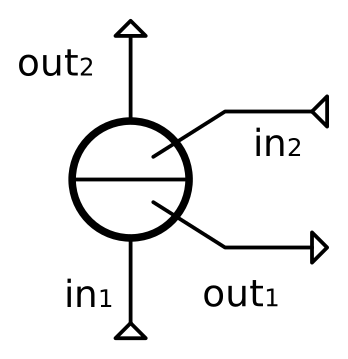

- Parameters:
label (str) – The label of the component.
design (list) – List containing design parameters (stated as String).
offdesign (list) – List containing offdesign parameters (stated as String).
design_path (str) – Path to the components design case.
local_offdesign (boolean) – Treat this component in offdesign mode in a design calculation.
local_design (boolean) – Treat this component in design mode in an offdesign calculation.
char_warnings (boolean) – Ignore warnings on default characteristics usage for this component.
printout (boolean) – Include this component in the network’s results printout.
Note
If you are using a drum in a network with multiple fluids, it is likely the fluid propagation causes trouble. If this is the case, try to specify the fluid composition at another connection of your network.
This component assumes, that the fluid composition between outlet 1 and inlet 2 does not change, thus there is no equation for the fluid mass fraction at the inlet 2!
Example
The drum separates saturated gas from saturated liquid. The liquid phase is transported to an evaporator, the staturated gas phase is extracted from the drum. In this example ammonia is evaporated using ambient air. A characteristic function is applied for the heat transfer coefficient of the evaporator. It is possible to load the CharLine with the function
load_default_charfrom the default lines. We want to use the ‘EVAPORATING FLUID’ lines of the heat exchanger.>>> from tespy.components import Sink, Source, Drum, Pump, HeatExchanger >>> from tespy.connections import Connection, Ref >>> from tespy.networks import Network >>> from tespy.tools.characteristics import CharLine >>> from tespy.tools.characteristics import load_default_char as ldc >>> import os >>> nw = Network(T_unit='C', p_unit='bar', h_unit='kJ / kg', iterinfo=False) >>> fa = Source('feed ammonia') >>> amb_in = Source('air inlet') >>> amb_out = Sink('air outlet') >>> s = Sink('steam') >>> dr = Drum('drum') >>> ev = HeatExchanger('evaporator') >>> erp = Pump('evaporator reciculation pump') >>> f_dr = Connection(fa, 'out1', dr, 'in1') >>> dr_erp = Connection(dr, 'out1', erp, 'in1') >>> erp_ev = Connection(erp, 'out1', ev, 'in2') >>> ev_dr = Connection(ev, 'out2', dr, 'in2') >>> dr_s = Connection(dr, 'out2', s, 'in1') >>> nw.add_conns(f_dr, dr_erp, erp_ev, ev_dr, dr_s) >>> amb_ev = Connection(amb_in, 'out1', ev, 'in1') >>> ev_amb = Connection(ev, 'out1', amb_out, 'in1') >>> nw.add_conns(amb_ev, ev_amb)
The ambient air enters the evaporator at 30 °C. The pinch point temperature difference (ttd_l) of the evaporator is at 5 K, and 1 MW of heat should be transferred. State of ammonia at the inlet is at -5 °C and 5 bar. From this design it is possible to calculate offdesign performance at 75 % part load.
>>> char1 = ldc('HeatExchanger', 'kA_char1', 'DEFAULT', CharLine)
>>> char2 = ldc('HeatExchanger', 'kA_char2', 'EVAPORATING FLUID', CharLine)
>>> ev.set_attr(pr1=0.999, pr2=0.99, ttd_l=5, kA_char1=char1,
...     kA_char2=char2, design=['pr1', 'ttd_l'],
...     offdesign=['zeta1', 'kA_char']
... )
>>> ev.set_attr(Q=-1e6)
>>> erp.set_attr(eta_s=0.8)
>>> f_dr.set_attr(p=5, T=-5)
>>> erp_ev.set_attr(m=Ref(f_dr, 4, 0), fluid={'NH3': 1})
>>> amb_ev.set_attr(fluid={'air': 1}, T=30)
>>> ev_amb.set_attr(p=1)
>>> nw.solve('design')
>>> nw.assert_convergence()
>>> nw.save('tmp.json')
>>> round(ev_amb.T.val - erp_ev.T.val ,1)
5.0
>>> round(f_dr.h.val, 1)
322.7
>>> round(dr_erp.h.val, 1)
364.9
>>> round(ev_dr.h.val, 1)
687.2
>>> round(f_dr.m.val, 2)
0.78
>>> ev.set_attr(Q=-0.75e6)
>>> nw.solve('offdesign', design_path='tmp.json')
>>> round(f_dr.m.val, 2)
0.58
>>> round(ev_amb.T.val - erp_ev.T.val ,1)
3.0
>>> os.remove('tmp.json')
- exergy_balance(T0)[source]
Calculate exergy balance of a merge.
- Parameters:
T0 (float) – Ambient temperature T0 / K.
Note
Please note, that the exergy balance accounts for physical exergy only.
\[\begin{split}\dot{E}_\mathrm{P} = \sum \dot{E}_{\mathrm{out,}j}^\mathrm{PH}\\ \dot{E}_\mathrm{F} = \sum \dot{E}_{\mathrm{in,}i}^\mathrm{PH}\end{split}\]
- get_plotting_data()[source]
Generate a dictionary containing FluProDia plotting information.
- Returns:
data (dict) – A nested dictionary containing the keywords required by the
calc_individual_isolinemethod of theFluidPropertyDiagramclass. The keys1and2connect the saturated liquid-vapor mixture of ‘in1’ with the saturated liquid (‘out1’) and saturated vapor (‘out2’), while the keys3and4connect the (superheated) gas of ‘in2’ with the same. The key5connects both saturated states.
- static initialise_target(c, key)[source]
Return a starting value for pressure and enthalpy at inlet.
- Parameters:
c (tespy.connections.connection.Connection) – Connection to perform initialisation on.
key (str) – Fluid property to retrieve.
- Returns:
val (float) – Starting value for pressure/enthalpy in SI units.
\[\begin{split}val = \begin{cases} 10^6 & \text{key = 'p'}\\ h\left(p, x=0 \right) & \text{key = 'h' at inlet 1}\\ h\left(p, x=0.7 \right) & \text{key = 'h' at inlet 2} \end{cases}\end{split}\]
tespy.components.nodes.merge module
Module of class Merge.
This file is part of project TESPy (github.com/oemof/tespy). It’s copyrighted by the contributors recorded in the version control history of the file, available from its original location tespy/components/nodes/merge.py
SPDX-License-Identifier: MIT
- class tespy.components.nodes.merge.Merge(label, **kwargs)[source]
Bases:
NodeBaseClass for merge points with multiple inflows and one outflow.
Mandatory Equations
Inlets/Outlets
specify number of outlets with
num_in(default value: 2)out1
Image

- Parameters:
label (str) – The label of the component.
design (list) – List containing design parameters (stated as String).
offdesign (list) – List containing offdesign parameters (stated as String).
design_path (str) – Path to the components design case.
local_offdesign (boolean) – Treat this component in offdesign mode in a design calculation.
local_design (boolean) – Treat this component in design mode in an offdesign calculation.
char_warnings (boolean) – Ignore warnings on default characteristics usage for this component.
printout (boolean) – Include this component in the network’s results printout.
num_in (float, dict) – Number of inlets for this component, default value: 2.
Example
The merge mixes a specified number of mass flows and has a single outlet. At the outlet, fluid composition and enthalpy are calculated by mass weighted fluid composition and enthalpy of the inlets.
>>> from tespy.components import Sink, Source, Merge
>>> from tespy.connections import Connection
>>> from tespy.networks import Network
>>> nw = Network(p_unit='bar', iterinfo=False)
>>> so1 = Source('source1')
>>> so2 = Source('source2')
>>> so3 = Source('source3')
>>> si1 = Sink('sink')
>>> m = Merge('merge', num_in=3)
>>> inc1 = Connection(so1, 'out1', m, 'in1')
>>> inc2 = Connection(so2, 'out1', m, 'in2')
>>> inc3 = Connection(so3, 'out1', m, 'in3')
>>> outg = Connection(m, 'out1', si1, 'in1')
>>> nw.add_conns(inc1, inc2, inc3, outg)
Consider a merge with three inlets which mixes three mass flows of the same fluid. In this case, the outlet mass flow will be the sum of both inlet mass flows and the outlet enthalpy will be the weighted sum of the inlet enthalpies. The pressure is equal for all connections of the merge imposed by the component’s mandatory constraints.
>>> T = 293.15
>>> inc1.set_attr(fluid={'O2': 1}, p=1, T=300, m=5)
>>> inc2.set_attr(fluid={'O2': 1}, T=450, m=5)
>>> inc3.set_attr(fluid={'O2': 1}, T=350, m=5)
>>> nw.solve('design')
>>> round(outg.m.val_SI, 1)
15.0
>>> round(outg.h.val_SI, 0)
334919.0
>>> round(outg.T.val_SI, 0)
367.0
We could also fix the outlet temperature and by that determine a missing mass flow, e.g. the hottest incoming stream.
>>> outg.set_attr(T=360)
>>> inc2.set_attr(m=None)
>>> nw.solve("design")
>>> round(inc2.m.val_SI, 1)
3.8
More interesting things can happen, if we want to take the fluid composition into account. For example, air (O2 + N2) is mixed with pure nitrogen and pure oxygen flows. At the outlet we want to have a new mixture with a fixed amount of nitrogen, e.g. 40 %. All gases enter the component at the same temperature. When changing the fluids, we have to rerun the network fluid detection, which is part of the topological setup. This usually only happens if you run a network with changed topology.
>>> T = 293.15
>>> inc1.reset_fluid_vector()
>>> inc2.reset_fluid_vector()
>>> inc3.reset_fluid_vector()
>>> outg.reset_fluid_vector()
>>> inc1.set_attr(fluid={'O2': 0.23, 'N2': 0.77}, p=1, T=T, m=5)
>>> inc2.set_attr(fluid={'O2': 1}, T=T, m=5)
>>> inc3.set_attr(fluid={'N2': 1}, T=T, m=None)
>>> outg.set_attr(fluid={'N2': 0.4}, T=None)
>>> nw.solve('design')
>>> m_expected = (
...     (inc1.fluid.val["O2"] * inc1.m.val_SI + inc2.m.val_SI)
...     / (1 - outg.fluid.val["N2"])
... )
>>> round(outg.m.val_SI, 2) == round(m_expected, 2)
True
>>> abs((outg.T.val_SI - T) / T) < 0.01
True
>>> T = 173.15
>>> inc1.set_attr(T=T)
>>> inc2.set_attr(T=T)
>>> inc3.set_attr(T=T)
>>> nw.solve('design')
>>> abs((outg.T.val_SI - T) / T) < 0.01
True
- energy_balance_func()[source]
Calculate energy balance.
- Returns:
residual (float) – Residual value of energy balance.
\[\begin{split}0 = \sum_i \left(\dot{m}_{in,i} \cdot h_{in,i} \right) - \dot{m}_{out} \cdot h_{out}\\ \forall i \in \text{inlets}\end{split}\]
- entropy_balance()[source]
Calculate entropy balance of a merge.
Note
A definition of reference points is included for compensation of differences in zero point definitions of different fluid compositions.
Reference temperature: 298.15 K.
Reference pressure: 1 bar.
\[\begin{split}\dot{S}_\mathrm{irr}= \dot{m}_\mathrm{out} \cdot \left( s_\mathrm{out} - s_\mathrm{out,ref} \right) - \sum_{i} \dot{m}_{\mathrm{in,}i} \cdot \left( s_{\mathrm{in,}i} - s_{\mathrm{in,ref,}i} \right)\\\end{split}\]
- exergy_balance(T0)[source]
Calculate exergy balance of a merge.
- Parameters:
T0 (float) – Ambient temperature T0 / K.
Note
Please note, that the exergy balance accounts for physical exergy only.
\[ \begin{align}\begin{aligned}\begin{split}\dot{E}_\mathrm{P} = \begin{cases} \begin{cases} \sum_i \dot{m}_i \cdot \left(e_\mathrm{out}^\mathrm{PH} - e_{\mathrm{in,}i}^\mathrm{PH}\right) & T_{\mathrm{in,}i} < T_\mathrm{out} \text{ \& } T_{\mathrm{in,}i} \geq T_0 \\ \sum_i \dot{m}_i \cdot e_\mathrm{out}^\mathrm{PH} & T_{\mathrm{in,}i} < T_\mathrm{out} \text{ \& } T_{\mathrm{in,}i} < T_0 \\ \end{cases} & T_\mathrm{out} > T_0\\\end{split}\\\begin{split}\text{not defined (nan)} & T_\mathrm{out} = T_0\\\end{split}\\\begin{split}\begin{cases} \sum_i \dot{m}_i \cdot e_\mathrm{out}^\mathrm{PH} & T_{\mathrm{in,}i} > T_\mathrm{out} \text{ \& } T_{\mathrm{in,}i} \geq T_0 \\ \sum_i \dot{m}_i \cdot \left(e_\mathrm{out}^\mathrm{PH} - e_{\mathrm{in,}i}^\mathrm{PH}\right) & T_{\mathrm{in,}i} > T_\mathrm{out} \text{ \& } T_{\mathrm{in,}i} < T_0 \\ \end{cases} & T_\mathrm{out} < T_0\\ \end{cases}\end{split}\\\begin{split}\dot{E}_\mathrm{F} = \begin{cases} \begin{cases} \sum_i \dot{m}_i \cdot \left(e_{\mathrm{in,}i}^\mathrm{PH} - e_\mathrm{out}^\mathrm{PH}\right) & T_{\mathrm{in,}i} > T_\mathrm{out} \\ \sum_i \dot{E}_{\mathrm{in,}i}^\mathrm{PH} & T_{\mathrm{in,}i} < T_\mathrm{out} \text{ \& } T_{\mathrm{in,}i} < T_0 \\ \end{cases} & T_\mathrm{out} > T_0\\\end{split}\\\begin{split}\sum_i \dot{E}_{\mathrm{in,}i}^\mathrm{PH} & T_\mathrm{out} = T_0\\\end{split}\\\begin{split}\begin{cases} \sum_i \dot{E}_{\mathrm{in,}i}^\mathrm{PH} & T_{\mathrm{in,}i} > T_\mathrm{out} \text{ \& } T_{\mathrm{in,}i} \geq T_0 \\ \sum_i \dot{m}_i \cdot \left(e_{\mathrm{in,}i}^\mathrm{PH} - e_\mathrm{out}^\mathrm{PH}\right) & T_{\mathrm{in,}i} < T_\mathrm{out} \\ \end{cases} & T_\mathrm{out} < T_0\\ \end{cases}\end{split}\\\forall i \in \text{merge inlets}\\\dot{E}_\mathrm{bus} = \text{not defined (nan)}\end{aligned}\end{align} \]
- fluid_deriv(increment_filter, k, dependents=None)[source]
Calculate partial derivatives of fluid balance.
- Parameters:
increment_filter (ndarray) – Matrix for filtering non-changing variables.
k (int) – Position of derivatives in Jacobian matrix (k-th equation).
- fluid_func()[source]
Calculate the vector of residual values for fluid balance equations.
- Returns:
residual (list) – Vector of residual values for component’s fluid balance.
\[\begin{split}0 = \sum_i \dot{m}_{in,i} \cdot x_{fl,in,i} - \dot {m}_{out} \cdot x_{fl,out}\\ \forall fl \in \text{network fluids}, \; \forall i \in \text{inlets}\end{split}\]
- get_plotting_data()[source]
Generate a dictionary containing FluProDia plotting information.
- Returns:
data (dict) – A nested dictionary containing the keywords required by the
calc_individual_isolinemethod of theFluidPropertyDiagramclass. First level keys are the connection index (‘in1’ -> ‘out1’, therefore1etc.).
tespy.components.nodes.separator module
Module of class Separator.
This file is part of project TESPy (github.com/oemof/tespy). It’s copyrighted by the contributors recorded in the version control history of the file, available from its original location tespy/components/nodes/separator.py
SPDX-License-Identifier: MIT
- class tespy.components.nodes.separator.Separator(label, **kwargs)[source]
Bases:
NodeBaseA separator separates fluid components from a mass flow.
Mandatory Equations
tespy.components.nodes.base.NodeBase.pressure_equality_func()tespy.components.nodes.separator.Separator.energy_balance_func()
Inlets/Outlets
in1
specify number of outlets with
num_out(default value: 2)
Image

Note
Fluid separation requires power and cooling, equations have not been implemented, yet!
- Parameters:
label (str) – The label of the component.
design (list) – List containing design parameters (stated as String).
offdesign (list) – List containing offdesign parameters (stated as String).
design_path (str) – Path to the components design case.
local_offdesign (boolean) – Treat this component in offdesign mode in a design calculation.
local_design (boolean) – Treat this component in design mode in an offdesign calculation.
char_warnings (boolean) – Ignore warnings on default characteristics usage for this component.
printout (boolean) – Include this component in the network’s results printout.
num_out (float, dict) – Number of outlets for this component, default value: 2.
Example
The separator is used to split up a single mass flow into a specified number of different parts at identical pressure and temperature but different fluid composition. Fluids can be separated from each other.
>>> from tespy.components import Sink, Source, Separator
>>> from tespy.connections import Connection
>>> from tespy.networks import Network
>>> nw = Network(p_unit='bar', T_unit='C', iterinfo=False)
>>> so = Source('source')
>>> si1 = Sink('sink1')
>>> si2 = Sink('sink2')
>>> s = Separator('separator', num_out=2)
>>> inc = Connection(so, 'out1', s, 'in1')
>>> outg1 = Connection(s, 'out1', si1, 'in1')
>>> outg2 = Connection(s, 'out2', si2, 'in1')
>>> nw.add_conns(inc, outg1, outg2)
An Air (simplified) mass flow of 5 kg/s is split up into two mass flows. One mass flow of 1 kg/s containing 10 % oxygen and 90 % nitrogen leaves the separator. It is possible to calculate the fluid composition of the second mass flow. Specify starting values for the second mass flow fluid composition for calculation stability.
>>> inc.set_attr(fluid={'O2': 0.23, 'N2': 0.77}, p=1, T=20, m=5)
>>> outg1.set_attr(fluid={'O2': 0.1, 'N2': 0.9}, m=1)
>>> outg2.set_attr(fluid0={'O2': 0.5, 'N2': 0.5})
>>> nw.solve('design')
>>> outg2.fluid.val['O2']
0.2625
In the same way, it is possible to specify one of the fluid components in the second mass flow instead of the first mass flow. The solver will find the mass flows matching the desired composition. 65 % of the mass flow will leave the separator at the second outlet the case of 30 % oxygen mass fraction for this outlet.
>>> outg1.set_attr(m=None)
>>> outg2.set_attr(fluid={'O2': 0.3})
>>> nw.solve('design')
>>> outg2.fluid.val['O2']
0.3
>>> round(outg2.m.val_SI / inc.m.val_SI, 2)
0.65
- energy_balance_deriv(increment_filter, k, dependents=None)[source]
Calculate partial derivatives of energy balance.
- Parameters:
increment_filter (ndarray) – Matrix for filtering non-changing variables.
k (int) – Position of derivatives in Jacobian matrix (k-th equation).
- energy_balance_func()[source]
Calculate energy balance.
- Returns:
residual (list) – Residual value of energy balance.
\[\begin{split}0 = T_{in} - T_{out,j}\\ \forall j \in \text{outlets}\end{split}\]
- fluid_deriv(increment_filter, k, dependents=None)[source]
Calculate partial derivatives of fluid balance.
- Parameters:
increment_filter (ndarray) – Matrix for filtering non-changing variables.
k (int) – Position of derivatives in Jacobian matrix (k-th equation).
- fluid_func()[source]
Calculate the vector of residual values for fluid balance equations.
- Returns:
residual (list) – Vector of residual values for component’s fluid balance.
\[\begin{split}0 = \dot{m}_{in} \cdot x_{fl,in} - \dot {m}_{out,j} \cdot x_{fl,out,j}\\ \forall fl \in \text{network fluids,} \; \forall j \in \text{outlets}\end{split}\]
tespy.components.nodes.splitter module
Module of class Splitter.
This file is part of project TESPy (github.com/oemof/tespy). It’s copyrighted by the contributors recorded in the version control history of the file, available from its original location tespy/components/nodes/splitter.py
SPDX-License-Identifier: MIT
- class tespy.components.nodes.splitter.Splitter(label, **kwargs)[source]
Bases:
NodeBaseSplit up a mass flow in parts of identical enthalpy and fluid composition.
Mandatory Equations
tespy.components.nodes.base.NodeBase.pressure_equality_func()tespy.components.nodes.splitter.Splitter.fluid_func()tespy.components.nodes.splitter.Splitter.energy_balance_func()
Inlets/Outlets
in1
specify number of outlets with
num_out(default value: 2)
Image
- Parameters:
label (str) – The label of the component.
design (list) – List containing design parameters (stated as String).
offdesign (list) – List containing offdesign parameters (stated as String).
design_path (str) – Path to the components design case.
local_offdesign (boolean) – Treat this component in offdesign mode in a design calculation.
local_design (boolean) – Treat this component in design mode in an offdesign calculation.
char_warnings (boolean) – Ignore warnings on default characteristics usage for this component.
printout (boolean) – Include this component in the network’s results printout.
num_out (float, dict) – Number of outlets for this component, default value: 2.
Example
A splitter is used to split up a single mass flow into a specified number of different parts at identical pressure, enthalpy and fluid composition.
>>> from tespy.components import Sink, Source, Splitter
>>> from tespy.connections import Connection
>>> from tespy.networks import Network
>>> nw = Network(p_unit='bar', T_unit='C', iterinfo=False)
>>> so = Source('source')
>>> si1 = Sink('sink1')
>>> si2 = Sink('sink2')
>>> si3 = Sink('sink3')
>>> s = Splitter('splitter', num_out=3)
>>> inc = Connection(so, 'out1', s, 'in1')
>>> outg1 = Connection(s, 'out1', si1, 'in1')
>>> outg2 = Connection(s, 'out2', si2, 'in1')
>>> outg3 = Connection(s, 'out3', si3, 'in1')
>>> nw.add_conns(inc, outg1, outg2, outg3)
An Air (simplified) mass flow is split up into three mass flows. The total incoming mass flow is 5 kg/s, 3 kg/s and 1 kg/s respectively are leaving the splitter into the first two outlets. The residual mass flow will drain in the last outlet. Temperature and fluid composition will not change.
>>> inc.set_attr(fluid={'O2': 0.23, 'N2': 0.77}, p=1, T=20, m=5)
>>> outg1.set_attr(m=3)
>>> outg2.set_attr(m=1)
>>> nw.solve('design')
>>> round(outg3.m.val_SI, 1)
1.0
>>> round(inc.T.val, 1)
20.0
>>> round(outg3.T.val, 1)
20.0
- energy_balance_deriv(increment_filter, k, dependents=None)[source]
Calculate partial derivatives for energy balance equation.
- Returns:
deriv (list) – Matrix of partial derivatives.
- energy_balance_func()[source]
Calculate energy balance.
- Returns:
residual (list) – Residual value of energy balance.
\[\begin{split}0 = h_{in} - h_{out,j} \; \forall j \in \mathrm{outlets}\\\end{split}\]
- enthalpy_structure_matrix(k)[source]
Calculate partial derivatives for energy balance equation.
- Returns:
deriv (list) – Matrix of partial derivatives.
tespy.components.piping.pipe module
Module of class Pipe.
This file is part of project TESPy (github.com/oemof/tespy). It’s copyrighted by the contributors recorded in the version control history of the file, available from its original location tespy/components/piping/pipe.py
SPDX-License-Identifier: MIT
- class tespy.components.piping.pipe.Pipe(label, **kwargs)[source]
Bases:
SimpleHeatExchangerThe Pipe is a subclass of a SimpleHeatExchanger.
Mandatory Equations
tespy.components.component.Component.fluid_func()tespy.components.component.Component.mass_flow_func()
Optional Equations
tespy.components.heat_exchangers.simple.SimpleHeatExchanger.energy_balance_func()tespy.components.heat_exchangers.simple.SimpleHeatExchanger.darcy_func()tespy.components.heat_exchangers.simple.SimpleHeatExchanger.hazen_williams_func()tespy.components.heat_exchangers.simple.SimpleHeatExchanger.kA_group_func()tespy.components.heat_exchangers.simple.SimpleHeatExchanger.kA_char_group_func()
Inlets/Outlets
in1
out1
Image
- Parameters:
label (str) – The label of the component.
design (list) – List containing design parameters (stated as String).
offdesign (list) – List containing offdesign parameters (stated as String).
design_path (str) – Path to the components design case.
local_offdesign (boolean) – Treat this component in offdesign mode in a design calculation.
local_design (boolean) – Treat this component in design mode in an offdesign calculation.
char_warnings (boolean) – Ignore warnings on default characteristics usage for this component.
printout (boolean) – Include this component in the network’s results printout.
Q (float, dict,
"var") – Heat transfer, \(Q/\text{W}\).pr (float, dict,
"var") – Outlet to inlet pressure ratio, \(pr/1\).zeta (float, dict,
"var") – Geometry independent friction coefficient, \(\frac{\zeta}{D^4}/\frac{1}{\text{m}^4}\).D (float, dict,
"var") – Diameter of the pipes, \(D/\text{m}\).L (float, dict,
"var") – Length of the pipes, \(L/\text{m}\).ks (float, dict,
"var") – Pipe’s roughness, \(ks/\text{m}\).darcy_group (str, dict) – Parametergroup for pressure drop calculation based on pipes dimensions using darcy weissbach equation.
ks_HW (float, dict,
"var") – Pipe’s roughness, \(ks/\text{1}\).hw_group (str, dict) – Parametergroup for pressure drop calculation based on pipes dimensions using hazen williams equation.
kA (float, dict,
"var") – Area independent heat transfer coefficient, \(kA/\frac{\text{W}}{\text{K}}\).kA_char (tespy.tools.characteristics.CharLine, dict) – Characteristic line for heat transfer coefficient.
Tamb (float, dict) – Ambient temperature, provide parameter in network’s temperature unit.
kA_group (str, dict) – Parametergroup for heat transfer calculation from ambient temperature and area independent heat transfer coefficient kA.
Example
A mass flow of 10 kg/s ethanol is transported in a pipeline. The pipe is considered adiabatic and has a length of 500 meters. We can calculate the diameter required at a given pressure loss of 2.5 %. After we determined the required diameter, we can predict pressure loss at a different mass flow through the pipeline.
>>> from tespy.components import Sink, Source, Pipe
>>> from tespy.connections import Connection
>>> from tespy.networks import Network
>>> import os
>>> nw = Network()
>>> nw.set_attr(p_unit='bar', T_unit='C', h_unit='kJ / kg', iterinfo=False)
>>> so = Source('source 1')
>>> si = Sink('sink 1')
>>> pi = Pipe('pipeline')
>>> pi.set_attr(pr=0.975, Q=0, design=['pr'], L=100, D='var', ks=5e-5)
>>> inc = Connection(so, 'out1', pi, 'in1')
>>> outg = Connection(pi, 'out1', si, 'in1')
>>> nw.add_conns(inc, outg)
>>> inc.set_attr(fluid={'ethanol': 1}, m=10, T=30, p=3)
>>> nw.solve('design')
>>> nw.save('tmp.json')
>>> round(pi.D.val, 3)
0.119
>>> outg.p.val / inc.p.val == pi.pr.val
True
>>> inc.set_attr(m=15)
>>> pi.set_attr(D=pi.D.val)
>>> nw.solve('offdesign', design_path='tmp.json')
>>> round(pi.pr.val, 2)
0.94
>>> os.remove('tmp.json')
tespy.components.piping.valve module
Module of class Valve.
This file is part of project TESPy (github.com/oemof/tespy). It’s copyrighted by the contributors recorded in the version control history of the file, available from its original location tespy/components/piping.py
SPDX-License-Identifier: MIT
- class tespy.components.piping.valve.Valve(label, **kwargs)[source]
Bases:
ComponentThe Valve throttles a fluid without changing enthalpy.
Mandatory Equations
tespy.components.component.Component.fluid_func()tespy.components.component.Component.mass_flow_func()
Optional Equations
Inlets/Outlets
in1
out1
Image
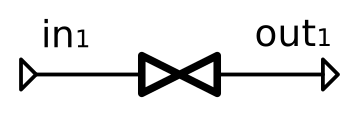

- Parameters:
label (str) – The label of the component.
design (list) – List containing design parameters (stated as String).
offdesign (list) – List containing offdesign parameters (stated as String).
design_path (str) – Path to the components design case.
local_offdesign (boolean) – Treat this component in offdesign mode in a design calculation.
local_design (boolean) – Treat this component in design mode in an offdesign calculation.
char_warnings (boolean) – Ignore warnings on default characteristics usage for this component.
printout (boolean) – Include this component in the network’s results printout.
pr (float, dict,
"var") – Outlet to inlet pressure ratio, \(pr/1\)zeta (float, dict,
"var") – Geometry independent friction coefficient, \(\frac{\zeta}{D^4}/\frac{1}{\text{m}^4}\).dp_char (tespy.tools.characteristics.CharLine, dict) – Characteristic line for difference pressure to mass flow.
Example
A mass flow of 1 kg/s methane is throttled from 80 bar to 15 bar in a valve. The inlet temperature is at 50 °C. It is possible to determine the outlet temperature as the throttling does not change enthalpy.
>>> from tespy.components import Sink, Source, Valve
>>> from tespy.connections import Connection
>>> from tespy.networks import Network
>>> import os
>>> nw = Network(p_unit='bar', T_unit='C', iterinfo=False)
>>> so = Source('source')
>>> si = Sink('sink')
>>> v = Valve('valve')
>>> so_v = Connection(so, 'out1', v, 'in1')
>>> v_si = Connection(v, 'out1', si, 'in1')
>>> nw.add_conns(so_v, v_si)
>>> v.set_attr(offdesign=['zeta'])
>>> so_v.set_attr(fluid={'CH4': 1}, m=1, T=50, p=80, design=['m'])
>>> v_si.set_attr(p=15)
>>> nw.solve('design')
>>> nw.save('tmp.json')
>>> round(v_si.T.val, 1)
26.3
>>> round(v.pr.val, 3)
0.188
The simulation determined the area independent zeta value \(\frac{\zeta}{D^4}\). This zeta remains constant if the cross sectional area of the valve opening does not change. Using the zeta value we can determine the pressure ratio at a different feed pressure.
>>> so_v.set_attr(p=70)
>>> nw.solve('offdesign', design_path='tmp.json')
>>> round(so_v.m.val, 1)
0.9
>>> round(v_si.T.val, 1)
30.0
>>> os.remove('tmp.json')
- dp_char_func()[source]
Equation for characteristic line of difference pressure to mass flow.
- Returns:
residual (ndarray) – Residual value of equation.
\[0=p_\mathrm{in}-p_\mathrm{out}-f\left( expr \right)\]
- entropy_balance()[source]
Calculate entropy balance of a valve.
Note
The entropy balance makes the follwing parameter available:
\[\begin{split}\text{S\_irr}=\dot{m} \cdot \left(s_\mathrm{out}-s_\mathrm{in} \right)\\\end{split}\]
- exergy_balance(T0)[source]
Calculate exergy balance of a valve.
- Parameters:
T0 (float) – Ambient temperature T0 / K.
Note
\[ \begin{align}\begin{aligned}\begin{split}\dot{E}_\mathrm{P} = \begin{cases} \text{not defined (nan)} & T_\mathrm{in}, T_\mathrm{out} \geq T_0\\ \dot{E}_\mathrm{out}^\mathrm{T} & T_\mathrm{in} > T_0 \geq T_\mathrm{out}\\ \dot{E}_\mathrm{out}^\mathrm{T} - \dot{E}_\mathrm{in}^\mathrm{T} & T_0 \geq T_\mathrm{in}, T_\mathrm{out}\\ \end{cases}\end{split}\\\begin{split}\dot{E}_\mathrm{F} = \begin{cases} \dot{E}_\mathrm{in}^\mathrm{PH} - \dot{E}_\mathrm{out}^\mathrm{PH} & T_\mathrm{in}, T_\mathrm{out} \geq T_0\\ \dot{E}_\mathrm{in}^\mathrm{T} + \dot{E}_\mathrm{in}^\mathrm{M}- \dot{E}_\mathrm{out}^\mathrm{M} & T_\mathrm{in} > T_0 \geq T_\mathrm{out}\\ \dot{E}_\mathrm{in}^\mathrm{M} - \dot{E}_\mathrm{out}^\mathrm{M} & T_0 \geq T_\mathrm{in}, T_\mathrm{out}\\ \end{cases}\end{split}\end{aligned}\end{align} \]
- get_plotting_data()[source]
Generate a dictionary containing FluProDia plotting information.
- Returns:
data (dict) – A nested dictionary containing the keywords required by the
calc_individual_isolinemethod of theFluidPropertyDiagramclass. First level keys are the connection index (‘in1’ -> ‘out1’, therefore1etc.).
- initialise_source(c, key)[source]
Return a starting value for pressure and enthalpy at outlet.
- Parameters:
c (tespy.connections.connection.Connection) – Connection to perform initialisation on.
key (str) – Fluid property to retrieve.
- Returns:
val (float) – Starting value for pressure/enthalpy in SI units.
\[\begin{split}val = \begin{cases} 4 \cdot 10^5 & \text{key = 'p'}\\ 5 \cdot 10^5 & \text{key = 'h'} \end{cases}\end{split}\]
- initialise_target(c, key)[source]
Return a starting value for pressure and enthalpy at inlet.
- Parameters:
c (tespy.connections.connection.Connection) – Connection to perform initialisation on.
key (str) – Fluid property to retrieve.
- Returns:
val (float) – Starting value for pressure/enthalpy in SI units.
\[\begin{split}val = \begin{cases} 5 \cdot 10^5 & \text{key = 'p'}\\ 5 \cdot 10^5 & \text{key = 'h'} \end{cases}\end{split}\]
tespy.components.power.bus module
Module of class PowerBus.
This file is part of project TESPy (github.com/oemof/tespy). It’s copyrighted by the contributors recorded in the version control history of the file, available from its original location tespy/components/power/bus.py
SPDX-License-Identifier: MIT
- class tespy.components.power.bus.PowerBus(label, **kwargs)[source]
Bases:
ComponentA PowerBus can hold any number incoming and outgoing power flows.
For example, it can be used to model single shaft gas turbine systems or to calculate the net power generation of a rankine cycle plant
Mandatory Equations
Inlets/Outlets
None
Optional inlets/outlets
specify number of inlets with
num_inspecify number of outlets with
num_out
Image


- Parameters:
label (str) – The label of the component.
design (list) – List containing design parameters (stated as String).
offdesign (list) – List containing offdesign parameters (stated as String).
design_path (str) – Path to the components design case.
local_offdesign (boolean) – Treat this component in offdesign mode in a design calculation.
local_design (boolean) – Treat this component in design mode in an offdesign calculation.
char_warnings (boolean) – Ignore warnings on default characteristics usage for this component.
printout (boolean) – Include this component in the network’s results printout.
num_in (float) – Number of inlets
num_out (float) – Number of outlets
Example
In a very simple example, a PowerBus is utilized to distribute power from the grid to 3 different consumers.
>>> from tespy.components import PowerSource, PowerSink, PowerBus
>>> from tespy.connections import PowerConnection
>>> from tespy.networks import Network
>>> import os
>>> nw = Network(p_unit='bar', T_unit='C', iterinfo=False)
We can add a PowerSource representing the grid and three PowerSink components representing different power demands.
>>> grid = PowerSource('grid')
>>> bus = PowerBus('power bus', num_in=1, num_out=3)
>>> demand1 = PowerSink('power demand 1')
>>> demand2 = PowerSink('power demand 2')
>>> demand3 = PowerSink('power demand 3')
>>> e1 = PowerConnection(grid, 'power', bus, 'power_in1')
>>> e2 = PowerConnection(bus, 'power_out1', demand1, 'power')
>>> e3 = PowerConnection(bus, 'power_out2', demand2, 'power')
>>> e4 = PowerConnection(bus, 'power_out3', demand3, 'power')
>>> nw.add_conns(e1, e2, e3, e4)
We have 4 variables (4 energy flows) and one equation (bus energy balance) in our system. That means, we have to fix three values of the variables, e.g. we can fix the three demand values:
>>> e2.set_attr(E=10e3)
>>> e3.set_attr(E=20e3)
>>> e4.set_attr(E=30e3)
>>> nw.solve('design')
>>> nw.assert_convergence()
>>> round(e1.E.val_SI) == 60000
True
tespy.components.power.generator module
Module of class Generator.
This file is part of project TESPy (github.com/oemof/tespy). It’s copyrighted by the contributors recorded in the version control history of the file, available from its original location tespy/components/power/generator.py
SPDX-License-Identifier: MIT
- class tespy.components.power.generator.Generator(label, **kwargs)[source]
Bases:
ComponentA generator converts mechanical energy into electrical energy.
Mandatory Equations
None
Optional Equations
Inlets/Outlets
None
Optional inlets/outlets
power_in
power_out
Image


- Parameters:
label (str) – The label of the component.
design (list) – List containing design parameters (stated as String).
offdesign (list) – List containing offdesign parameters (stated as String).
design_path (str) – Path to the components design case.
local_offdesign (boolean) – Treat this component in offdesign mode in a design calculation.
local_design (boolean) – Treat this component in design mode in an offdesign calculation.
char_warnings (boolean) – Ignore warnings on default characteristics usage for this component.
printout (boolean) – Include this component in the network’s results printout.
eta (float, dict) – Outlet to inlet efficiency, \(\eta/1\)
delta_power (float, dict) – Fixed power offset, :math:` ext{delta_power}/ ext{W}`
eta_char (tespy.tools.characteristics.CharLine, dict) – Characteristic line for efficiency to power as function of design efficiency.
Example
A turbine generates mechanical power which is used to generate electrical power by the generator.
>>> from tespy.components import Sink, Source, Turbine, Generator, PowerSink
>>> from tespy.connections import Connection, PowerConnection
>>> from tespy.networks import Network
>>> import os
>>> nw = Network(p_unit='bar', T_unit='C', iterinfo=False)
>>> so = Source('source')
>>> si = Sink('sink')
>>> turbine = Turbine('turbine')
Steam flows through the turbine and we can set it up as we are used to for systems without power components.
>>> c1 = Connection(so, 'out1', turbine, 'in1')
>>> c2 = Connection(turbine, 'out1', si, 'in1')
>>> nw.add_conns(c1, c2)
>>> c1.set_attr(fluid={'water': 1}, T=500, p=50, m=1)
>>> c2.set_attr(p=5)
>>> turbine.set_attr(eta_s=0.9)
>>> nw.solve('design')
We can add the Generator and a PowerSink and then connect these parts to the turbine.
>>> generator = Generator('generator')
>>> power_sink = PowerSink('power sink')
>>> e1 = PowerConnection(turbine, 'power', generator, 'power_in')
>>> e2 = PowerConnection(generator, 'power_out', power_sink, 'power')
>>> nw.add_conns(e1, e2)
Now we have added two variables to our problem (the power flows of e1 and e2), but only one equation (the power balance for the turbine). The connection between the two power flows can be made through specifying the efficiency of the generator:
>>> generator.set_attr(eta=.98)
>>> nw.solve('design')
>>> nw.assert_convergence()
>>> round(e1.E.val_SI) == -round(turbine.P.val)
True
>>> round(e2.E.val_SI) == -round(turbine.P.val * 0.98)
True
We could also specify the electrical energy instead of fixing the steam mass flow to calculate the resulting steam mass flow:
>>> e2.set_attr(E=1e6)
>>> c1.set_attr(m=None)
>>> nw.solve('design')
>>> round(c1.m.val, 3)
1.837
Or, fix both (electrical and mechanical power flows) and leave open the generator efficiency:
>>> e1.set_attr(E=1.1e6)
>>> generator.set_attr(eta=None)
>>> nw.solve('design')
>>> round(generator.eta.val, 2)
0.91
>>> e1.set_attr(E=None)
>>> generator.set_attr(delta_power=50e3)
>>> nw.solve('design')
>>> round(generator.eta.val, 3)
0.952
- delta_power_func()[source]
Equation for power delta of the component
- Returns:
residual (float) – Residual value of equation
\[0=\dot E_\text{in} - \dot E_\text{out} - \Delta \dot E\]
- eta_char_func()[source]
Equation for efficiency characteristics of the component
- Returns:
residual (float) – Residual value of equation
\[0=\dot E_\text{in} \cdot \eta_\text{design} \cdot f\left(\frac{\dot E_\text{out}}{\dot E_\text{out,design}}\right) - \dot E_\text{out}\]
tespy.components.power.motor module
Module of class Motor.
This file is part of project TESPy (github.com/oemof/tespy). It’s copyrighted by the contributors recorded in the version control history of the file, available from its original location tespy/components/power/motor.py
SPDX-License-Identifier: MIT
- class tespy.components.power.motor.Motor(label, **kwargs)[source]
Bases:
ComponentA motor converts electrical energy into mechanical energy.
Mandatory Equations
None
Optional Equations
Inlets/Outlets
None
Optional inlets/outlets
power_in
power_out
Image


- Parameters:
label (str) – The label of the component.
design (list) – List containing design parameters (stated as String).
offdesign (list) – List containing offdesign parameters (stated as String).
design_path (str) – Path to the components design case.
local_offdesign (boolean) – Treat this component in offdesign mode in a design calculation.
local_design (boolean) – Treat this component in design mode in an offdesign calculation.
char_warnings (boolean) – Ignore warnings on default characteristics usage for this component.
printout (boolean) – Include this component in the network’s results printout.
eta (float, dict) – Outlet to inlet efficiency, \(\eta/1\)
delta_power (float, dict) – Fixed power offset, :math:` ext{delta_power}/ ext{W}`
eta_char (tespy.tools.characteristics.CharLine, dict) – Characteristic line for efficiency to power as function of design efficiency.
Example
A compressor provides compressed air which is used in a compressed air distribution system. The energy is provided by an electrical motor.
>>> from tespy.components import Sink, Source, Compressor, Motor, PowerSource
>>> from tespy.connections import Connection, PowerConnection
>>> from tespy.networks import Network
>>> import os
>>> nw = Network(p_unit='bar', T_unit='C', iterinfo=False)
>>> so = Source('source')
>>> si = Sink('sink')
>>> compressor = Compressor('compressor')
Ambient air flows into the compressor and is ejected at 4 bar. We can set the system up without the use of any of the power components.
>>> c1 = Connection(so, 'out1', compressor, 'in1')
>>> c2 = Connection(compressor, 'out1', si, 'in1')
>>> nw.add_conns(c1, c2)
>>> c1.set_attr(fluid={'air': 1}, T=25, p=1, m=1)
>>> c2.set_attr(p=4)
>>> compressor.set_attr(eta_s=0.8)
>>> nw.solve('design')
We can add the Motor and a PowerSource and then connect these parts to the compressor.
>>> motor = Motor('motor')
>>> power_source = PowerSource('power source')
>>> e1 = PowerConnection(power_source, 'power', motor, 'power_in')
>>> e2 = PowerConnection(motor, 'power_out', compressor, 'power')
>>> nw.add_conns(e1, e2)
Now we have added two variables to our problem (the power flows of e1 and e2), but only one equation (the power balance for the compressor). The connection between the two power flows can be made through specifying the efficiency of the motor:
>>> motor.set_attr(eta=.98)
>>> nw.solve('design')
>>> nw.assert_convergence()
>>> round(e2.E.val_SI) == round(compressor.P.val)
True
>>> round(e1.E.val_SI) == round(compressor.P.val / 0.98)
True
We could also specify the electrical energy instead of fixing the air mass flow to calculate the resulting air mass flow:
>>> e1.set_attr(E=1e5)
>>> c1.set_attr(m=None)
>>> nw.solve('design')
>>> round(c1.m.val, 3)
0.539
Or, fix both (electrical and mechanical power flows) and leave open the motor efficiency:
>>> e2.set_attr(E=0.9e5)
>>> motor.set_attr(eta=None)
>>> nw.solve('design')
>>> round(motor.eta.val, 2)
0.9
>>> e2.set_attr(E=None)
>>> motor.set_attr(delta_power=5e3)
>>> nw.solve('design')
>>> round(motor.eta.val, 3)
0.95
- delta_power_func()[source]
Equation for power delta of the component
- Returns:
residual (float) – Residual value of equation
\[0=\dot E_\text{in} - \dot E_\text{out} - \Delta \dot E\]
- eta_char_func()[source]
Equation for efficiency characteristics of the component
- Returns:
residual (float) – Residual value of equation
\[0=\dot E_\text{in} \cdot \eta_\text{design} \cdot f\left(\frac{\dot E_\text{in}}{\dot E_\text{in,design}}\right) - \dot E_\text{out}\]
tespy.components.power.sink module
Module of class PowerSink.
This file is part of project TESPy (github.com/oemof/tespy). It’s copyrighted by the contributors recorded in the version control history of the file, available from its original location tespy/components/power/sink.py
SPDX-License-Identifier: MIT
- class tespy.components.power.sink.PowerSink(label, **kwargs)[source]
Bases:
ComponentA power flow drains in a PowerSink.
- Parameters:
label (str) – The label of the component.
design (list) – List containing design parameters (stated as String).
offdesign (list) – List containing offdesign parameters (stated as String).
design_path (str) – Path to the components design case.
local_offdesign (boolean) – Treat this component in offdesign mode in a design calculation.
local_design (boolean) – Treat this component in design mode in an offdesign calculation.
char_warnings (boolean) – Ignore warnings on default characteristics usage for this component.
printout (boolean) – Include this component in the network’s results printout.
Example
Create a PowerSink and specify a label.
>>> from tespy.components import PowerSink
>>> si = PowerSink('a labeled sink')
>>> si.label
'a labeled sink'
tespy.components.power.source module
Module of class PowerSource.
This file is part of project TESPy (github.com/oemof/tespy). It’s copyrighted by the contributors recorded in the version control history of the file, available from its original location tespy/components/power/source.py
SPDX-License-Identifier: MIT
- class tespy.components.power.source.PowerSource(label, **kwargs)[source]
Bases:
ComponentA power flow emerges from a PowerSource.
- Parameters:
label (str) – The label of the component.
design (list) – List containing design parameters (stated as String).
offdesign (list) – List containing offdesign parameters (stated as String).
design_path (str) – Path to the components design case.
local_offdesign (boolean) – Treat this component in offdesign mode in a design calculation.
local_design (boolean) – Treat this component in design mode in an offdesign calculation.
char_warnings (boolean) – Ignore warnings on default characteristics usage for this component.
printout (boolean) – Include this component in the network’s results printout.
Example
Create a PowerSource and specify a label.
>>> from tespy.components import PowerSource
>>> so = PowerSource('a labeled source')
>>> so.label
'a labeled source'
tespy.components.reactors.fuel_cell module
Module of class FuelCell.
This file is part of project TESPy (github.com/oemof/tespy). It’s copyrighted by the contributors recorded in the version control history of the file, available from its original location tespy/components/reactors/fuel_cell.py
SPDX-License-Identifier: MIT
- class tespy.components.reactors.fuel_cell.FuelCell(label, **kwargs)[source]
Bases:
ComponentThe fuel cell produces power by oxidation of hydrogen.
Mandatory Equations
tespy.components.reactors.fuel_cell.FuelCell.cooling_fluid_func()tespy.components.reactors.fuel_cell.FuelCell.reactor_mass_flow_func()tespy.components.reactors.fuel_cell.FuelCell.cooling_mass_flow_func()tespy.components.reactors.fuel_cell.FuelCell.reactor_pressure_func()tespy.components.reactors.fuel_cell.FuelCell.energy_balance_func()
Optional Equations
Inlets/Outlets
in1 (cooling inlet), in2 (oxygen inlet), in3 (hydrogen inlet)
out1 (cooling outlet), out2 (water outlet)
Image
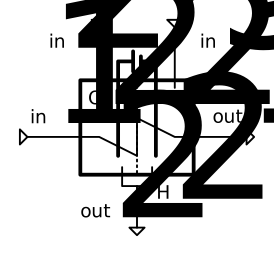
- Parameters:
label (str) – The label of the component.
design (list) – List containing design parameters (stated as String).
offdesign (list) – List containing offdesign parameters (stated as String).
design_path (str) – Path to the components design case.
local_offdesign (boolean) – Treat this component in offdesign mode in a design calculation.
local_design (boolean) – Treat this component in design mode in an offdesign calculation.
char_warnings (boolean) – Ignore warnings on default characteristics usage for this component.
printout (boolean) – Include this component in the network’s results printout.
P (float, dict,
"var") – Power input, \(P/\text{W}\).Q (float, dict) – Heat output of cooling, \(Q/\text{W}\)
e (float, dict,
"var") – Electrolysis specific energy consumption, \(e/(\text{J}/\text{m}^3)\).eta (float, dict) – Electrolysis efficiency, \(\eta/1\).
pr (float, dict,
"var") – Cooling loop pressure ratio, \(pr/1\).zeta (float, dict,
"var") – Geometry independent friction coefficient for cooling loop pressure drop, \(\frac{\zeta}{D^4}/\frac{1}{\text{m}^4}\).
Note
Other than usual components, the fuel cell has the fluid composition built into its equations for the feed hydrogen and oxygen inlets as well as the water outlet. Thus, the user must not specify the fluid composition at these connections!
Example
The example shows a simple adaptation of the fuel cell. It works with water as cooling fluid.
>>> from tespy.components import (Sink, Source, FuelCell)
>>> from tespy.connections import Connection
>>> from tespy.networks import Network
>>> from tespy.tools import ComponentCharacteristics as dc_cc
>>> nw = Network(T_unit='C', p_unit='bar', v_unit='l / s', iterinfo=False)
>>> fc = FuelCell('fuel cell')
>>> oxygen_source = Source('oxygen_source')
>>> hydrogen_source = Source('hydrogen_source')
>>> cw_source = Source('cw_source')
>>> cw_sink = Sink('cw_sink')
>>> water_sink = Sink('water_sink')
>>> cw_in = Connection(cw_source, 'out1', fc, 'in1')
>>> cw_out = Connection(fc, 'out1', cw_sink, 'in1')
>>> oxygen_in = Connection(oxygen_source, 'out1', fc, 'in2')
>>> hydrogen_in = Connection(hydrogen_source, 'out1', fc, 'in3')
>>> water_out = Connection(fc, 'out2', water_sink, 'in1')
>>> nw.add_conns(cw_in, cw_out, oxygen_in, hydrogen_in, water_out)
The fuel cell produces 200kW of electrical power with an efficiency of 0.45. The thermodynamic parameters of the input oxygen and hydrogen are given, the mass flow rates are calculated out of the given power output. The temperature of the water at the outlet should be 50 °C. The cooling fluid is pure water and is heated up from 25 °C to 40 °C.
>>> fc.set_attr(eta=0.45, P=-200e03, pr=0.9)
>>> cw_in.set_attr(T=25, p=1, fluid={'H2O': 1})
>>> cw_out.set_attr(T=40)
>>> oxygen_in.set_attr(T=25, p=1)
>>> hydrogen_in.set_attr(T=25)
>>> water_out.set_attr(T=50)
>>> nw.solve('design')
>>> round(cw_in.m.val, 1)
10.2
>>> Q = fc.Q.val / 1e3
>>> round(Q, 0)
-642.0
>>> round(fc.eta.val, 2)
0.45
- calc_P()[source]
Calculate fuel cell power output.
- Returns:
P (float) – Value of power output.
\[\begin{split}\begin{split} P = & +\dot{m}_{in,2} \cdot \left( h_{in,2} - h_{in,2,ref} \right)\\ & + \dot{m}_{in,3} \cdot \left( h_{in,3} - h_{in,3,ref} - e_0 \right)\\ & - \dot{m}_{in,1} \cdot \left( h_{out,1} - h_{in,1} \right)\\ & - \dot{m}_{out,2} \cdot \left( h_{out,2} - h_{out,2,ref} \right)\\ \end{split}\end{split}\]
Note
The temperature for the reference state is set to 25 °C, thus the produced water must be liquid as proposed in the calculation of the minimum specific energy for oxidation:
tespy.components.reactors.fuel_cell.FuelCell.calc_e0(). The part of the equation regarding the cooling water is implemented with negative sign as the energy for cooling is extracted from the reactor. - Reference temperature: 298.15 K. - Reference pressure: 1 bar.
- calc_e0()[source]
Calculate the specific energy output of the fuel cell.
- Returns:
float – Specific energy.
\[\begin{split}e0 = \frac{\sum_i {\Delta H_f^0}_i - \sum_j {\Delta H_f^0}_j } {M_{H_2}}\\ \forall i \in \text{reation products},\\ \forall j \in \text{reation educts},\\ \Delta H_f^0: \text{molar formation enthalpy}\end{split}\]
- energy_balance_deriv(increment_filter, k, dependents=None)[source]
Partial derivatives for reactor energy balance.
- Parameters:
increment_filter (ndarray) – Matrix for filtering non-changing variables.
k (int) – Position of derivatives in Jacobian matrix (k-th equation).
- energy_balance_func()[source]
Calculate the residual in energy balance.
- Returns:
residual (float) – Residual value of energy balance equation.
\[\begin{split}\begin{split} 0=&P + \dot{m}_\mathrm{out,2}\cdot\left(h_\mathrm{out,2}- h_\mathrm{out,2,ref}\right)\\ &+\dot{m}_\mathrm{in,1}\cdot\left( h_\mathrm{out,1} - h_\mathrm{in,1} \right)\\ & -\dot{m}_\mathrm{in,2} \cdot \left( h_\mathrm{in,2} - h_\mathrm{in,2,ref} \right)\\ & -\dot{m}_\mathrm{in,3} \cdot \left( h_\mathrm{in,3} - h_\mathrm{in,3,ref} - e_0\right)\\ \end{split}\end{split}\]Reference temperature: 298.15 K.
Reference pressure: 1 bar.
- eta_func()[source]
Equation for efficiency.
- Returns:
residual (float) – Residual value of equation.
\[0 = P - \eta \cdot \dot{m}_{H_2,in} \cdot e_0\]
- heat_func()[source]
Equation for heat output.
- Returns:
residual (float) – Residual value of equation.
\[0 = \dot{Q}-\dot{m}_{in,1}\cdot \left(h_{out,1}-h_{in,1}\right)\]
- initialise_source(c, key)[source]
Return a starting value for pressure and enthalpy at inlet.
- Parameters:
c (tespy.connections.connection.Connection) – Connection to perform initialisation on.
key (str) – Fluid property to retrieve.
- Returns:
val (float) – Starting value for pressure/enthalpy in SI units.
\[\begin{split}val = \begin{cases} 5 \cdot 10^5 & \text{key = 'p'}\\ h\left(T=293.15, p=5 \cdot 10^5\right) & \text{key = 'h'} \end{cases}\end{split}\]
- initialise_target(c, key)[source]
Return a starting value for pressure and enthalpy at outlet.
- Parameters:
c (tespy.connections.connection.Connection) – Connection to perform initialisation on.
key (str) – Fluid property to retrieve.
- Returns:
val (float) – Starting value for pressure/enthalpy in SI units.
\[\begin{split}val = \begin{cases} 5 \cdot 10^5 & \text{key = 'p'}\\ h\left(T=323.15, p=5 \cdot 10^5\right) & \text{key = 'h'} \end{cases}\end{split}\]
- reactor_mass_flow_deriv(increment_filter, k, dependents=None)[source]
Calculate the partial derivatives for all mass flow balance equations.
- Returns:
deriv (ndarray) – Matrix with partial derivatives for the mass flow equations.
- reactor_mass_flow_func()[source]
Equations for mass conservation.
- Returns:
residual (list) – Residual values of equation.
\[\begin{split}O_2 = \frac{M_{O_2}}{M_{O_2} + 2 \cdot M_{H_2}}\\ 0=O_2\cdot\dot{m}_\mathrm{H_{2}O,out,1}- \dot{m}_\mathrm{O_2,in,2}\\ 0 = \left(1 - O_2\right) \cdot \dot{m}_\mathrm{H_{2}O,out,1} - \dot{m}_\mathrm{H_2,in,1}\end{split}\]
- reactor_pressure_func()[source]
Equations for reactor pressure balance.
- Returns:
residual (list) – Residual values of equation.
\[\begin{split}0 = p_\mathrm{in,2} - p_\mathrm{out,2}\\ 0 = p_\mathrm{in,3} - p_\mathrm{out,2}\end{split}\]
- reactor_pressure_structure_matrix(k)[source]
Equations for reactor pressure balance.
- Returns:
residual (list) – Residual values of equations.
\[\begin{split}0 = p_\mathrm{in,2} - p_\mathrm{out,2}\\ 0 = p_\mathrm{in,3} - p_\mathrm{out,2}\end{split}\]
tespy.components.reactors.water_electrolyzer module
Module of class WaterElectrolyzer.
This file is part of project TESPy (github.com/oemof/tespy). It’s copyrighted by the contributors recorded in the version control history of the file, available from its original location tespy/components/reactors/water_electrolyzer.py
SPDX-License-Identifier: MIT
- class tespy.components.reactors.water_electrolyzer.WaterElectrolyzer(label, **kwargs)[source]
Bases:
ComponentThe water electrolyzer produces hydrogen and oxygen from water and power.
Mandatory Equations
tespy.components.reactors.water_electrolyzer.WaterElectrolyzer.fluid_func()tespy.components.reactors.water_electrolyzer.WaterElectrolyzer.mass_flow_func()tespy.components.reactors.water_electrolyzer.WaterElectrolyzer.reactor_pressure_func()tespy.components.reactors.water_electrolyzer.WaterElectrolyzer.energy_balance_func()tespy.components.reactors.water_electrolyzer.WaterElectrolyzer.gas_temperature_func()
Optional Equations
cooling loop:
tespy.components.reactors.water_electrolyzer.WaterElectrolyzer.eta_func()tespy.components.reactors.water_electrolyzer.WaterElectrolyzer.eta_char_func()tespy.components.reactors.water_electrolyzer.WaterElectrolyzer.heat_func()tespy.components.reactors.water_electrolyzer.WaterElectrolyzer.specific_energy_consumption_func()
Inlets/Outlets
in1 (cooling inlet), in2 (feed water inlet)
out1 (cooling outlet), out2 (oxygen outlet), out3 (hydrogen outlet)
Image
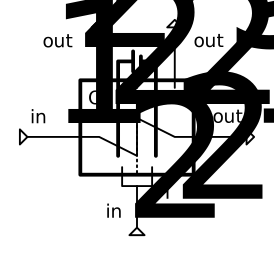

- Parameters:
label (str) – The label of the component.
design (list) – List containing design parameters (stated as String).
offdesign (list) – List containing offdesign parameters (stated as String).
design_path (str) – Path to the components design case.
local_offdesign (boolean) – Treat this component in offdesign mode in a design calculation.
local_design (boolean) – Treat this component in design mode in an offdesign calculation.
char_warnings (boolean) – Ignore warnings on default characteristics usage for this component.
printout (boolean) – Include this component in the network’s results printout.
P (float, dict,
"var") – Power input, \(P/\text{W}\).Q (float, dict) – Heat output of cooling, \(Q/\text{W}\)
e (float, dict,
"var") – Electrolysis specific energy consumption, \(e/(\text{J}/\text{m}^3)\).eta (float, dict) – Electrolysis efficiency (referring to H2 higher heating value), \(\eta/1\).
eta_char (tespy.tools.characteristics.CharLine, dict) – Electrolysis efficiency characteristic line.
pr (float, dict,
"var") – Cooling loop pressure ratio, \(pr/1\).zeta (float, dict,
"var") – Geometry independent friction coefficient for cooling loop pressure drop, \(\frac{\zeta}{D^4}/\frac{1}{\text{m}^4}\).
Note
Other than usual components, the water electrolyzer has the fluid composition built into its equations for the feed water inlet and the hydrogen and oxygen outlet. Thus, the user must not specify the fluid composition at these connections!
Example
Create a water electrolyzer and compress the hydrogen, e.g. for a hydrogen storage.
>>> from tespy.components import (Sink, Source, Compressor,
... WaterElectrolyzer)
>>> from tespy.connections import Connection
>>> from tespy.networks import Network
>>> import os
>>> nw = Network(T_unit='C', p_unit='bar', v_unit='l / s', iterinfo=False)
>>> fw = Source('feed water')
>>> oxy = Sink('oxygen sink')
>>> hydro = Sink('hydrogen sink')
>>> cw_cold = Source('cooling water source')
>>> cw_hot = Sink('cooling water sink')
>>> comp = Compressor('compressor', eta_s=0.9)
>>> el = WaterElectrolyzer('electrolyzer')
The electrolyzer should produce 100 l/s of hydrogen at an operating pressure of 10 bars and an outlet temperature of 50 °C. The fluid composition needs to be specified for the cooling liquid only. The storage pressure is 25 bars. The electrolysis efficiency is at 80 % and the compressor isentropic efficiency at 85 %. After designing the plant the offdesign electrolysis efficiency is predicted by the characteristic line. The default characteristic line can be found here:
tespy.data.>>> fw_el = Connection(fw, 'out1', el, 'in2') >>> el_o = Connection(el, 'out2', oxy, 'in1') >>> el_cmp = Connection(el, 'out3', comp, 'in1') >>> cmp_h = Connection(comp, 'out1', hydro, 'in1') >>> cw_el = Connection(cw_cold, 'out1', el, 'in1') >>> el_cw = Connection(el, 'out1', cw_hot, 'in1') >>> nw.add_conns(fw_el, el_o, el_cmp, cmp_h, cw_el, el_cw) >>> fw_el.set_attr(p=10, T=15) >>> cw_el.set_attr(p=5, T=15, fluid={'H2O': 1}) >>> el_cw.set_attr(T=45) >>> cmp_h.set_attr(p=25) >>> el_cmp.set_attr(v=100, T=50) >>> el.set_attr(eta=0.8, pr=0.99, design=['eta', 'pr'], ... offdesign=['eta_char', 'zeta']) >>> comp.set_attr(eta_s=0.85) >>> nw.solve('design') >>> nw.save('tmp.json') >>> round(el.e0 / el.P.val * el_cmp.m.val_SI, 1) 0.8 >>> P_design = el.P.val >>> round(P_design / 1e6, 1) 13.2 >>> nw.solve('offdesign', design_path='tmp.json') >>> round(el.eta.val, 1) 0.8 >>> el_cmp.set_attr(v=None) >>> el.set_attr(P=P_design * 0.2) >>> nw.solve('offdesign', design_path='tmp.json') >>> round(el.eta.val, 2) 0.84 >>> os.remove('tmp.json')
- bus_deriv(bus)[source]
Calculate partial derivatives of the bus function.
- Parameters:
bus (tespy.connections.bus.Bus) – TESPy bus object.
- Returns:
deriv (ndarray) – Matrix of partial derivatives.
- bus_func(bus)[source]
Calculate the value of the bus function.
- Parameters:
bus (tespy.connections.bus.Bus) – TESPy bus object.
- Returns:
val (float) – Value of energy transfer \(\dot{E}\). This value is passed to
tespy.components.component.Component.calc_bus_value()for value manipulation according to the specified characteristic line of the bus.\[\begin{split}\dot{E} = \begin{cases} P & \text{key = 'P'}\\ - \dot{m}_{in,1} \cdot \left(h_{out,1} - h_{in,1} \right) & \text{key = 'Q'}\\ \end{cases}\end{split}\]
- calc_P()[source]
Calculate water electrolyzer power input.
- Returns:
P (float) – Value of power input.
\[\begin{split}\begin{split} P = & -\dot{m}_{in,2} \cdot \left( h_{in,2} - h_{in,2,ref} \right)\\ & + \dot{m}_{in,1} \cdot \left( h_{out,1} - h_{in,1} \right)\\ & + \dot{m}_{out,2} \cdot \left( h_{out,2} - h_{out,2,ref} \right)\\ & - \dot{m}_{out,3} \cdot \left( h_{out,3} - h_{out,3,ref} + e_0\right)\\ \end{split}\end{split}\]
Note
The temperature for the reference state is set to 25 °C, thus the feed water must be liquid as proposed in the calculation of the minimum specific energy consumption for electrolysis:
tespy.components.reactors.water_electrolyzer.WaterElectrolyzer.calc_e0(). The part of the equation regarding the cooling water is implemented with negative sign as the energy for cooling is extracted from the reactor.Reference temperature: 298.15 K.
Reference pressure: 1 bar.
- calc_e0()[source]
Calculate the minimum specific energy required for electrolysis.
- Returns:
float – Minimum specific energy.
\[\begin{split}e0 = -\frac{\sum_i {\Delta H_f^0}_i - \sum_j {\Delta H_f^0}_j } {M_{H_2}}\\ \forall i \in \text{reation products},\\ \forall j \in \text{reation educts},\\ \Delta H_f^0: \text{molar formation enthalpy}\end{split}\]
- energy_balance_deriv(increment_filter, k, dependents=None)[source]
Partial derivatives for reactor energy balance.
- Parameters:
increment_filter (ndarray) – Matrix for filtering non-changing variables.
k (int) – Position of derivatives in Jacobian matrix (k-th equation).
- energy_balance_func()[source]
Calculate the residual in energy balance.
- Returns:
residual (float) – Residual value of energy balance equation.
\[\begin{split}\begin{split} 0=&P + \dot{m}_\mathrm{in,2}\cdot\left(h_\mathrm{in,2}- h_\mathrm{in,2,ref}\right)\\ &-\dot{m}_\mathrm{in,1}\cdot\left( h_\mathrm{out,1} - h_\mathrm{in,1} \right)\\ & -\dot{m}_\mathrm{out,2} \cdot \left( h_\mathrm{out,2} - h_\mathrm{out,2,ref} \right)\\ & +\dot{m}_\mathrm{out,3} \cdot \left( h_\mathrm{out,3} - h_\mathrm{out,3,ref} + e_0\right)\\ \end{split}\end{split}\]Reference temperature: 298.15 K.
Reference pressure: 1 bar.
- eta_char_deriv(increment_filter, k, dependents=None)[source]
Partial derivatives electrolysis efficiency characteristic.
- Parameters:
increment_filter (ndarray) – Matrix for filtering non-changing variables.
k (int) – Position of derivatives in Jacobian matrix (k-th equation).
- eta_char_func()[source]
Equation for given efficiency characteristic of a water electrolyzer.
- Returns:
residual (float) – Residual value of equation.
\[0 = P - \dot{m}_{H_2,out,3} \cdot \frac{e_0}{\eta_{design}\cdot f\left(expr \right)}\]
- eta_func()[source]
Equation for electrolysis efficiency.
- Returns:
residual (float) – Residual value of equation.
\[0 = P \cdot \eta - \dot{m}_{H_2,out,3} \cdot e_0\]
- exergy_balance(T0)[source]
Exergy balance calculation method.
- Parameters:
T0 (float) – Ambient temperature T0 / K.
- gas_temperature_func()[source]
Equation for temperature equality of product gases.
- Returns:
residual (float) – Residual value of equation.
\[0 = T_\mathrm{out,2} - T_\mathrm{out,3}\]
- heat_func()[source]
Equation for heat output.
- Returns:
residual (float) – Residual value of equation.
\[0 = \dot{Q}-\dot{m}_{in,1}\cdot \left(h_{in,1}-h_{out,1}\right)\]
- initialise_source(c, key)[source]
Return a starting value for pressure and enthalpy at outlet.
- Parameters:
c (tespy.connections.connection.Connection) – Connection to perform initialisation on.
key (str) – Fluid property to retrieve.
- Returns:
val (float) – Starting value for pressure/enthalpy in SI units.
\[\begin{split}val = \begin{cases} 5 \cdot 10^5 & \text{key = 'p'}\\ h\left(T=323.15, p=5 \cdot 10^5\right) & \text{key = 'h'} \end{cases}\end{split}\]
- initialise_target(c, key)[source]
Return a starting value for pressure and enthalpy at inlet.
- Parameters:
c (tespy.connections.connection.Connection) – Connection to perform initialisation on.
key (str) – Fluid property to retrieve.
- Returns:
val (float) – Starting value for pressure/enthalpy in SI units.
\[\begin{split}val = \begin{cases} 5 \cdot 10^5 & \text{key = 'p'}\\ h\left(T=293.15, p=5 \cdot 10^5\right) & \text{key = 'h'} \end{cases}\end{split}\]
- reactor_mass_flow_deriv(increment_filter, k, dependents=None)[source]
Calculate the partial derivatives for all mass flow balance equations.
- Returns:
deriv (ndarray) – Matrix with partial derivatives for the mass flow equations.
- reactor_mass_flow_func()[source]
Equations for mass conservation.
- Returns:
residual (list) – Residual values of equation.
\[\begin{split}O_2 = \frac{M_{O_2}}{M_{O_2} + 2 \cdot M_{H_2}}\\ 0 =\dot{m}_\mathrm{in,1}-\dot{m}_\mathrm{out,1}\\ 0=O_2\cdot\dot{m}_\mathrm{H_{2}O,in,2}- \dot{m}_\mathrm{O_2,out,2}\\ 0 = \left(1 - O_2\right) \cdot \dot{m}_\mathrm{H_{2}O,in,2} - \dot{m}_\mathrm{H_2,out,3}\end{split}\]
- reactor_pressure_func()[source]
Equations for reactor pressure balance.
- Returns:
residual (list) – Residual values of equation.
\[\begin{split}0 = p_\mathrm{in,2} - p_\mathrm{out,2}\\ 0 = p_\mathrm{in,3} - p_\mathrm{out,2}\end{split}\]
- reactor_pressure_structure_matrix(k)[source]
Equations for reactor pressure balance.
- Returns:
residual (list) – Residual values of equations.
\[\begin{split}0 = p_\mathrm{in,2} - p_\mathrm{out,2}\\ 0 = p_\mathrm{in,3} - p_\mathrm{out,2}\end{split}\]
tespy.components.turbomachinery.compressor module
Module of class Compressor.
This file is part of project TESPy (github.com/oemof/tespy). It’s copyrighted by the contributors recorded in the version control history of the file, available from its original location tespy/components/turbomachinery/compressor.py
SPDX-License-Identifier: MIT
- class tespy.components.turbomachinery.compressor.Compressor(label, **kwargs)[source]
Bases:
TurbomachineClass for axial or radial compressor.
Mandatory Equations
tespy.components.component.Component.fluid_func()tespy.components.component.Component.mass_flow_func()
Optional Equations
tespy.components.turbomachinery.base.Turbomachine.energy_balance_func()tespy.components.turbomachinery.compressor.Compressor.eta_s_func()tespy.components.turbomachinery.compressor.Compressor.eta_s_char_func()tespy.components.turbomachinery.compressor.Compressor.char_map_eta_s_func()tespy.components.turbomachinery.compressor.Compressor.char_map_pr_func()
Inlets/Outlets
in1
out1
Image

- Parameters:
label (str) – The label of the component.
design (list) – List containing design parameters (stated as String).
offdesign (list) – List containing offdesign parameters (stated as String).
design_path (str) – Path to the components design case.
local_offdesign (boolean) – Treat this component in offdesign mode in a design calculation.
local_design (boolean) – Treat this component in design mode in an offdesign calculation.
char_warnings (boolean) – Ignore warnings on default characteristics usage for this component.
printout (boolean) – Include this component in the network’s results printout.
P (float, dict) – Power, \(P/\text{W}\)
eta_s (float, dict) – Isentropic efficiency, \(\eta_s/1\)
pr (float, dict,
"var") – Outlet to inlet pressure ratio, \(pr/1\)eta_s_char (tespy.tools.characteristics.CharLine, dict) – Characteristic curve for isentropic efficiency, provide CharLine as function
func.char_map (tespy.tools.characteristics.CharMap, dict) – Characteristic map for pressure rise and isentropic efficiency vs. nondimensional mass flow, see
tespy.tools.characteristics.CharMapfor further information. Provide a CompressorMap as functionfunc.igva (float, dict,
"var") – Inlet guide vane angle, \(igva/^\circ\).
Example
Create an air compressor model and calculate the power required for compression of 50 l/s of ambient air to 5 bars. Using a generic compressor map how does the efficiency change in different operation mode (e.g. 90 % of nominal volumetric flow)?
>>> from tespy.components import Sink, Source, Compressor
>>> from tespy.connections import Connection
>>> from tespy.networks import Network
>>> import os
>>> nw = Network(p_unit='bar', T_unit='C', h_unit='kJ / kg', v_unit='l / s',
... iterinfo=False)
>>> si = Sink('sink')
>>> so = Source('source')
>>> comp = Compressor('compressor')
>>> inc = Connection(so, 'out1', comp, 'in1')
>>> outg = Connection(comp, 'out1', si, 'in1')
>>> nw.add_conns(inc, outg)
Specify the compressor parameters: nominal efficiency and pressure ratio. For offdesign mode the characteristic map is selected instead of the isentropic efficiency. For offdesign, the inlet guide vane angle should be variable in order to maintain the same pressure ratio at a different volumetric flow.
>>> comp.set_attr(pr=5, eta_s=0.8, design=['eta_s'],
... offdesign=['char_map_pr', 'char_map_eta_s'])
>>> inc.set_attr(fluid={'air': 1}, p=1, T=20, v=50)
>>> nw.solve('design')
>>> nw.save('tmp.json')
>>> round(comp.P.val, 0)
12772.0
>>> round(comp.eta_s.val, 2)
0.8
>>> inc.set_attr(v=45)
>>> comp.set_attr(igva='var')
>>> nw.solve('offdesign', design_path='tmp.json')
>>> round(comp.eta_s.val, 2)
0.77
>>> os.remove('tmp.json')
- char_map_eta_s_func()[source]
Calculate isentropic efficiency from characteristic map.
- Returns:
residual (float) – Residual value of equation.
Note
X: speedline index (rotational speed is constant)
Y: nondimensional mass flow
igva: variable inlet guide vane angle for value manipulation according to [25].
\[\begin{split}X = \sqrt{\frac{T_\mathrm{in,design}}{T_\mathrm{in}}}\\ Y = \frac{\dot{m}_\mathrm{in} \cdot p_\mathrm{in,design}} {\dot{m}_\mathrm{in,design} \cdot p_\mathrm{in} \cdot X}\\ \vec{Y} = f\left(X,Y\right)\cdot\left(1-\frac{igva}{100}\right)\\ \vec{Z}=f\left(X,Y\right)\cdot\left(1-\frac{igva^2}{10000}\right)\\ 0 = \frac{\eta_\mathrm{s}}{\eta_\mathrm{s,design}} - f\left(Y,\vec{Y},\vec{Z}\right)\end{split}\]
- char_map_pr_func()[source]
Calculate pressure ratio from characteristic map.
- Returns:
residual (float) – Residual value of equations.
Note
X: speedline index (rotational speed is constant)
Y: nondimensional mass flow
igva: variable inlet guide vane angle for value manipulation according to [25].
\[\begin{split}X = \sqrt{\frac{T_\mathrm{in,design}}{T_\mathrm{in}}}\\ Y = \frac{\dot{m}_\mathrm{in} \cdot p_\mathrm{in,design}} {\dot{m}_\mathrm{in,design} \cdot p_\mathrm{in} \cdot X}\\ \vec{Y} = f\left(X,Y\right)\cdot\left(1-\frac{igva}{100}\right)\\ \vec{Z} = f\left(X,Y\right)\cdot\left(1-\frac{igva}{100}\right)\\ 0 = \frac{p_{out} \cdot p_{in,design}} {p_\mathrm{in} \cdot p_\mathrm{out,design}}- f\left(Y,\vec{Y},\vec{Z}\right)\end{split}\]
- convergence_check()[source]
Perform a convergence check.
Note
Manipulate enthalpies/pressure at inlet and outlet if not specified by user to match physically feasible constraints.
- energy_connector_balance_func()[source]
(optional) energy balance equation connecting the power connector to the component’s power
- Returns:
residual (float) – Residual value of equation
\[0=\dot E - \dot{m}_{in}\cdot\left(h_{out}-h_{in}\right)\]
- eta_s_char_func()[source]
Equation for given isentropic efficiency characteristic.
- Returns:
residual (float) – Residual value of equation.
\[0 = \left(h_{out}-h_{in}\right) \cdot \eta_{s,design} \cdot f\left( expr \right) -\left( h_{out,s} - h_{in} \right)\]
- eta_s_deriv(increment_filter, k, dependents=None)[source]
Partial derivatives for isentropic efficiency.
- Parameters:
increment_filter (ndarray) – Matrix for filtering non-changing variables.
k (int) – Position of derivatives in Jacobian matrix (k-th equation).
- eta_s_func()[source]
Equation for given isentropic efficiency of a compressor.
- Returns:
residual (float) – Residual value of equation.
\[0 = -\left( h_{out} - h_{in} \right) \cdot \eta_{s} + \left( h_{out,s} - h_{in} \right)\]
- exergy_balance(T0)[source]
Calculate exergy balance of a compressor.
- Parameters:
T0 (float) – Ambient temperature T0 / K.
Note
\[ \begin{align}\begin{aligned}\begin{split}\dot{E}_\mathrm{P} = \begin{cases} \dot{E}_\mathrm{out}^\mathrm{PH} - \dot{E}_\mathrm{in}^\mathrm{PH} & T_\mathrm{in}, T_\mathrm{out} \geq T_0\\ \dot{E}_\mathrm{out}^\mathrm{T} + \dot{E}_\mathrm{out}^\mathrm{M} - \dot{E}_\mathrm{in}^\mathrm{M} & T_\mathrm{out} > T_0 \leq T_\mathrm{in}\\ \dot{E}_\mathrm{out}^\mathrm{M} - \dot{E}_\mathrm{in}^\mathrm{M} & T_0 \geq T_\mathrm{in}, T_\mathrm{out}\\ \end{cases}\end{split}\\\begin{split}\dot{E}_\mathrm{F} = \begin{cases} P & T_\mathrm{in}, T_\mathrm{out} \geq T_0\\ P + \dot{E}_\mathrm{in}^\mathrm{T} & T_\mathrm{out} > T_0 \leq T_\mathrm{in}\\ P + \dot{E}_\mathrm{in}^\mathrm{T} -\dot{E}_\mathrm{out}^\mathrm{T} & T_0 \geq T_\mathrm{in}, T_\mathrm{out}\\ \end{cases}\end{split}\\\dot{E}_\mathrm{bus} = P\end{aligned}\end{align} \]
- static initialise_Source(c, key)[source]
Return a starting value for pressure and enthalpy at outlet.
- Parameters:
c (tespy.connections.connection.Connection) – Connection to perform initialisation on.
key (str) – Fluid property to retrieve.
- Returns:
val (float) – Starting value for pressure/enthalpy in SI units.
\[\begin{split}val = \begin{cases} 10^6 & \text{key = 'p'}\\ 6 \cdot 10^5 & \text{key = 'h'} \end{cases}\end{split}\]
- static initialise_target(c, key)[source]
Return a starting value for pressure and enthalpy at inlet.
- Parameters:
c (tespy.connections.connection.Connection) – Connection to perform initialisation on.
key (str) – Fluid property to retrieve.
- Returns:
val (float) – Starting value for pressure/enthalpy in SI units.
\[\begin{split}val = \begin{cases} 10^5 & \text{key = 'p'}\\ 4 \cdot 10^5 & \text{key = 'h'} \end{cases}\end{split}\]
tespy.components.turbomachinery.pump module
Module of class Pump.
This file is part of project TESPy (github.com/oemof/tespy). It’s copyrighted by the contributors recorded in the version control history of the file, available from its original location tespy/components/turbomachinery/pump.py
SPDX-License-Identifier: MIT
- class tespy.components.turbomachinery.pump.Pump(label, **kwargs)[source]
Bases:
TurbomachineClass for axial or radial pumps.
Mandatory Equations
tespy.components.component.Component.fluid_func()tespy.components.component.Component.mass_flow_func()
Optional Equations
Inlets/Outlets
in1
out1
Image

- Parameters:
label (str) – The label of the component.
design (list) – List containing design parameters (stated as String).
offdesign (list) – List containing offdesign parameters (stated as String).
design_path (str) – Path to the components design case.
local_offdesign (boolean) – Treat this component in offdesign mode in a design calculation.
local_design (boolean) – Treat this component in design mode in an offdesign calculation.
char_warnings (boolean) – Ignore warnings on default characteristics usage for this component.
printout (boolean) – Include this component in the network’s results printout.
P (float, dict) – Power, \(P/\text{W}\)
eta_s (float, dict) – Isentropic efficiency, \(\eta_s/1\)
pr (float, dict,
"var") – Outlet to inlet pressure ratio, \(pr/1\)eta_s_char (tespy.tools.characteristics.CharLine, dict) – Characteristic curve for isentropic efficiency, provide CharLine as function
func.flow_char (tespy.tools.characteristics.CharLine, dict) – Characteristic curve for pressure rise as function of volumetric flow \(x/\frac{\text{m}^3}{\text{s}} \, y/\text{Pa}\).
Example
A pump with a known pump curve (difference pressure as function of volumetric flow) pumps 1,5 l/s of water in design conditions. E.g. for a given isentropic efficiency it is possible to calculate power consumption and pressure at the pump.
>>> from tespy.components import Sink, Source, Pump
>>> from tespy.connections import Connection
>>> from tespy.networks import Network
>>> from tespy.tools.characteristics import CharLine
>>> import os
>>> nw = Network(p_unit='bar', T_unit='C', h_unit='kJ / kg', v_unit='l / s',
... iterinfo=False)
>>> si = Sink('sink')
>>> so = Source('source')
>>> pu = Pump('pump')
>>> inc = Connection(so, 'out1', pu, 'in1')
>>> outg = Connection(pu, 'out1', si, 'in1')
>>> nw.add_conns(inc, outg)
After that we calculate offdesign performance using the pump curve and a characteristic function for the pump efficiency. We can calulate the offdesign efficiency and the volumetric flow, if the difference pressure changed. The default characteristc lines are to be found in the
tespy.datamodule. Of course you are able to specify your own characteristcs, like done for theflow_char. More information on how to specify characteristic functions are given in the corresponding part of the online documentation.>>> v = np.array([0, 0.4, 0.8, 1.2, 1.6, 2]) / 1000 >>> dp = np.array([15, 14, 12, 9, 5, 0]) * 1e5 >>> char = CharLine(x=v, y=dp) >>> pu.set_attr(eta_s=0.8, flow_char={'char_func': char, 'is_set': True}, ... design=['eta_s'], offdesign=['eta_s_char']) >>> inc.set_attr(fluid={'water': 1}, p=1, T=20, v=1.5, design=['v']) >>> nw.solve('design') >>> nw.save('tmp.json') >>> round(pu.pr.val, 0) 7.0 >>> round(outg.p.val - inc.p.val, 0) 6.0 >>> round(pu.P.val, 0) 1125.0 >>> outg.set_attr(p=12) >>> nw.solve('offdesign', design_path='tmp.json') >>> round(pu.eta_s.val, 2) 0.71 >>> round(inc.v.val, 1) 0.9 >>> os.remove('tmp.json')
- convergence_check()[source]
Perform a convergence check.
Note
Manipulate enthalpies/pressure at inlet and outlet if not specified by user to match physically feasible constraints.
- energy_connector_balance_func()[source]
(optional) energy balance equation connecting the power connector to the component’s power
- Returns:
residual (float) – Residual value of equation
\[0=\dot E - \dot{m}_{in}\cdot\left(h_{out}-h_{in}\right)\]
- eta_s_char_func()[source]
Equation for given isentropic efficiency characteristic.
- Returns:
residual (float) – Residual value of equation.
\[0 = \left(h_{out}-h_{in}\right) \cdot \eta_{s,design} \cdot f\left( expr \right) -\left( h_{out,s} - h_{in} \right)\]
- eta_s_deriv(increment_filter, k, dependents=None)[source]
Partial derivatives for isentropic efficiency.
- Parameters:
increment_filter (ndarray) – Matrix for filtering non-changing variables.
k (int) – Position of derivatives in Jacobian matrix (k-th equation).
- eta_s_func()[source]
Equation for given isentropic efficiency.
- Returns:
residual (float) – Residual value of equation.
\[0 = -\left( h_{out} - h_{in} \right) \cdot \eta_{s} + \left( h_{out,s} - h_{in} \right)\]
- exergy_balance(T0)[source]
Calculate exergy balance of a pump.
- Parameters:
T0 (float) – Ambient temperature T0 / K.
Note
\[ \begin{align}\begin{aligned}\begin{split}\dot{E}_\mathrm{P} = \begin{cases} \dot{E}_\mathrm{out}^\mathrm{PH} - \dot{E}_\mathrm{in}^\mathrm{PH} & T_\mathrm{in}, T_\mathrm{out} \geq T_0\\ \dot{E}_\mathrm{out}^\mathrm{T} + \dot{E}_\mathrm{out}^\mathrm{M} - \dot{E}_\mathrm{in}^\mathrm{M} & T_\mathrm{out} > T_0 \leq T_\mathrm{in}\\ \dot{E}_\mathrm{out}^\mathrm{M} - \dot{E}_\mathrm{in}^\mathrm{M} & T_0 \geq T_\mathrm{in}, T_\mathrm{out}\\ \end{cases}\end{split}\\\begin{split}\dot{E}_\mathrm{F} = \begin{cases} P & T_\mathrm{in}, T_\mathrm{out} \geq T_0\\ P + \dot{E}_\mathrm{in}^\mathrm{T} & T_\mathrm{out} > T_0 \leq T_\mathrm{in}\\ P + \dot{E}_\mathrm{in}^\mathrm{T} -\dot{E}_\mathrm{out}^\mathrm{T} & T_0 \geq T_\mathrm{in}, T_\mathrm{out}\\ \end{cases}\end{split}\\\dot{E}_\mathrm{bus} = P\end{aligned}\end{align} \]
- flow_char_func()[source]
Equation for given flow characteristic of a pump.
- Returns:
residual (float) – Residual value of equation.
\[0 = p_{out} - p_{in} - f\left( expr \right)\]
- static initialise_Source(c, key)[source]
Return a starting value for pressure and enthalpy at outlet.
- Parameters:
c (tespy.connections.connection.Connection) – Connection to perform initialisation on.
key (str) – Fluid property to retrieve.
- Returns:
val (float) – Starting value for pressure/enthalpy in SI units.
\[\begin{split}val = \begin{cases} 10^6 & \text{key = 'p'}\\ 3 \cdot 10^5 & \text{key = 'h'} \end{cases}\end{split}\]
- static initialise_target(c, key)[source]
Return a starting value for pressure and enthalpy at inlet.
- Parameters:
c (tespy.connections.connection.Connection) – Connection to perform initialisation on.
key (str) – Fluid property to retrieve.
- Returns:
val (float) – Starting value for pressure/enthalpy in SI units.
\[\begin{split}val = \begin{cases} 10^5 & \text{key = 'p'}\\ 2.9 \cdot 10^5 & \text{key = 'h'} \end{cases}\end{split}\]
tespy.components.turbomachinery.turbine module
Module of class Turbine.
This file is part of project TESPy (github.com/oemof/tespy). It’s copyrighted by the contributors recorded in the version control history of the file, available from its original location tespy/components/turbomachinery/turbine.py
SPDX-License-Identifier: MIT
- class tespy.components.turbomachinery.turbine.Turbine(label, **kwargs)[source]
Bases:
TurbomachineClass for gas or steam turbines.
The component Turbine is the parent class for the components:
tespy.components.turbomachinery.steam_turbine.SteamTurbine
Mandatory Equations
tespy.components.component.Component.fluid_func()tespy.components.component.Component.mass_flow_func()
Optional Equations
tespy.components.turbomachinery.base.Turbomachine.energy_balance_func()tespy.components.turbomachinery.turbine.Turbine.eta_s_func()tespy.components.turbomachinery.turbine.Turbine.eta_s_char_func()
Inlets/Outlets
in1
out1
Image

- Parameters:
label (str) – The label of the component.
design (list) – List containing design parameters (stated as String).
offdesign (list) – List containing offdesign parameters (stated as String).
design_path (str) – Path to the components design case.
local_offdesign (boolean) – Treat this component in offdesign mode in a design calculation.
local_design (boolean) – Treat this component in design mode in an offdesign calculation.
char_warnings (boolean) – Ignore warnings on default characteristics usage for this component.
printout (boolean) – Include this component in the network’s results printout.
P (float, dict) – Power, \(P/\text{W}\)
eta_s (float, dict) – Isentropic efficiency, \(\eta_s/1\)
pr (float, dict,
"var") – Outlet to inlet pressure ratio, \(pr/1\)eta_s_char (tespy.tools.characteristics.CharLine, dict) – Characteristic curve for isentropic efficiency, provide CharLine as function
func.cone (dict) – Apply Stodola’s cone law (works in offdesign only).
Example
A steam turbine expands 10 kg/s of superheated steam at 550 °C and 110 bar to 0,5 bar at the outlet. For example, it is possible to calulate the power output and vapour content at the outlet for a given isentropic efficiency.
>>> from tespy.components import Sink, Source, Turbine
>>> from tespy.connections import Connection
>>> from tespy.networks import Network
>>> from tespy.tools import ComponentCharacteristics as dc_cc
>>> import os
>>> nw = Network(p_unit='bar', T_unit='C', h_unit='kJ / kg', iterinfo=False)
>>> si = Sink('sink')
>>> so = Source('source')
>>> t = Turbine('turbine')
>>> inc = Connection(so, 'out1', t, 'in1')
>>> outg = Connection(t, 'out1', si, 'in1')
>>> nw.add_conns(inc, outg)
In design conditions the isentropic efficiency is specified. For offdesign a characteristic function will be applied, together with Stodola’s cone law coupling the turbine mass flow to inlet pressure.
>>> t.set_attr(eta_s=0.9, design=['eta_s'],
... offdesign=['eta_s_char', 'cone'])
>>> inc.set_attr(fluid={'water': 1}, m=10, T=550, p=110, design=['p'])
>>> outg.set_attr(p=0.5)
>>> nw.solve('design')
>>> nw.save('tmp.json')
>>> round(t.P.val, 0)
-10452574.0
>>> round(outg.x.val, 3)
0.914
>>> inc.set_attr(m=8)
>>> nw.solve('offdesign', design_path='tmp.json')
>>> round(t.eta_s.val, 3)
0.898
>>> round(inc.p.val, 1)
88.6
>>> os.remove('tmp.json')
- cone_func()[source]
Equation for stodolas cone law.
- Returns:
residual (float) – Residual value of equation.
\[0 = \frac{\dot{m}_{in,ref} \cdot p_{in}}{p_{in,ref}} \cdot \sqrt{\frac{p_{in,ref} \cdot v_{in}}{p_{in} \cdot v_{in,ref}}} \cdot \sqrt{\frac{1 - \left(\frac{p_{out}}{p_{in}} \right)^{2}} {1 - \left(\frac{p_{out,ref}}{p_{in,ref}} \right)^{2}}} - \dot{m}_{in}\]
- convergence_check()[source]
Perform a convergence check.
Note
Manipulate enthalpies/pressure at inlet and outlet if not specified by user to match physically feasible constraints.
- energy_connector_balance_func()[source]
(optional) energy balance equation connecting the power connector to the component’s power
- Returns:
residual (float) – Residual value of equation
\[0=\dot E + \dot{m}_{in}\cdot\left(h_{out}-h_{in}\right)\]
- eta_s_char_func()[source]
Equation for given isentropic efficiency characteristic.
- Returns:
residual (float) – Residual value of equation.
\[0 = - \left( h_\mathrm{out} - h_\mathrm{in} \right) + \eta_\mathrm{s,design} \cdot f\left( expr \right) \cdot \left(h_\mathrm{out,s}-h_\mathrm{in}\right)\]
- eta_s_deriv(increment_filter, k, dependents=None)[source]
Partial derivatives for isentropic efficiency function.
- Parameters:
increment_filter (ndarray) – Matrix for filtering non-changing variables.
k (int) – Position of derivatives in Jacobian matrix (k-th equation).
- eta_s_func()[source]
Equation for given isentropic efficiency of a turbine.
- Returns:
residual (float) – Residual value of equation.
\[0 = -\left( h_{out} - h_{in} \right) + \left( h_{out,s} - h_{in} \right) \cdot \eta_{s,e}\]
- exergy_balance(T0)[source]
Calculate exergy balance of a turbine.
- Parameters:
T0 (float) – Ambient temperature T0 / K.
Note
\[ \begin{align}\begin{aligned}\begin{split} \dot{E}_\mathrm{P} = \begin{cases} -P & T_\mathrm{in}, T_\mathrm{out} \geq T_0\\ -P + \dot{E}_\mathrm{out}^\mathrm{T} & T_\mathrm{in} > T_0 \geq T_\mathrm{out}\\ -P +\dot{E}_\mathrm{out}^\mathrm{T}- \dot{E}_\mathrm{in}^\mathrm{T} & T_0 \geq T_\mathrm{in}, T_\mathrm{out}\\ \end{cases}\end{split}\\\begin{split}\dot{E}_\mathrm{F} = \begin{cases} \dot{E}_\mathrm{in}^\mathrm{PH} - \dot{E}_\mathrm{out}^\mathrm{PH} & T_\mathrm{in}, T_\mathrm{out} \geq T_0\\ \dot{E}_\mathrm{in}^\mathrm{T} + \dot{E}_\mathrm{in}^\mathrm{M} - \dot{E}_\mathrm{out}^\mathrm{M} & T_\mathrm{in} > T_0 \geq T_\mathrm{out}\\ \dot{E}_\mathrm{in}^\mathrm{M} - \dot{E}_\mathrm{out}^\mathrm{M} & T_0 \geq T_\mathrm{in}, T_\mathrm{out}\\ \end{cases}\end{split}\\\dot{E}_\mathrm{bus} = -P\end{aligned}\end{align} \]
- static initialise_Source(c, key)[source]
Return a starting value for pressure and enthalpy at outlet.
- Parameters:
c (tespy.connections.connection.Connection) – Connection to perform initialisation on.
key (str) – Fluid property to retrieve.
- Returns:
val (float) – Starting value for pressure/enthalpy in SI units.
\[\begin{split}val = \begin{cases} 5 \cdot 10^4 & \text{key = 'p'}\\ 1.5 \cdot 10^6 & \text{key = 'h'} \end{cases}\end{split}\]
- static initialise_target(c, key)[source]
Return a starting value for pressure and enthalpy at inlet.
- Parameters:
c (tespy.connections.connection.Connection) – Connection to perform initialisation on.
key (str) – Fluid property to retrieve.
- Returns:
val (float) – Starting value for pressure/enthalpy in SI units.
\[\begin{split}val = \begin{cases} 2.5 \cdot 10^6 & \text{key = 'p'}\\ 2 \cdot 10^6 & \text{key = 'h'} \end{cases}\end{split}\]
tespy.components.turbomachinery.base module
Module of class Turbomachine.
This file is part of project TESPy (github.com/oemof/tespy). It’s copyrighted by the contributors recorded in the version control history of the file, available from its original location tespy/components/turbomachinery/base.py
SPDX-License-Identifier: MIT
- class tespy.components.turbomachinery.base.Turbomachine(label, **kwargs)[source]
Bases:
ComponentParent class for compressor, pump and turbine.
Mandatory Equations
tespy.components.component.Component.fluid_func()tespy.components.component.Component.mass_flow_func()
Optional Equations
tespy.components.turbomachinery.base.base.energy_balance_func()
Inlets/Outlets
in1
out1
- Parameters:
label (str) – The label of the component.
design (list) – List containing design parameters (stated as String).
offdesign (list) – List containing offdesign parameters (stated as String).
design_path (str) – Path to the components design case.
local_offdesign (boolean) – Treat this component in offdesign mode in a design calculation.
local_design (boolean) – Treat this component in design mode in an offdesign calculation.
char_warnings (boolean) – Ignore warnings on default characteristics usage for this component.
printout (boolean) – Include this component in the network’s results printout.
P (float, dict) – Power, \(P/\text{W}\)
pr (float, dict,
"var") – Outlet to inlet pressure ratio, \(pr/1\)
Example
For an example please refer to:
- bus_deriv(bus)[source]
Calculate partial derivatives of the bus function.
- Parameters:
bus (tespy.connections.bus.Bus) – TESPy bus object.
- Returns:
deriv (ndarray) – Matrix of partial derivatives.
- bus_func(bus)[source]
Calculate the value of the bus function.
- Parameters:
bus (tespy.connections.bus.Bus) – TESPy bus object.
- Returns:
residual (float) – Value of energy transfer \(\dot{E}\). This value is passed to
tespy.components.component.Component.calc_bus_value()for value manipulation according to the specified characteristic line of the bus.\[\dot{E} = \dot{m}_{in} \cdot \left(h_{out} - h_{in} \right)\]
- energy_balance_func()[source]
Calculate energy balance of a turbomachine.
- Returns:
residual (float) – Residual value of turbomachine energy balance
\[0=\dot{m}_{in}\cdot\left(h_{out}-h_{in}\right)-P\]
- entropy_balance()[source]
Calculate entropy balance of turbomachine.
Note
The entropy balance makes the follwing parameter available:
\[\begin{split}\text{S\_irr}=\dot{m} \cdot \left(s_\mathrm{out}-s_\mathrm{in} \right)\\\end{split}\]
- get_plotting_data()[source]
Generate a dictionary containing FluProDia plotting information.
- Returns:
data (dict) – A nested dictionary containing the keywords required by the
calc_individual_isolinemethod of theFluidPropertyDiagramclass. First level keys are the connection index (‘in1’ -> ‘out1’, therefore1etc.).